beehiiv Review: The Newsletter Platform Built for Media Businesses
Pros
- Built specifically for newsletters — not a repurposed email marketing tool
- Built-in monetization with ad network, paid subscriptions, and boosts
- Referral program tools for organic subscriber growth
- Clean, distraction-free writing experience
- Detailed analytics including subscriber engagement scoring
Cons
- Not a general-purpose email marketing platform
- Paid plans are expensive compared to traditional email tools
- Automation capabilities are limited
- Ecommerce and transactional email features are minimal
- Younger platform with less proven long-term track record
What is beehiiv?
beehiiv is the newsletter platform built by people who ran newsletters at scale and got tired of using tools that were never designed for them. Founded in 2021 by Tyler Denk, a former Morning Brew engineer, beehiiv was created to solve a specific problem: existing email marketing tools are built for marketers running campaigns, not creators running media businesses. The difference matters more than most people realize.
Traditional email platforms optimize for conversion — open rates, click-throughs, automation workflows, sales funnels. beehiiv optimizes for audience building and monetization — subscriber growth, engagement depth, ad revenue, paid content, and referral loops. It treats every newsletter as a media property and provides the infrastructure to run it like one. Since launch, beehiiv has attracted over 100,000 newsletter operators and has become the platform of choice for independent publishers who outgrew Substack but do not need a full marketing automation suite.
We have evaluated beehiiv alongside traditional email platforms for creator clients, media companies, and solopreneurs building audience-first businesses. This review covers where it excels, where it falls short, and who it is actually built for.
Pricing Breakdown
beehiiv’s pricing reflects its positioning as a media platform rather than a commodity email tool:
- Launch (Free): 2,500 subscribers, unlimited sends, custom website, basic analytics, 1 publication
- Scale ($49/mo or $39/mo annual): 100,000 subscribers, ad network access, referral program, paid subscriptions, custom domains, advanced analytics, audience polls, automations, A/B testing
- Max ($99/mo or $79/mo annual): Everything in Scale plus priority support, advanced segmentation, custom newsletter themes, API access, multiple publications, removal of beehiiv branding
The pricing jumps from free to $49/mo with no intermediate tier. This gap is meaningful for creators in the 2,500-10,000 subscriber range who have outgrown the free plan but are not yet generating enough newsletter revenue to justify $49/mo. Compared to MailerLite at $9/mo or Kit at $25/mo for similar subscriber counts, beehiiv’s paid plans are expensive as pure email tools.
The value proposition changes when you factor in monetization. If the beehiiv Ad Network and Boosts program generate $200+/mo in revenue — which is realistic at 10,000+ engaged subscribers — the $49/mo platform cost becomes a business expense with positive ROI rather than a marketing overhead.
Key Features We Tested
Writing and Publishing
The beehiiv editor is one of the cleanest writing experiences in the newsletter space. The interface strips away the clutter of traditional email builders — no drag-and-drop blocks, no marketing widgets, no sidebar full of icons you will never use. You write, format, add images, and publish. The focus is on the content, not the chrome around it.
The editor supports rich text formatting, embedded media (images, videos, tweets, YouTube), custom HTML blocks, and reusable content sections. Templates are available for common newsletter layouts, and custom themes let you establish consistent branding across issues. The mobile editing experience is functional, which matters for creators who draft on the go.
Publishing works across channels simultaneously. When you hit send, beehiiv distributes your newsletter to email subscribers and publishes it on your custom website, which functions as a searchable archive. This dual-distribution model means every newsletter issue also becomes a web page that can rank in search engines and attract organic traffic — a significant advantage for long-term audience building.
Monetization Suite
This is where beehiiv separates from every other email tool on the market. The platform offers three distinct revenue streams, all built in:
Ad Network: beehiiv connects newsletter operators with advertisers through its marketplace. Advertisers select newsletters based on niche, audience size, and engagement metrics. Creators approve or reject ad placements. Revenue varies by niche — finance and tech newsletters command higher CPMs than general interest — but creators with 10,000+ subscribers can realistically earn $500-2,000/mo through the network alone.
Paid Subscriptions: You can gate content behind a paywall, offering free and premium tiers. Subscribers pay monthly or annually through Stripe integration. beehiiv handles the billing, access management, and subscriber lifecycle. This model mirrors Substack’s approach but with more design control and lower platform fees.
Boosts: The Boosts marketplace lets you earn money by recommending other beehiiv newsletters to your audience. When a subscriber you recommend signs up for another newsletter and stays engaged, you earn a bounty (typically $1-3 per subscriber). Conversely, you can pay to boost your own newsletter through other creators’ recommendation sections.
Growth Tools
beehiiv includes several features specifically designed to accelerate subscriber growth:
Referral Program: Built-in referral tracking lets you reward subscribers who refer friends. You set milestone rewards (refer 3 friends to unlock bonus content, refer 10 for a free ebook). The system handles tracking, attribution, and reward delivery. Morning Brew famously used this model to grow to millions of subscribers, and beehiiv makes it accessible without custom development.
Recommendation Network: When new subscribers join your newsletter, beehiiv can suggest related newsletters, and vice versa. This cross-promotion creates a network effect where growth in the ecosystem benefits all participants.
Subscriber Segmentation: Scale and Max plans include segmentation based on engagement level, subscription source, poll responses, and custom tags. This lets you tailor content to different audience segments and improve retention.
Analytics
beehiiv’s analytics dashboard goes beyond standard email metrics. Opens and clicks are there, of course, but the platform also tracks subscriber engagement scores, growth trends, referral attribution, revenue per subscriber, churn rate, and audience demographics. The engagement scoring system identifies your most and least engaged subscribers, which is critical for maintaining deliverability and understanding your audience composition.
For creators coming from Substack (which offers minimal analytics) or Mailchimp (which tracks different metrics), beehiiv’s analytics feel purpose-built for the question every newsletter operator asks: “Is this working, and how do I grow faster?”
Who Should Use beehiiv?
beehiiv is the right platform for creators who think of their newsletter as a product — a media property that generates revenue, builds an audience, and scales over time. If you are a journalist, industry analyst, niche expert, or content creator building an audience-first business, beehiiv provides tools that traditional email platforms simply do not offer.
It is particularly strong for:
- Independent journalists and writers building paid newsletter businesses
- Industry experts monetizing niche knowledge through premium content and sponsorships
- Media companies launching or managing newsletter products
- Content creators who want multiple revenue streams from their audience
- Newsletter operators migrating from Substack for more control and customization
Who Should Avoid It?
Businesses that need traditional email marketing — promotional campaigns, ecommerce automation, CRM integration, transactional email — should look elsewhere. beehiiv is not built for that workflow. If you need abandoned cart sequences, product recommendation emails, or behavioral triggers based on purchase history, platforms like Klaviyo, ActiveCampaign, or GetResponse are the right tools.
Creators with very small audiences (under 2,500) who are not yet ready to monetize get the same value from beehiiv’s free plan as they would from Kit’s free plan or MailerLite’s free plan, which offer more traditional email marketing features alongside newsletter publishing.
Non-English-language creators should also evaluate carefully. beehiiv’s ad network and boosts marketplace are heavily weighted toward English-language audiences, which limits monetization potential for creators serving other markets.
The Bottom Line
beehiiv occupies a unique position in the email landscape. It is not the best email marketing platform — it is not trying to be. It is the best platform for building a newsletter-driven media business. The combination of a clean writing experience, multi-stream monetization, referral-driven growth tools, and creator-focused analytics creates a package that no traditional email tool matches.
The pricing asks creators to commit before they may be ready, and the limited automation and ecommerce features narrow the audience. But for newsletter operators who are serious about building an audience and generating revenue from it, beehiiv has earned its reputation as the platform to beat.
Our Verdict
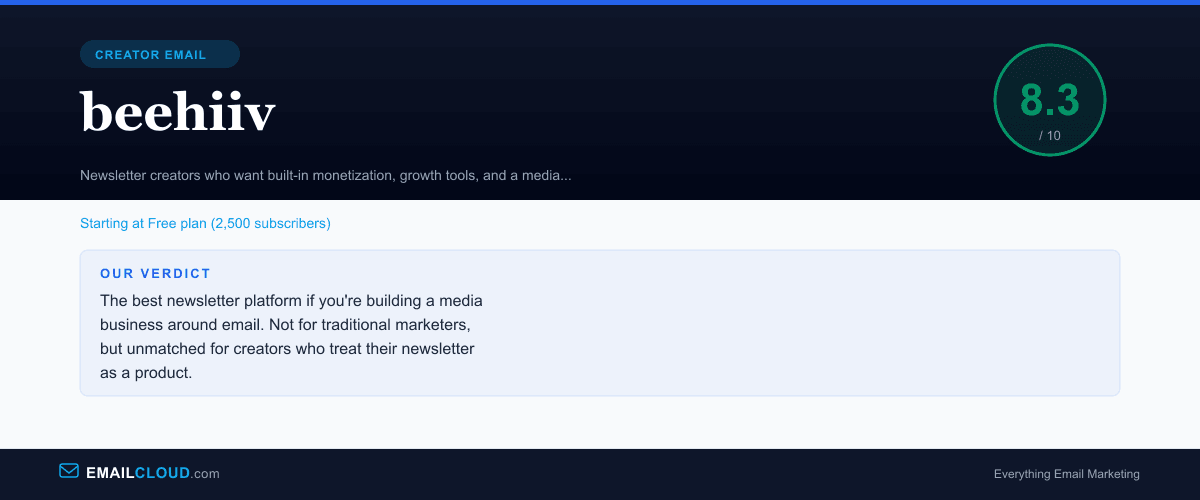
The best newsletter platform if you're building a media business around email. Not for traditional marketers, but unmatched for creators who treat their newsletter as a product.
Review Summary
Share this visual summary. Right-click to save.
Frequently Asked Questions
Is beehiiv better than Substack?
For serious newsletter operators, yes. beehiiv offers significantly more customization, better analytics, built-in referral programs, a multi-revenue monetization model (ads + paid subscriptions + boosts), and custom domains — none of which Substack provides. Substack is simpler and easier to start with, but beehiiv is built for creators who want to run their newsletter as a real business.
Can you make money with beehiiv?
Yes, through multiple channels. The beehiiv Ad Network connects you with advertisers willing to pay for placement in your newsletter. Paid subscriptions let you gate premium content behind a monthly or annual fee. The Boosts feature pays you $1-3 per subscriber for recommending other newsletters. Many creators combine all three to diversify revenue.
How does beehiiv's free plan work?
The free plan includes up to 2,500 subscribers, unlimited sends, a custom website, and basic analytics. You can publish and send newsletters at no cost. The free plan does not include the ad network, paid subscriptions, referral program, or advanced segmentation. It is a solid starting point for testing the platform before committing.
Is beehiiv good for email marketing?
Not in the traditional sense. beehiiv is optimized for recurring newsletters, not promotional campaigns, automated sequences, or ecommerce workflows. If you need drip campaigns, behavioral triggers, or product-based segmentation, platforms like ActiveCampaign, GetResponse, or Klaviyo are better suited. beehiiv is for content-first creators, not marketers.