Brevo Review: The Budget Powerhouse Formerly Known as Sendinblue
Pros
- Generous free plan with unlimited contacts
- Transactional email (SMTP relay) included — rare for marketing platforms
- SMS marketing built in alongside email
- Free CRM with pipeline management
- Among the most competitive pricing in the industry
Cons
- Daily send limit on free plan (300 emails/day)
- Email editor is functional but not design-forward
- Deliverability can be inconsistent for some senders
- Automation is adequate but not exceptional
- Brevo branding on free plan emails
What is Brevo?
Brevo — formerly Sendinblue, before the 2023 rebrand that confused everyone — is the email marketing platform that competes on value rather than glamour. Founded in 2012 in Paris by Armand Thiberge, the platform has grown to serve over 500,000 businesses by offering a combination of features that most competitors split across multiple products and price tiers: marketing email, transactional email, SMS, CRM, and marketing automation, all in one platform at prices that undercut the industry.
The rebrand from Sendinblue to Brevo was meant to signal a broader vision beyond email, but the core product identity has not changed. This is still the platform that small and mid-size businesses choose when they need a capable marketing stack without the budget for premium tools. It is not the sleekest option. It is not the most powerful. But it may be the most practical for businesses that need to do several things adequately rather than one thing exceptionally.
We have used Brevo for newsletter campaigns, transactional email flows, SMS notifications, and basic CRM management across multiple client accounts. This review covers what that experience looks like in practice.
Pricing Breakdown
Brevo’s pricing model is unique in the email marketing space: plans are based on email volume, not contact count. You can store unlimited contacts on every plan, including free. This is a meaningful advantage for businesses with large subscriber lists and moderate send frequencies.
- Free: Unlimited contacts, 300 emails/day (roughly 9,000/month), transactional email, SMS (pay-as-you-go), CRM, basic automation, Brevo branding
- Starter ($9/mo): 5,000 emails/month, no daily sending limit, basic reporting, email support, option to remove Brevo branding ($12/mo)
- Business ($18/mo): 5,000 emails/month, marketing automation, A/B testing, advanced statistics, multi-user access, send time optimization, landing pages, phone support
- Enterprise (custom): Dedicated account manager, advanced integrations, sub-account management, SSO, custom volume pricing
Email volume scales on paid plans: 20,000 emails/month on Starter runs $25/mo, 40,000 emails runs $35/mo, and 100,000 emails runs $69/mo. Compare that to Mailchimp at $100+/mo for similar volume with 10,000 contacts, and the cost difference is stark.
SMS pricing is pay-as-you-go, starting at roughly $0.011 per message for US numbers. This is competitive with dedicated SMS platforms and eliminates the need for a separate SMS subscription.
Transactional email is included on all plans — even free — which is remarkable. Most marketing platforms either do not support transactional email at all or charge separately for it. Having your marketing emails, transactional emails, and SMS under one billing account simplifies both cost management and technical integration.
Key Features We Tested
Email Campaigns
The email builder uses a drag-and-drop editor with a functional but unremarkable interface. Content blocks include text, images, buttons, columns, headers, footers, and dynamic content sections. The template library offers about 60 responsive designs — adequate for common campaign types, but a fraction of what Mailchimp or AWeber provide.
Where Brevo’s email campaigns stand out is in send-time optimization. The Business plan and above includes a feature that analyzes each contact’s historical open-time patterns and delivers emails at the time each individual is most likely to engage. In our testing, this consistently improved open rates by 8-15% compared to fixed-time sends — a meaningful lift for businesses optimizing engagement.
The email editor handles basic personalization (merge tags, conditional content blocks on Business plans) and supports custom HTML for teams that want full control. It is not beautiful, but it is reliable.
Transactional Email
This is Brevo’s hidden gem and one of the most underappreciated features in the email marketing space. Transactional email — order confirmations, password resets, shipping notifications, account alerts — is critical infrastructure for any online business, and most marketing platforms either do not support it or require a separate product.
Brevo includes a full SMTP relay service and transactional email API on all plans. You configure your application to send through Brevo’s infrastructure, and transactional emails are delivered with the same authentication and reputation management as your marketing emails. The dashboard shows delivery rates, open rates, and error logs for transactional sends alongside marketing campaign metrics.
For businesses currently paying for separate marketing email (Mailchimp, $20/mo) and transactional email (Postmark, $15/mo) services, consolidating to Brevo can cut costs by 50% or more while simplifying their stack. The transactional delivery speed is solid — median delivery times under 3 seconds in our testing — though not quite as fast as dedicated transactional services like Postmark or Amazon SES for high-volume senders.
SMS Marketing
Brevo’s SMS module lets you send promotional messages, transactional notifications, and automated SMS as part of marketing workflows. Contact management, opt-in tracking, and compliance tools are built in. SMS messages can include personalization fields, shortened tracking links, and opt-out instructions.
The integration between email and SMS workflows is smooth — a single automation can send an email, wait for engagement, and follow up via SMS if the email was not opened. This multi-channel approach is available on the Business plan and above.
SMS pricing is transparent and pay-as-you-go. You purchase credits at tiered rates and use them across campaigns and automations. No monthly SMS subscription fee — you pay only for messages sent.
CRM
Brevo includes a free CRM with contact management, deal tracking, and pipeline visualization. The CRM is not as sophisticated as HubSpot’s or Salesforce’s — it lacks custom objects, advanced reporting, and deep workflow integration. But for small businesses that need basic deal tracking alongside their email marketing, having a CRM included at no cost eliminates one more subscription from the stack.
Contact profiles aggregate data from email campaigns, SMS interactions, website visits (via tracking script), and CRM deal history. This unified view is helpful for understanding customer engagement across channels, even if the analytics are not as deep as purpose-built CRM platforms.
Automation
The automation builder supports visual workflows with triggers (form submission, email opened, link clicked, contact added to list, date-based, website event), conditions (if/else branching, A/B splits), and actions (send email, send SMS, update contact, webhook, add to list). The builder is intuitive and handles common automation scenarios: welcome series, abandoned browse, re-engagement, birthday messages.
The automation is adequate. It covers the workflows most small businesses need. But it lacks the depth of ActiveCampaign’s conditional logic, the ecommerce-specific workflows of Klaviyo, or the CRM-triggered automations of HubSpot. If automation is the primary driver of your marketing strategy, Brevo may feel limiting as your sophistication grows.
Who Should Use Brevo?
Brevo is the right platform for businesses that need a multi-channel marketing stack on a budget. If you send marketing emails, transactional emails, and SMS — and you do not want to pay for three separate tools — Brevo consolidates all three at a price point that is hard to beat.
It suits:
- Small businesses that need email marketing with a free CRM
- Online businesses that need both marketing and transactional email under one roof
- Budget-conscious teams with large contact lists and moderate send volumes
- Agencies managing multiple client accounts on a predictable budget
- Developers who need SMTP relay with a marketing-friendly interface for non-technical team members
Who Should Avoid It?
Design-focused brands that need pixel-perfect emails should look at Mailchimp or MailerLite for better templates and editor flexibility. Ecommerce businesses with complex automation needs should evaluate Klaviyo or Omnisend for deeper product-level integration. Enterprise companies with sophisticated CRM requirements will outgrow Brevo’s CRM quickly and should consider HubSpot or Salesforce.
Businesses where email deliverability is mission-critical should test carefully. Brevo’s deliverability is generally solid (90-93% inbox placement in our testing), but shared infrastructure means occasional reputation dips caused by other senders. For maximum deliverability control, platforms like AWeber (excellent shared reputation) or services with dedicated IP options from day one may be safer choices.
The Bottom Line
Brevo is the Swiss Army knife of budget marketing platforms. It does not excel at any single thing — the email editor is not the best, the CRM is not the deepest, the automation is not the most powerful, the deliverability is not the most consistent. But the combination of marketing email, transactional email, SMS, CRM, and automation at $9-18/mo, with unlimited contacts on every plan, represents a value proposition that is genuinely difficult for competitors to match.
For businesses that need to do several things well without premium pricing for each, Brevo delivers where it matters most: on the budget line.
Our Verdict
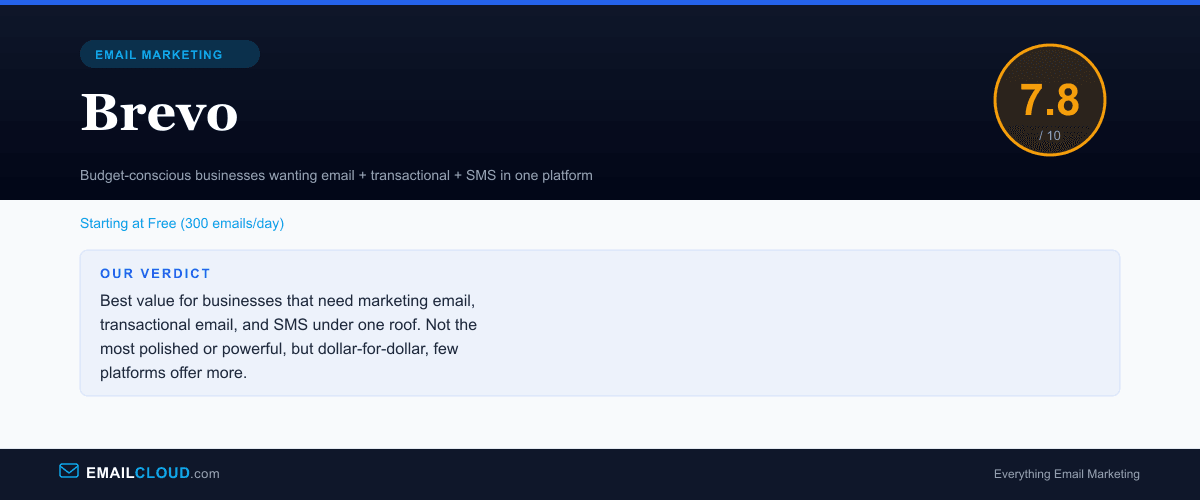
Best value for businesses that need marketing email, transactional email, and SMS under one roof. Not the most polished or powerful, but dollar-for-dollar, few platforms offer more.
Review Summary
Share this visual summary. Right-click to save.
Frequently Asked Questions
Is Brevo the same as Sendinblue?
Yes. Sendinblue rebranded to Brevo in May 2023. The product, team, and infrastructure are the same — only the name changed. Existing Sendinblue accounts transitioned to Brevo branding automatically. The rebrand was part of a broader positioning shift from email-focused tool to multi-channel marketing platform.
Is Brevo good for transactional email?
Yes. Brevo is one of the few marketing platforms that includes transactional email (SMTP relay) alongside marketing email. This means you can send order confirmations, password resets, and shipping notifications through the same platform you use for newsletters and promotions. The transactional email API is reliable with delivery speeds comparable to dedicated services like Postmark or Mailgun.
How does Brevo compare to Mailchimp?
Brevo offers significantly better value. The free plan includes unlimited contacts (vs. Mailchimp's 500), and paid plans are 40-60% cheaper at equivalent list sizes. Mailchimp has a better email editor and template library, but Brevo includes SMS, transactional email, and CRM — features Mailchimp either lacks or charges extra for.
Does Brevo charge per contact or per email?
Brevo charges per email sent, not per contact stored. This is a fundamental pricing difference from most competitors. You can store unlimited contacts on all plans, including free, and only pay based on how many emails you send per month. For businesses with large lists and moderate send frequency, this model is significantly cheaper.