Drip Review: The Ecommerce CRM That Knows Your Customers
Pros
- Deep ecommerce integrations — Shopify, WooCommerce, BigCommerce with full data sync
- Visual workflow builder with sophisticated conditional branching and multi-channel triggers
- Revenue attribution shows exactly which emails drive sales
- Strong segmentation using purchase behavior, browsing data, and custom events
- Pre-built ecommerce playbooks for common revenue-driving scenarios
Cons
- No free plan and pricing is mid-to-high range
- Steeper learning curve than simpler ecommerce email tools like Omnisend
- SMS features are limited compared to Klaviyo or Omnisend
- Template design options are functional but not visually inspiring
The Quick Verdict
Drip is the ecommerce email platform for stores that have outgrown basic tools but are not ready for Klaviyo’s complexity and cost. The CRM-powered approach puts customer data at the center of every email interaction, and the visual workflow builder makes sophisticated automation accessible without an engineering degree. The Shopify and WooCommerce integrations are deep and reliable. Revenue attribution gives you clear visibility into which emails generate sales. At $39/mo starting, Drip is not cheap, but the value is solid for ecommerce businesses generating consistent revenue and wanting to maximize customer lifetime value through email.
What Drip Does Well
CRM-Powered Email Marketing
Drip was one of the first platforms to combine CRM functionality with email marketing specifically for ecommerce. Every subscriber in Drip has a rich customer profile that includes contact information, purchase history, browsing behavior, email engagement, custom events, and tags. This profile powers everything else — segmentation, automation triggers, and personalization all draw from the same unified customer record.
The CRM approach means you are not just sending emails to a list. You are managing relationships with individual customers, and the email is one touchpoint in that relationship. When a customer browses a product, adds it to their cart, abandons checkout, receives a reminder email, and then returns to complete the purchase — Drip tracks and connects every step of that journey. That complete picture is what enables genuinely personalized email marketing rather than generic blasts.
For stores with repeat customers — subscriptions, consumables, fashion, food and beverage — this relationship-centric approach directly impacts customer lifetime value. Understanding purchase frequency, average order value trends, and product affinities for individual customers lets you time and tailor your emails with precision.
Visual Workflow Builder
Drip’s automation builder is excellent. The visual canvas lets you build multi-step workflows with branching logic, time delays, conditional splits, and parallel paths. Available triggers include:
- Subscriber joins a campaign or tag
- Makes a purchase (specific product, category, or any purchase)
- Abandons a cart
- Views a product page
- Clicks a link in an email
- Hits a custom event via the API
- Reaches a date-based milestone
Conditional splits allow you to branch workflows based on any customer data point — tags, custom fields, purchase history, engagement scores, or segment membership. You can create flows that treat first-time buyers differently from repeat customers, high-value buyers differently from one-time bargain shoppers, and engaged subscribers differently from dormant contacts.
The pre-built playbooks deserve mention. Drip provides ready-to-activate workflows for welcome series, abandoned cart recovery, post-purchase follow-up, win-back campaigns, and cross-sell sequences. Each playbook includes recommended timing, subject lines, and content structures based on ecommerce best practices. You can activate a playbook and have a complete automation running in minutes, then customize it based on your store’s specific results.
Deep Store Integrations
Drip integrates natively with Shopify, WooCommerce, BigCommerce, and custom stores via API. The integrations sync:
- Customer profiles — demographics, lifetime value, order count
- Order history — line items, revenue, discounts, fulfillment status
- Product catalog — full catalog with variants, images, pricing
- Cart data — real-time cart contents and abandonment events
- Browsing activity — product page views, category browsing, site search (with tracking snippet)
The WooCommerce integration is particularly noteworthy. While Klaviyo has historically been Shopify-first with WooCommerce as a secondary consideration, Drip has invested heavily in WooCommerce support. For the substantial number of ecommerce businesses running on WordPress and WooCommerce, Drip provides an ecommerce email experience comparable to what Klaviyo offers Shopify stores.
BigCommerce integration is also strong, making Drip one of the better options for stores on that platform.
Revenue Attribution
Drip’s revenue attribution tracks which emails, automations, and campaigns directly contribute to purchases. The reporting shows revenue generated per campaign, per automation, and per email within a workflow. You can see your cost per acquisition, revenue per subscriber, and return on email marketing investment in clear dashboard views.
This attribution data transforms email marketing from a cost center into a measurable revenue channel. When you can show that a specific abandoned cart workflow generated $12,000 in revenue last month on a $39 platform cost, the ROI conversation becomes straightforward.
Where Drip Falls Short
No Free Plan
Drip does not offer a free plan, and the starting price of $39/mo for 2,500 contacts puts it above the budget tier. A 14-day free trial is available, which provides enough time to set up integrations and test workflows, but not enough to fully evaluate long-term deliverability or revenue impact.
For early-stage stores testing their first products, the cost is a barrier. Omnisend’s free plan (250 contacts with all features) or Sender’s free tier (2,500 contacts) provide a cost-free starting point. Drip is better suited for stores that have already validated product-market fit and are investing in growth.
Learning Curve
While Drip’s interface is cleaner than Klaviyo’s, it is more complex than Omnisend or Mailchimp. The CRM features, workflow builder, and segmentation options provide power, but that power comes with a learning curve. New users should expect to spend several hours setting up their initial workflows and understanding how data flows through the platform.
The documentation is thorough, and the onboarding emails are helpful. But businesses looking for a “set up email marketing in 30 minutes” experience will find Drip requires more investment than simpler alternatives.
SMS Is Limited
Drip offers SMS marketing, but the capabilities are more limited than what Klaviyo and Omnisend provide. SMS campaigns and automation triggers are available, but the message builder is basic, and SMS-specific analytics are less detailed. If unified email and SMS marketing is a priority, Klaviyo’s combined offering is more mature.
Template Design
Drip’s email templates are functional and clean but not visually inspiring. The drag-and-drop editor handles standard content blocks competently, and ecommerce-specific blocks like product recommendations and dynamic content work well. But the overall design aesthetic is utilitarian — closer to a well-formatted business email than a brand showcase.
For stores where email design is a brand expression (fashion, beauty, lifestyle), this utilitarian approach may feel limiting. Platforms like Flodesk or even Mailchimp’s newer templates offer more visual flair.
Pricing Breakdown
Drip’s pricing scales with contact count:
- 2,500 contacts: $39/mo
- 5,000 contacts: $89/mo
- 10,000 contacts: $154/mo
- 25,000 contacts: $369/mo
- 50,000 contacts: $699/mo
All plans include unlimited email sends, SMS (usage-based), automation, segmentation, and all features. There is no feature gating between tiers — the only variable is contact count.
At 10,000 contacts, Drip ($154/mo) sits between Omnisend ($115/mo) and Klaviyo ($150/mo). At 25,000 contacts, Drip ($369/mo) is comparable to Klaviyo ($375/mo) and more expensive than Omnisend ($260/mo).
Who Should Use Drip
Drip is the right platform for:
- Mid-size ecommerce stores (1,000-50,000 customers) that need more sophisticated email automation than Omnisend provides but do not need Klaviyo’s full predictive analytics suite
- WooCommerce stores wanting an ecommerce email platform with deep WordPress integration — Drip’s WooCommerce support is among the best available
- Data-driven store owners who want clear revenue attribution and CRM-powered customer insights to inform their email strategy
Who Should Look Elsewhere
Stores with fewer than 500 customers or under $5K/mo in revenue should start with Omnisend’s free plan or Sender and migrate to Drip once email marketing generates measurable revenue. Paying $39/mo for a platform before you have proven product-market fit does not make financial sense.
Non-ecommerce businesses should look at ActiveCampaign, MailerLite, or GetResponse. Drip’s features are purpose-built for online stores, and businesses without purchase data and product catalogs will not see value from most of the platform’s capabilities.
The Bottom Line
Drip has found its niche as the ecommerce email platform that balances power and usability. The CRM-powered approach, strong workflow builder, and solid store integrations make it a capable alternative to Klaviyo at a comparable price point. WooCommerce stores, in particular, should give Drip serious consideration — the WordPress integration is best-in-class. It will not dethrone Klaviyo for Shopify Plus stores, but for the broad middle market of ecommerce businesses wanting smart email automation, Drip delivers reliable results.
Our Verdict
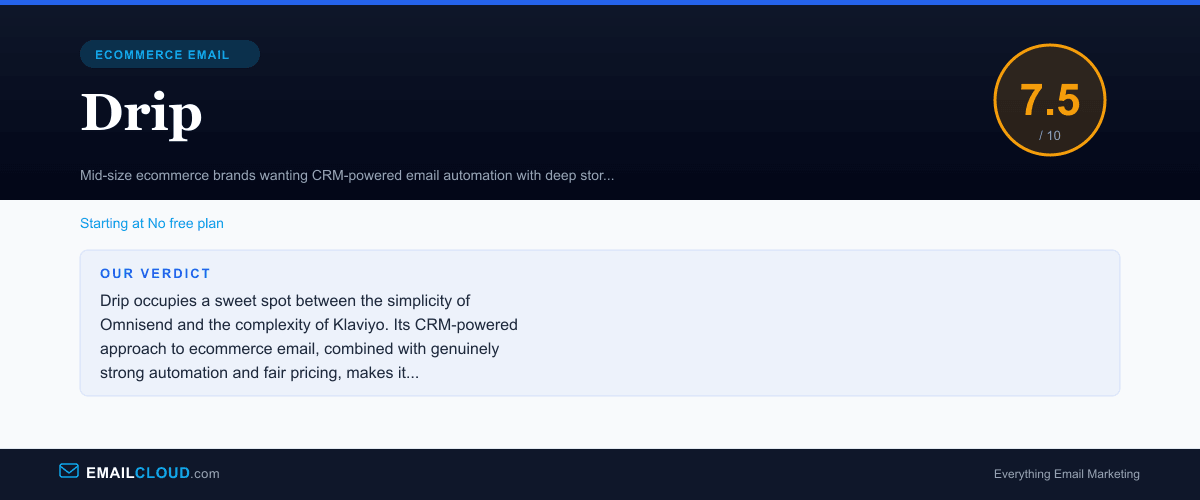
Drip occupies a sweet spot between the simplicity of Omnisend and the complexity of Klaviyo. Its CRM-powered approach to ecommerce email, combined with genuinely strong automation and fair pricing, makes it an excellent choice for mid-size online stores. It is not the cheapest or the most powerful, but it balances capability and usability better than most.
Review Summary
Share this visual summary. Right-click to save.
Frequently Asked Questions
How does Drip compare to Klaviyo?
Drip and Klaviyo compete directly in the ecommerce email space. Klaviyo has deeper Shopify integration, predictive analytics, and a larger user base. Drip counters with a more intuitive workflow builder, better multi-channel support beyond just email and SMS, and pricing that is slightly more accessible at mid-range subscriber counts. For Shopify Plus stores, Klaviyo is usually the better choice. For WooCommerce stores or Shopify stores under $1M in revenue, Drip is a strong alternative.
Is Drip only for ecommerce?
While Drip was built for ecommerce, it can technically be used by any business. However, many of its best features — revenue attribution, purchase-based segmentation, product recommendation blocks, and ecommerce playbooks — are specifically designed for online stores. Non-ecommerce businesses will end up paying for features they cannot use and would be better served by ActiveCampaign, MailerLite, or GetResponse.
Does Drip integrate with WooCommerce?
Yes. Drip has a native WooCommerce integration that syncs customer data, order history, product catalog, and cart activity. The integration supports abandoned cart workflows, post-purchase automation, and purchase-based segmentation. The WooCommerce integration is one of Drip's strengths compared to Klaviyo, which has historically prioritized Shopify over WooCommerce.