Klaviyo Review: The Undisputed King of Ecommerce Email
Pros
- Deepest Shopify integration available — real-time product and customer sync
- Incredible segmentation with behavioral, transactional, and predictive data
- Pre-built ecommerce flows that generate revenue from day one
- Email and SMS in one platform with unified customer profiles
- Predictive analytics including customer lifetime value and churn risk
Cons
- Gets expensive at scale — 10,000 contacts runs $150/mo
- Steep learning curve with a feature-dense interface
- Overkill for non-ecommerce businesses
- Dashboard can be slow to load with large datasets
- Support quality is inconsistent — great at times, slow at others
What is Klaviyo?
Klaviyo is the email platform that ecommerce brands graduate to. It is not the first tool most store owners try — that is usually Mailchimp or the email feature built into their Shopify theme. But once a store hits real revenue and the owner realizes they need more than basic newsletters to drive growth, Klaviyo is where the conversation inevitably leads.
Founded in 2012 by Andrew Bialecki and Ed Hallen, Klaviyo was purpose-built for ecommerce from day one. Not adapted from a general email tool. Not retrofitted with store integrations. Built, from the data model up, to understand the relationship between products, customers, and purchasing behavior. That architectural decision is the foundation of everything Klaviyo does well — and the reason it went public in September 2023 at a $9 billion valuation.
Today Klaviyo serves over 143,000 ecommerce brands, with a particularly dominant position in the Shopify ecosystem. We have deployed Klaviyo for stores across fashion, supplements, home goods, food and beverage, and beauty — from $20K/mo startups to $5M/mo established brands. This review reflects what the platform delivers at those scales.
Pricing Breakdown
Klaviyo’s pricing is the most common objection, and it deserves a transparent examination:
- Free: Up to 250 active profiles, 500 email sends/month, 150 SMS credits, all features included
- Email ($20/mo for 251-500 profiles): Unlimited email sends, all segmentation and automation features, email support
- Email + SMS ($35/mo for 251-500 profiles): Everything in Email plus SMS/MMS campaigns and flows, unified customer profiles
Scaling with list size is where costs climb:
- 1,000 profiles: $30/mo (email), $45/mo (email + SMS)
- 2,500 profiles: $60/mo (email), $75/mo (email + SMS)
- 5,000 profiles: $100/mo (email), $115/mo (email + SMS)
- 10,000 profiles: $150/mo (email), $165/mo (email + SMS)
- 25,000 profiles: $375/mo (email), $390/mo (email + SMS)
- 50,000 profiles: $720/mo (email), $735/mo (email + SMS)
At 10,000 profiles, Klaviyo at $150/mo costs roughly 30-50% more than Omnisend ($115/mo) or Mailchimp ($100/mo Standard). At 50,000 profiles, the gap widens further. The question is whether Klaviyo’s deeper data capabilities generate enough incremental revenue to justify the premium.
For stores doing meaningful revenue ($500K+/year), the answer is almost always yes. A single well-optimized abandoned cart flow on Klaviyo typically recovers 5-15% of abandoned carts. On a store with $50K/mo in revenue and a 70% cart abandonment rate, that is $1,750-$5,250/mo in recovered revenue — far exceeding any subscription cost.
Key Features We Tested
Shopify Integration
Klaviyo’s Shopify integration is not just good — it is the standard against which every other ecommerce email integration is measured. The one-click install syncs:
- Customer profiles — name, email, address, lifetime spend, order count, average order value, first and last order dates
- Order history — every transaction with line items, discounts applied, shipping details, fulfillment status
- Product catalog — full catalog with images, descriptions, prices, variants, categories, and tags
- Browsing behavior — pages viewed, products browsed, searches performed, time on site
- Cart data — real-time cart contents, cart value, items added and removed
This data syncs in real time, not on a batch schedule. When a customer adds a product to their cart, Klaviyo knows within seconds. When they complete a purchase, their profile updates immediately. This real-time data model is what enables Klaviyo’s sophisticated segmentation and timing-sensitive automation.
For Shopify Plus merchants, the integration goes deeper with custom checkout extensibility, Shopify Flow triggers, and API-level access for custom data pipelines.
Segmentation and Data
Segmentation is Klaviyo’s defining strength. The platform lets you build segments using any combination of:
- Profile data — location, lifetime value, order count, average order value, first order date
- Behavioral data — email opens/clicks, website browsing, product views, search terms
- Transactional data — products purchased, categories bought from, discount code usage, return history
- Predictive data — predicted next order date, expected lifetime value, churn risk score, predicted gender
- Custom properties — any data you pass via API, CSV, or integration
The predictive analytics deserve special attention. Klaviyo calculates predicted customer lifetime value (CLV), expected date of next purchase, and churn risk probability for every profile in your account. These predictions are based on individual purchasing patterns analyzed against your store’s overall customer behavior.
This means you can build segments like “customers predicted to churn in the next 30 days who have a lifetime value over $200” and target them with specific retention campaigns. Or “customers whose predicted next order date is within the next week” for timely re-engagement. These predictive segments consistently outperform static segments in our testing, with 20-40% higher conversion rates on targeted campaigns.
Pre-Built Flows
Klaviyo includes pre-built automation flows for every major ecommerce scenario:
- Welcome series — multi-email onboarding with progressive profiling and first-purchase incentive
- Abandoned cart — time-delayed series with product images, social proof, and escalating incentives
- Browse abandonment — triggered by product page views without add-to-cart
- Post-purchase — thank you, cross-sell recommendations, review requests, replenishment reminders
- Winback — re-engagement for lapsed customers based on purchase frequency patterns
- Price drop — notification when a browsed or wishlisted product drops in price
- Back in stock — alerts when out-of-stock products are replenished
- Birthday and anniversary — milestone celebrations with discount incentives
Each flow comes with recommended timing, subject lines, and content blocks based on aggregate performance data from Klaviyo’s customer base. You can activate them with minimal customization and refine based on your store’s results.
The visual flow builder supports conditional splits based on any profile property, time delays, A/B tests, SMS branches, and multi-path logic. Building a flow that sends an abandoned cart email after 2 hours, waits 24 hours, checks if the customer purchased, and if not sends a different email with a discount code — while simultaneously sending an SMS to contacts who opted in — takes about 15 minutes.
Email Builder
Klaviyo’s email builder is capable but not beautiful. The drag-and-drop editor handles standard content blocks (text, images, buttons, columns, social links) plus ecommerce-specific blocks (product feeds, dynamic recommendations, discount codes, table blocks). Templates are clean and conversion-focused rather than design-forward.
The standout feature is dynamic product blocks. You can insert personalized product recommendations based on browsing history, purchase history, trending items, or custom algorithms. A single email template can show different products to every recipient based on their individual data profile. This dynamic personalization is one of the highest-converting features in ecommerce email and is very difficult to replicate on general-purpose platforms.
Template management supports cloning, versioning, and shared template libraries for teams. Custom HTML is fully supported. The preview tool shows rendering across major email clients.
Who Should Use Klaviyo?
Klaviyo is built for ecommerce businesses that treat email as a revenue channel, not a communication tool. If your store generates consistent revenue and you want to maximize customer lifetime value through sophisticated, data-driven email and SMS marketing, Klaviyo is the platform.
It is the strongest fit for:
- Shopify stores doing $20K+/mo that need deep product integration and behavioral automation
- DTC brands building customer relationships through lifecycle email marketing
- Ecommerce businesses scaling from $500K to $10M+ that need predictive analytics and advanced segmentation
- Multi-channel retailers that want email and SMS managed in one platform with unified data
- Marketing teams comfortable with data-driven decision making and willing to invest time in optimization
Who Should Avoid It?
Stores in the early stage (under $10K/mo revenue) should start with Omnisend or Mailchimp and migrate to Klaviyo once their email marketing generates enough revenue to justify the premium. Paying $150/mo for an email platform when your store does $8K/mo in total revenue does not make financial sense, regardless of the platform’s capabilities.
Non-ecommerce businesses have no reason to use Klaviyo. The entire data model, segmentation engine, and automation library are built around ecommerce transactions. A SaaS company, professional services firm, or content creator would pay premium prices for features they cannot use. Platforms like ActiveCampaign, GetResponse, or HubSpot serve those use cases better.
Business owners who want simplicity should also look elsewhere. Klaviyo’s interface is feature-dense, and the learning curve is real. If you want to set up email marketing in an afternoon and never think about it again, Klaviyo is the wrong tool. It rewards investment and optimization — users who build sophisticated segments, test flow variations, and analyze performance data will see outsized returns. Users who set up basic flows and walk away will not see enough value to justify the cost.
Deliverability
Klaviyo’s deliverability is strong, consistently in the 93-96% inbox placement range. The platform provides dedicated sending domains, DKIM and SPF authentication guides, and smart sending features that prevent over-mailing. Deliverability monitoring in the dashboard shows inbox placement trends, bounce rates, and spam complaint rates.
The Smart Sending feature automatically suppresses emails to contacts who received a message within a configurable time window, which prevents fatigue-related spam complaints. For ecommerce stores running multiple automated flows alongside regular campaigns, this feature is critical for maintaining sender reputation.
Before launching any campaign, we recommend running your email content through our Spam Word Checker — ecommerce emails tend to use promotional language that can trigger spam filters if overused.
The Bottom Line
Klaviyo is not cheap. It is not simple. It is not for everyone. But for ecommerce businesses that treat email marketing as a revenue driver, it is the most capable platform available. The depth of Shopify integration, the sophistication of segmentation, the power of predictive analytics, and the quality of pre-built flows create a system that consistently generates measurable ROI for stores willing to invest the time and budget.
If you run a Shopify store doing real revenue and you are still on Mailchimp or a free tool, you are leaving money on the table. Klaviyo earns its premium.
Our Verdict
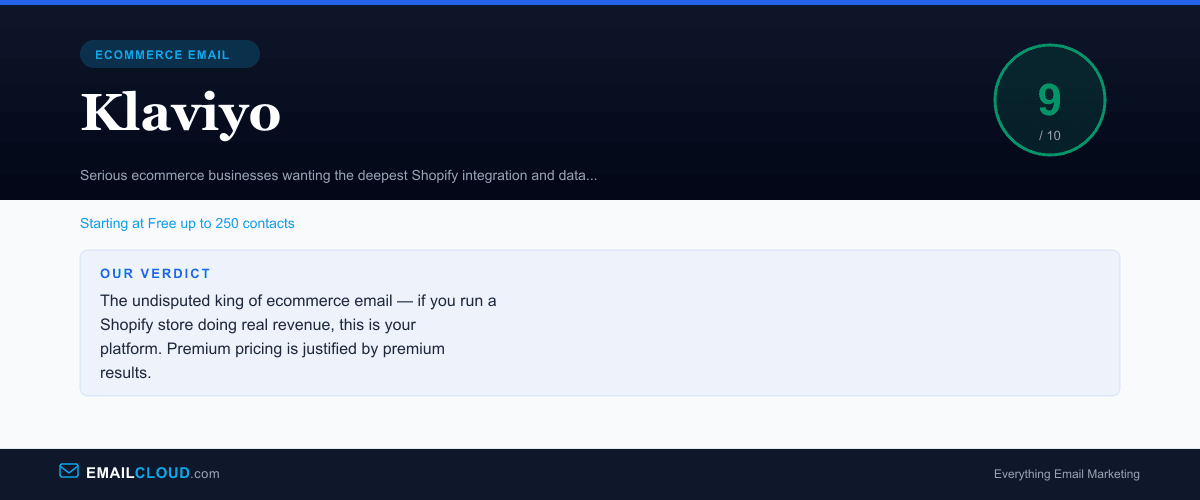
The undisputed king of ecommerce email — if you run a Shopify store doing real revenue, this is your platform. Premium pricing is justified by premium results.
Review Summary
Share this visual summary. Right-click to save.
Frequently Asked Questions
Is Klaviyo worth the price for small stores?
It depends on your revenue. If your store does $10K+/mo in revenue, Klaviyo's automation flows and segmentation will likely generate more than enough incremental revenue to cover the subscription cost. For stores doing under $5K/mo, Omnisend provides 80-90% of the functionality at 40% less cost and is the better starting point.
How does Klaviyo integrate with Shopify?
Klaviyo has the deepest Shopify integration in the market. It syncs customer profiles, order history, product catalog, browsing behavior, cart contents, and checkout data in real time. This means you can segment by specific products purchased, average order value, purchase frequency, predicted next order date, and hundreds of other data points. The integration installs in minutes from the Shopify App Store.
Can Klaviyo replace my SMS platform?
Yes. Klaviyo includes SMS marketing on all paid plans, with unified customer profiles that track both email and SMS interactions. You can build automation flows that use email and SMS together — send an abandoned cart email, follow up with an SMS if unopened. SMS pricing is usage-based starting at $0.01 per message for US numbers.
What is Klaviyo's deliverability like?
Klaviyo's deliverability is strong, typically in the 93-96% inbox placement range. The platform enforces strict list quality requirements and provides deliverability monitoring tools. Dedicated sending domains and smart sending features help maintain sender reputation. For ecommerce senders with clean lists, Klaviyo's deliverability infrastructure is reliable.