Omnisend Review: The Ecommerce Email Platform That Won't Break the Bank
Pros
- Built specifically for ecommerce — Shopify, WooCommerce, BigCommerce integrations
- Pre-built automation workflows for common ecommerce scenarios
- Email and SMS marketing in one platform at competitive pricing
- Product picker pulls items directly from your store into emails
- Solid free plan with access to all features for up to 250 contacts
Cons
- Not well-suited for non-ecommerce businesses
- Template customization is more limited than dedicated email builders
- Reporting could offer deeper product-level analytics
- Fewer integrations than Klaviyo's ecosystem
- SMS pricing is separate and can add up quickly
What is Omnisend?
Omnisend is the ecommerce email platform that figured out something important: most online stores do not need enterprise-grade data science. They need abandoned cart emails that work, welcome sequences that convert, and SMS reminders that bring shoppers back. And they need it at a price that does not eat into their margins.
Founded in 2014 in Lithuania, Omnisend started as an email marketing tool for Shopify stores and has expanded to support WooCommerce, BigCommerce, Wix, and other ecommerce platforms. The company has grown to serve over 100,000 ecommerce brands, and its positioning is refreshingly clear: this is email and SMS marketing built for online stores, not a general-purpose platform that also does ecommerce.
We have deployed Omnisend for Shopify stores ranging from $5K/mo in revenue to $500K/mo, across categories including apparel, supplements, home goods, and specialty food. This review covers how it performs across those use cases.
Pricing Breakdown
Omnisend’s pricing is one of its strongest competitive advantages, especially relative to Klaviyo:
- Free: 250 contacts, 500 emails/month, 60 SMS, all features included (automations, segmentation, reporting), Omnisend branding
- Standard ($16/mo for 500 contacts): 6,000 emails/month, unlimited push notifications, SMS credits included, customer success manager at higher tiers
- Pro ($59/mo for 500 contacts): Unlimited emails, advanced reporting, priority support, higher SMS credits
Pricing scales with contact count. Here is what standard plans cost at key list sizes:
- 2,500 contacts: $35/mo
- 5,000 contacts: $65/mo
- 10,000 contacts: $115/mo
- 25,000 contacts: $230/mo
Compare that to Klaviyo at the same list sizes: 2,500 contacts at $60/mo, 5,000 at $100/mo, 10,000 at $150/mo, 25,000 at $400/mo. Omnisend saves 30-45% at most list sizes while delivering comparable ecommerce email functionality. For growing stores watching their margins, that difference compounds.
SMS credits are included in paid plans rather than billed as a completely separate line item. The Standard plan includes a base allocation, and additional credits are purchased at competitive per-message rates. This bundled approach simplifies budgeting compared to platforms that charge separately for email and SMS subscriptions.
Key Features We Tested
Ecommerce Automation
Omnisend’s pre-built automation workflows are the platform’s bread and butter. Out of the box, you get ready-to-activate workflows for:
- Welcome series — multi-step sequence for new subscribers with customizable timing
- Abandoned cart — email and SMS reminders with product images pulled from the cart
- Browse abandonment — triggered when a shopper views products but does not add to cart
- Post-purchase — thank you emails, cross-sell recommendations, review requests
- Lapsed customer — re-engagement campaigns for customers who have not purchased in X days
- Order confirmation and shipping updates — transactional-style notifications
Each workflow comes pre-configured with industry-standard timing, subject lines, and content blocks. You can activate them as-is or customize every element. For store owners who do not have time to build automations from scratch, these pre-built flows generate revenue from day one.
The visual workflow builder supports branching logic, conditional splits (based on order value, product category, customer segment), A/B testing, and multi-channel steps (email + SMS + push in the same workflow). It is not as granular as ActiveCampaign’s builder, but for ecommerce-specific automation, it covers the scenarios that drive revenue.
Product Picker and Email Builder
The product picker is a feature that every ecommerce email platform should have but many get wrong. Omnisend’s implementation connects directly to your store’s product catalog, letting you browse, search, and insert products into emails with one click. Product images, titles, prices, and descriptions are pulled automatically and stay in sync if you update your catalog.
The email builder uses a drag-and-drop interface with ecommerce-specific content blocks: product listings, discount codes, product recommendations, and gift boxes. Templates are designed for common ecommerce scenarios (sale announcement, new arrival, seasonal promotion, back-in-stock). Customization is adequate but not as flexible as Mailchimp’s editor or MailerLite’s builder — you can adjust colors, fonts, and layouts, but complex custom designs may feel constrained.
For most ecommerce email use cases — where the goal is showcasing products clearly rather than creating design-forward brand experiences — the builder does the job.
SMS Marketing
Having email and SMS in one platform eliminates the cost and complexity of managing a separate SMS tool. Omnisend’s SMS features include:
- Two-way messaging (where supported)
- SMS automation within the same workflows as email
- Subscriber consent management and compliance tools
- SMS campaign analytics alongside email metrics
- Global sending to 200+ countries
The integration between email and SMS is where Omnisend adds genuine value. A single automation workflow can send an abandoned cart email, wait 24 hours, check if the customer purchased, and if not, send an SMS reminder. This multi-channel approach consistently outperforms email-only campaigns in our testing — abandoned cart recovery rates typically improve 15-25% when SMS is added as a follow-up channel.
Segmentation
Omnisend’s segmentation is powered by ecommerce data. You can segment by purchase history (bought product X, spent over $100, purchased in last 30 days), shopping behavior (added to cart, browsed category, visited X times), email engagement (opened last 3 campaigns, clicked specific link), and customer lifecycle stage (new subscriber, first-time buyer, repeat customer, at risk, lapsed).
Pre-built segments for common ecommerce cohorts (high-value customers, one-time buyers, at-risk churners) save time and encourage data-driven targeting from day one. Custom segments support AND/OR logic with multiple conditions, which handles most ecommerce segmentation needs.
The segmentation is not as deep as Klaviyo’s — you will not find predictive lifetime value modeling or churn probability scores — but it covers the practical segments that drive revenue for most online stores.
Who Should Use Omnisend?
Omnisend is built for ecommerce businesses that need automated email and SMS marketing without enterprise pricing. If you run a Shopify, WooCommerce, or BigCommerce store and want to automate your customer communication, Omnisend delivers excellent value.
It is particularly well-suited for:
- Shopify stores doing $10K-$500K/mo that have outgrown basic email tools but do not need Klaviyo’s premium features
- Ecommerce businesses adding SMS to their marketing mix without managing a separate platform
- Store owners without a dedicated marketer who need pre-built workflows that generate revenue out of the box
- Multi-channel retailers that want email, SMS, and push notifications managed in one dashboard
Who Should Avoid It?
Non-ecommerce businesses should not use Omnisend. The platform is purpose-built for online stores, and its features, templates, and automation workflows reflect that focus. If you run a SaaS company, professional services firm, or content business, platforms like GetResponse, ActiveCampaign, or HubSpot will serve you better.
Ecommerce businesses doing over $1M in annual revenue with complex data needs should evaluate Klaviyo instead. At that scale, Klaviyo’s deeper data modeling, predictive analytics, and Shopify Plus integration provide measurable advantages that justify the higher cost.
Stores that need highly customized email designs should also consider whether Omnisend’s template constraints are acceptable. If your brand identity depends on pixel-perfect email design, a platform with a more flexible builder (or custom HTML support) may be necessary.
Deliverability
Omnisend’s deliverability is solid, typically landing in the 92-95% inbox placement range. The platform enforces list hygiene requirements, provides authentication guidance for SPF and DKIM, and monitors sender reputation across its infrastructure. Dedicated sending IPs are available on Pro plans for businesses that need maximum control over their sender reputation.
For ecommerce senders, we always recommend checking promotional content against common spam triggers. Run your campaign copy through our Spam Word Checker before sending — words like “free,” “limited time,” and “act now” are common in ecommerce emails and can impact inbox placement if overused.
The Bottom Line
Omnisend occupies the sweet spot in ecommerce email marketing: powerful enough to drive meaningful revenue through automation, affordable enough to leave margin on the table, and focused enough to avoid the feature bloat that makes general-purpose platforms frustrating for store owners.
It is not Klaviyo. It does not pretend to be. But for the vast majority of online stores — those in the messy middle between startup and enterprise — Omnisend provides the ecommerce email and SMS infrastructure you actually need, at a price that makes sense for your business.
Our Verdict
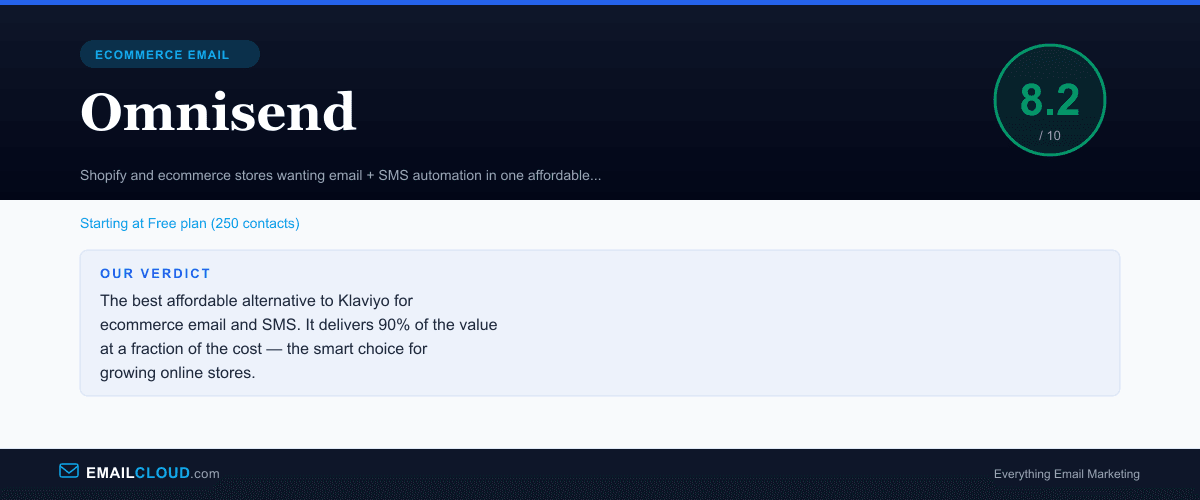
The best affordable alternative to Klaviyo for ecommerce email and SMS. It delivers 90% of the value at a fraction of the cost — the smart choice for growing online stores.
Review Summary
Share this visual summary. Right-click to save.
Frequently Asked Questions
Is Omnisend better than Klaviyo?
For most small to mid-size ecommerce stores, Omnisend offers better value. It provides 80-90% of Klaviyo's ecommerce email capabilities at a significantly lower price. Klaviyo wins on data depth, predictive analytics, and Shopify Plus integration. But if you run a Shopify store doing under $1M in annual revenue, Omnisend gives you what you need without the premium pricing.
Does Omnisend work with Shopify?
Yes. Omnisend has a native Shopify integration that syncs products, customers, and order data automatically. You can pull products directly into email templates, trigger automations based on purchase behavior, and segment audiences by purchase history, cart value, and product category. The integration installs in minutes from the Shopify App Store.
How much does Omnisend SMS cost?
SMS credits are included on paid plans — the Standard plan includes credits for the US at roughly $0.015 per message. Additional credits can be purchased as needed. International SMS rates are higher. SMS is also available on the free plan with a limited number of credits. The combined email + SMS pricing is still typically cheaper than running separate platforms for each channel.
Is Omnisend free?
Yes. Omnisend offers a free plan that includes up to 250 contacts, 500 emails per month, 60 SMS messages, and access to all features including automation workflows, segmentation, and reporting. The free plan gives you a full view of the platform's capabilities before committing to a paid plan.