Salesforce Marketing Cloud Review: Enterprise Email at Enterprise Scale
Pros
- Journey Builder is one of the most powerful customer journey tools ever built
- Deep native integration with Salesforce CRM — unified customer data model
- Multi-channel orchestration across email, SMS, push, social, and advertising
- Enterprise-grade security, compliance, and data governance
- Massive ecosystem of consultants, agencies, and certified professionals
Cons
- Extremely expensive — pricing starts above $1,000/mo and scales aggressively
- Implementation requires months and often a certified consultant
- Steep learning curve — the platform is genuinely complex
- Email builder (Content Builder) is functional but dated
- Overkill for any company that does not need enterprise capabilities
- Reporting requires technical expertise to configure properly
What is Salesforce Marketing Cloud?
Salesforce Marketing Cloud is the enterprise marketing platform within the Salesforce ecosystem — a suite of tools for email marketing, journey orchestration, mobile messaging, social media advertising, customer data management, and analytics. It is one of the most capable marketing platforms ever built, and also one of the most expensive and complex.
Originally Exact Target, the platform was acquired by Salesforce in 2013 for $2.5 billion and integrated into the Salesforce product family. The acquisition brought enterprise email marketing capabilities to Salesforce’s CRM ecosystem, creating a unified platform where sales data, service interactions, and marketing engagement live in a single customer record. This data unification is the foundation of everything Marketing Cloud does well.
Marketing Cloud serves the Fortune 500 and Global 2000 — organizations with millions of customer records, multi-country operations, complex compliance requirements, and marketing teams large enough to operate a platform that demands specialized expertise. It is not for small businesses. It is not for startups. It is not even for most mid-market companies. But for the enterprises it was built for, it remains one of the most powerful tools available.
We have worked with Marketing Cloud implementations across retail, financial services, healthcare, and technology. This review covers the platform’s genuine strengths, its equally genuine limitations, and the honest reality of what it takes to implement and operate.
Pricing Breakdown
Salesforce Marketing Cloud does not publish detailed pricing publicly. The platform uses custom quoting based on edition, features, contact volume, and sending volume. Here is what we know from published information and market experience:
Editions (approximate starting prices):
- Pro: ~$1,250/mo — email marketing, content builder, basic automation, analytics
- Corporate: ~$4,200/mo — everything in Pro plus Journey Builder, mobile messaging, advertising studio
- Enterprise: Custom pricing — everything in Corporate plus advanced analytics, multiple business units, API access, custom integrations
Additional costs:
- Professional services: $10,000-100,000+ for implementation depending on complexity
- Certified consultant fees: $150-300/hr for ongoing configuration and optimization
- Training: Salesforce Trailhead is free for self-study, but team training programs run $2,000-5,000 per person
- Add-ons: Data management, advanced analytics, and additional channels carry separate costs
For context: a mid-size enterprise implementation with Corporate edition, 500,000 contacts, professional services setup, and one consultant for ongoing optimization can easily reach $75,000-150,000 in the first year and $55,000-75,000 annually thereafter.
Compare this to ActiveCampaign ($300-500/mo for the same contact count) or HubSpot Marketing Hub ($3,600/mo for Enterprise), and the cost differential is stark. The question is whether Marketing Cloud’s enterprise capabilities create value that justifies the 10-20x price premium.
Key Features We Tested
Journey Builder
Journey Builder is Marketing Cloud’s crown jewel, and one of the most impressive marketing automation tools in any platform at any price point. It is a visual workflow designer for customer journeys that span multiple channels, multiple decision points, and extended time periods.
A Journey Builder workflow might look like this: A customer abandons a cart on your ecommerce site. Journey Builder creates an entry event, waits 2 hours, sends an abandoned cart email. If the customer returns and purchases, the journey routes to a post-purchase thank-you flow. If they do not open the email within 24 hours, a push notification fires. If they open but do not click, a different email with a discount incentive sends. If they click but do not purchase, a retargeting ad activates on Facebook and Instagram. Each path has independent timing, conditions, and channel selections.
The power is in the complexity it can handle. Real enterprise implementations have journeys with dozens of decision splits, channel-specific timing rules, velocity-based throttling, engagement scoring branches, and real-time data evaluations pulling from Salesforce CRM records. This level of orchestration is beyond what any SMB platform can achieve.
The tradeoff is that building these journeys requires specialized expertise. Marketing Cloud’s Journey Builder is not something a marketing coordinator configures in an afternoon. It requires training, planning, and often a certified consultant to design and implement properly.
Email Studio and Content Builder
Email Studio handles campaign creation, sending, and analytics. Content Builder is the design tool within Email Studio that creates email templates and content blocks.
Content Builder supports drag-and-drop editing, dynamic content blocks (content that changes based on recipient data), AMP for Email, and content inheritance (shared blocks reused across templates). The design capabilities are comprehensive but the interface feels dated compared to modern platforms like Kit or beehiiv. Enterprise users care more about functionality than aesthetics, but it is worth noting that the email building experience is not a joy.
Template management at enterprise scale is well-handled. Content approval workflows, version control, and template locking ensure brand consistency across teams and regions. Multi-language support lets you manage translations within a single template structure.
Data Management and Segmentation
Marketing Cloud’s data model is built on data extensions — database tables that store any structured data. Subscriber lists, purchase history, product catalogs, preference centers, custom data — everything is modeled as data extensions with defined relationships.
Segmentation queries run against this data model using a SQL-like filter builder (or actual SQL for power users). You can build segments that combine CRM data, email engagement, website behavior, purchase history, app usage, and custom data points. The depth is essentially unlimited — if you can get the data into Marketing Cloud, you can segment on it.
This data flexibility is a core enterprise requirement. Large organizations have complex data architectures, and Marketing Cloud accommodates them. But it also means that data modeling and management require technical expertise that simpler platforms abstract away.
Multi-Channel Capabilities
Marketing Cloud supports orchestration across channels:
- Email: Full email marketing and transactional email capabilities
- Mobile: SMS, MMS, and push notifications through MobileConnect and MobilePush
- Social: Social media advertising and publishing through Social Studio
- Advertising: Audience management for Google, Facebook, and display advertising
- Web: Personalized web content through Interaction Studio
The multi-channel capability means Journey Builder can route customers across channels based on their behavior and preferences. A customer who engages with email gets email. A customer who ignores email but uses the mobile app gets push notifications. The orchestration engine optimizes channel selection based on historical engagement patterns.
Who Should Use Salesforce Marketing Cloud?
Marketing Cloud is appropriate for a specific profile:
- Large enterprises (1,000+ employees) with complex multi-channel marketing operations
- Organizations already using Salesforce CRM that want unified customer data across sales, service, and marketing
- Companies with regulatory compliance requirements (HIPAA, GDPR, financial services regulations) that need enterprise security and governance
- Marketing teams with dedicated technical resources (marketing operations specialists, Salesforce administrators) to manage the platform
- Businesses with budgets that support $50,000+ annual marketing technology investment
Who Should Look Elsewhere?
Small and mid-size businesses should not use Marketing Cloud. The cost, complexity, and implementation timeline are designed for enterprise operations. HubSpot, ActiveCampaign, or GetResponse serve SMB needs at appropriate price points with dramatically simpler experiences.
Companies that only need email marketing — even at scale — should evaluate platforms that specialize in email rather than paying for Marketing Cloud’s multi-channel capabilities. ActiveCampaign handles sophisticated email automation for a fraction of the cost.
Organizations without Salesforce CRM should carefully consider whether Marketing Cloud makes sense. The platform’s greatest strength is CRM integration. Without it, you are paying enterprise prices for a platform that is not reaching its potential. HubSpot’s all-in-one CRM and marketing suite is often a better fit for companies without existing Salesforce investment.
Teams that want fast implementation should look elsewhere. Marketing Cloud implementations take months, not days. If you need to launch marketing campaigns next week, this is not the platform for that timeline.
Deliverability
Marketing Cloud’s deliverability infrastructure is enterprise-grade. Dedicated sending IPs, full authentication (SPF, DKIM, DMARC), reputation monitoring, and ISP relations are all included. Salesforce maintains relationships with major mailbox providers and provides deliverability consulting for Enterprise tier customers.
The platform includes Sender Authentication Package (SAP), which handles DNS configuration, branded links, and dedicated IP assignment. For large-volume enterprise senders, the deliverability infrastructure is robust.
The Bottom Line
Salesforce Marketing Cloud is the right platform for a small number of organizations and the wrong platform for everyone else. For large enterprises with complex customer journeys, Salesforce CRM integration, multi-channel marketing requirements, and the budget and team to operate it — Marketing Cloud provides capabilities that no other platform matches. Journey Builder alone justifies the investment for organizations with the sophistication to use it.
For the other 95% of businesses, Marketing Cloud is overengineered, overpriced, and over-complicated. ActiveCampaign, HubSpot, or GetResponse deliver better email marketing experiences at 5-20% of the cost with implementations measured in hours, not months. Choose Marketing Cloud only if you genuinely need what only it provides.
Our Verdict
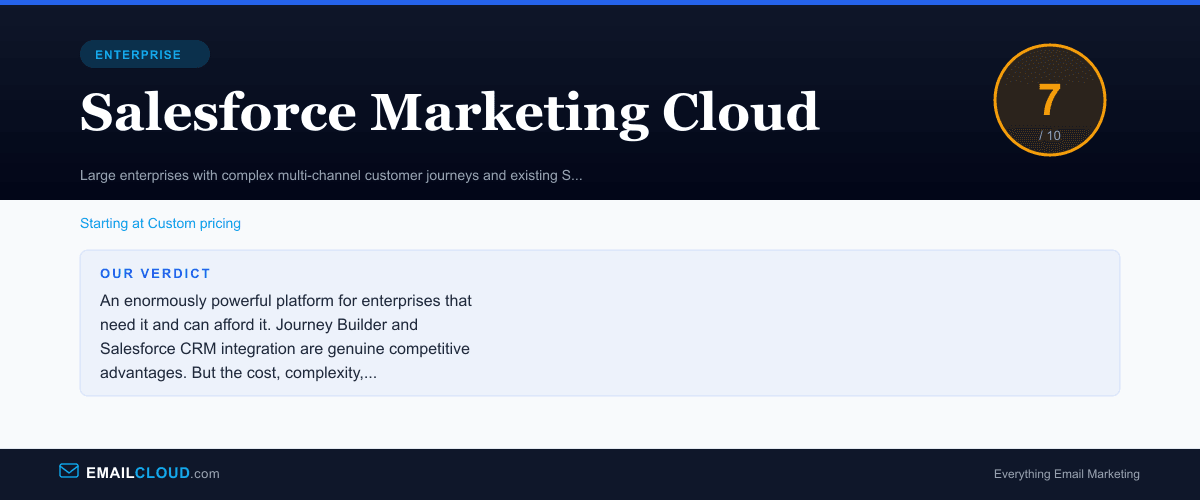
An enormously powerful platform for enterprises that need it and can afford it. Journey Builder and Salesforce CRM integration are genuine competitive advantages. But the cost, complexity, and implementation timeline make it appropriate for large organizations only.
Review Summary
Share this visual summary. Right-click to save.
Frequently Asked Questions
How much does Salesforce Marketing Cloud cost?
Salesforce Marketing Cloud uses custom pricing based on edition, features, and contact volume. Published starting prices are approximately $1,250/mo for the Pro edition and $4,200/mo for the Corporate edition. Enterprise and higher tiers are fully custom. Most implementations also require professional services for setup, which can add $10,000-100,000+ depending on complexity. Request a quote directly from Salesforce for current pricing.
Do you need Salesforce CRM to use Marketing Cloud?
No, but you should. Marketing Cloud can function independently, but the platform is designed to leverage Salesforce CRM data. Without the CRM integration, you lose the unified customer data model, sales activity data, and service interaction history that make Journey Builder and segmentation powerful. Using Marketing Cloud without Salesforce CRM is like buying a sports car and driving it in first gear.
Is Salesforce Marketing Cloud good for email marketing?
For enterprise email at scale, yes. The platform handles massive contact lists, sophisticated segmentation, multi-language campaigns, complex approval workflows, and compliance requirements that smaller platforms cannot. For small or mid-size businesses, it is dramatically over-engineered and overpriced. ActiveCampaign or HubSpot deliver better email marketing experiences for 90% of businesses at 10% of the cost.
How long does it take to implement Salesforce Marketing Cloud?
Typical implementations take 3-6 months. Complex implementations with custom integrations, data migration, and multi-country deployment can take 6-12 months. Most organizations hire certified Salesforce consultants or implementation partners because the platform's complexity exceeds what internal marketing teams can configure alone. Budget for professional services alongside the subscription cost.