2003: The CAN-SPAM Act: America's First Real Anti-Spam Law
On December 16, 2003, President George W. Bush signed the CAN-SPAM Act into law, establishing the first comprehensive federal framework for regulating commercial email in the United States. The law was supposed to be the government’s definitive answer to the spam crisis that had been overwhelming inboxes for years. Instead, it became one of the most criticized pieces of technology legislation in American history — a law that many argued made the spam problem worse, not better.
The Spam Crisis
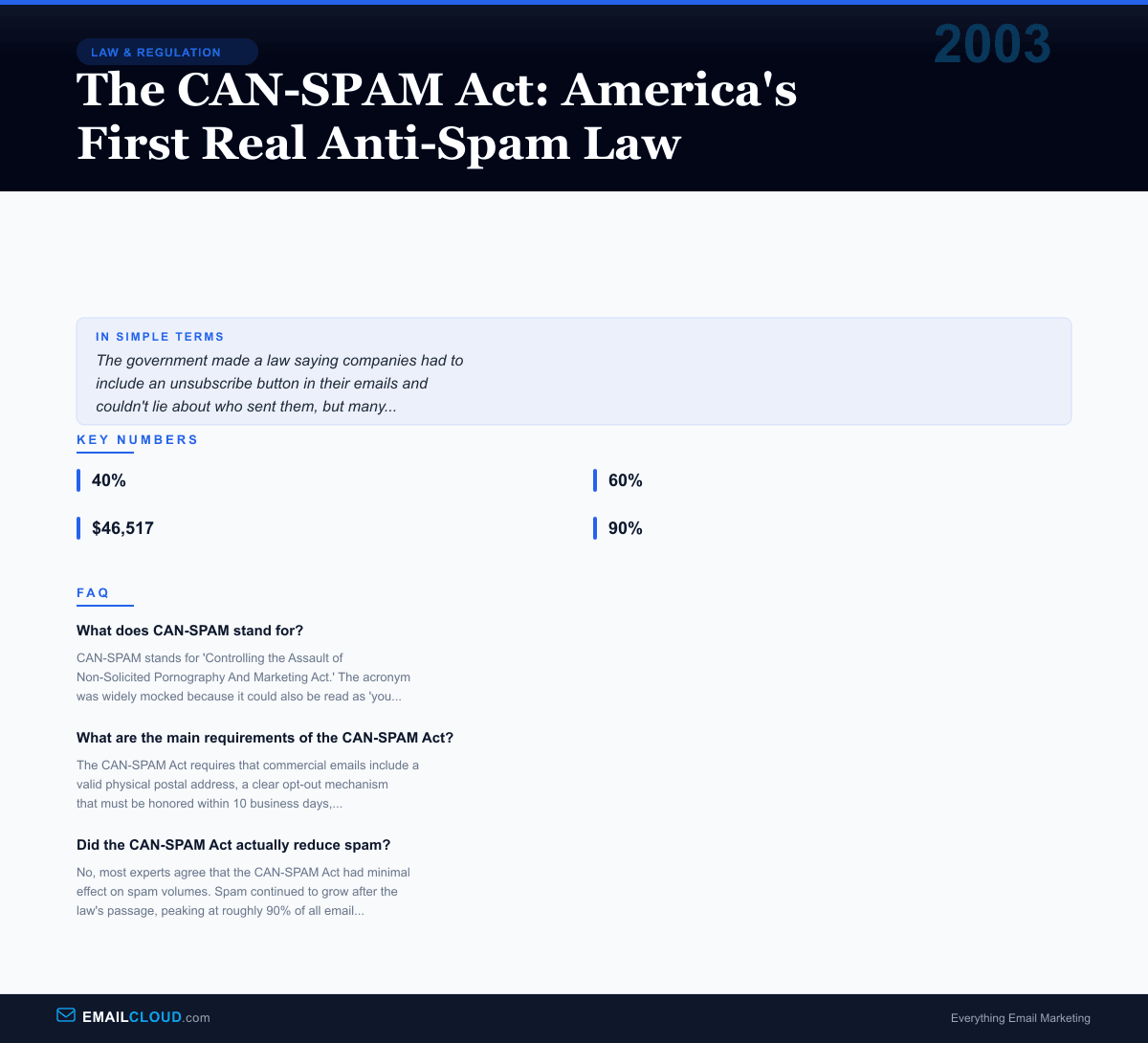
By 2003, spam had become a genuine emergency for email. Depending on whose numbers you trusted, unsolicited commercial email accounted for somewhere between 40% and 60% of all email traffic. The volume was growing exponentially. ISPs were spending millions on filtering infrastructure. Users were drowning in messages for discount pharmaceuticals, dubious financial opportunities, and content that was wildly inappropriate for the workplace.
State-level anti-spam laws existed but were a patchwork of conflicting regulations. California had passed a strict opt-in law (requiring explicit permission before sending commercial email), while other states had weaker opt-out provisions. The email marketing industry argued that a federal law was necessary to create a single, uniform standard. Consumer advocates agreed — but wanted a strong law, not a weak one.
What the Law Actually Said
The CAN-SPAM Act established several requirements for commercial email. Senders had to include a valid physical postal address in every message. They had to provide a clear and conspicuous opt-out mechanism — typically an unsubscribe link — and honor opt-out requests within 10 business days. Header information had to be accurate: you could not forge the “From” address or disguise the routing information. Subject lines could not be deceptive.
The law also prohibited certain practices: harvesting email addresses from websites without permission, using automated tools to generate random email addresses, and using unauthorized access to someone else’s computer to send email.
Violations could result in penalties of up to $46,517 per email (adjusted for inflation over the years), and the law included provisions for criminal prosecution of particularly egregious offenders. The Federal Trade Commission was given primary enforcement authority.
On paper, it sounded reasonable. In practice, there were enormous problems.
The “You CAN Spam” Problem
The most fundamental criticism of the CAN-SPAM Act was that it established an opt-out standard rather than an opt-in standard. Under opt-out, companies were free to send you commercial email without your permission — they just had to stop if you asked them to. Under the opt-in model that consumer advocates preferred (and that California had already enacted), companies would need your explicit permission before sending the first email.
This distinction was enormous. Opt-out meant that any company could email you until you unsubscribed — and with millions of companies, the burden was on consumers to unsubscribe from each one individually. Opt-in would have required companies to get permission first, dramatically reducing the volume of unwanted email.
The CAN-SPAM Act actually preempted California’s stricter opt-in law, replacing it with the weaker federal opt-out standard. Consumer advocates were furious. The law’s acronym — “Controlling the Assault of Non-Solicited Pornography And Marketing” — was widely reinterpreted as “You CAN Spam,” and the criticism stuck.
Who It Actually Helped
The biggest beneficiaries of the CAN-SPAM Act were legitimate businesses that wanted to use email marketing. The law gave them a clear set of rules to follow and protection from the patchwork of state laws. As long as they included a physical address, offered an unsubscribe option, and didn’t use deceptive headers or subject lines, they were operating within the law.
For actual spammers — the people sending millions of unsolicited messages from botnets using forged identities — the law was largely irrelevant. Most spam originated from overseas operations that were beyond the reach of U.S. law. Those who operated domestically were already breaking fraud laws. The CAN-SPAM Act gave prosecutors an additional tool, but it didn’t fundamentally change the enforcement landscape.
The FTC and Department of Justice did pursue cases under CAN-SPAM. Between 2004 and 2010, there were dozens of enforcement actions resulting in fines and prison sentences. But these cases targeted the most egregious domestic operators and barely dented the overall spam problem.
The Numbers Tell the Story
If the CAN-SPAM Act was meant to reduce spam, the data is damning. Spam volumes continued to climb after the law took effect in January 2004. By 2008, spam accounted for an estimated 90% of all email traffic worldwide. The peak was even higher by some measurements — Symantec reported that spam hit 92.3% of all email in 2009.
The decline in spam that eventually occurred in the 2010s had nothing to do with legislation. It was driven by technological improvements: better Bayesian spam filters, reputation-based filtering, and eventually, machine learning systems that could identify and block spam with high accuracy. Technology solved the problem that law could not.
The International Comparison
The CAN-SPAM Act’s weakness becomes even more apparent when compared to anti-spam laws in other countries. The European Union’s Privacy and Electronic Communications Directive, adopted in 2002, established an opt-in standard requiring prior consent for marketing emails. Canada’s CASL (Canada’s Anti-Spam Legislation), enacted in 2014, went even further with strict consent requirements and penalties up to $10 million per violation.
By the opt-out vs. opt-in measure, the United States has the weakest anti-spam law among major Western nations. The CAN-SPAM Act set a floor for commercial email behavior but arguably set the ceiling too low.
Legacy
Despite its limitations, the CAN-SPAM Act did establish norms that shaped the email marketing industry. The requirement for physical addresses, unsubscribe mechanisms, and honest header information became standard practice. Email service providers like Mailchimp, Constant Contact, and others built CAN-SPAM compliance into their platforms, making it the default for legitimate marketers.
The law also established the principle that email marketing is a regulated activity — that there are rules, and there are consequences for breaking them. Whether those rules were strong enough is a separate debate, but the framework existed. For email marketers today, CAN-SPAM compliance is table stakes, and tools like our Spam Word Checker help ensure content stays on the right side of both the law and spam filters.
Infographic
Share this visual summary. Right-click to save.
Related Events
Frequently Asked Questions
What does CAN-SPAM stand for?
CAN-SPAM stands for 'Controlling the Assault of Non-Solicited Pornography And Marketing Act.' The acronym was widely mocked because it could also be read as 'you CAN spam,' and critics argued the law did more to legitimize commercial email than to prevent spam.
What are the main requirements of the CAN-SPAM Act?
The CAN-SPAM Act requires that commercial emails include a valid physical postal address, a clear opt-out mechanism that must be honored within 10 business days, accurate header information, and non-deceptive subject lines. It also prohibits harvesting email addresses and using false or misleading transmission information.
Did the CAN-SPAM Act actually reduce spam?
No, most experts agree that the CAN-SPAM Act had minimal effect on spam volumes. Spam continued to grow after the law's passage, peaking at roughly 90% of all email traffic around 2008-2010. The law was most useful for enforcement actions against legitimate companies rather than stopping actual spammers, who typically operated overseas.