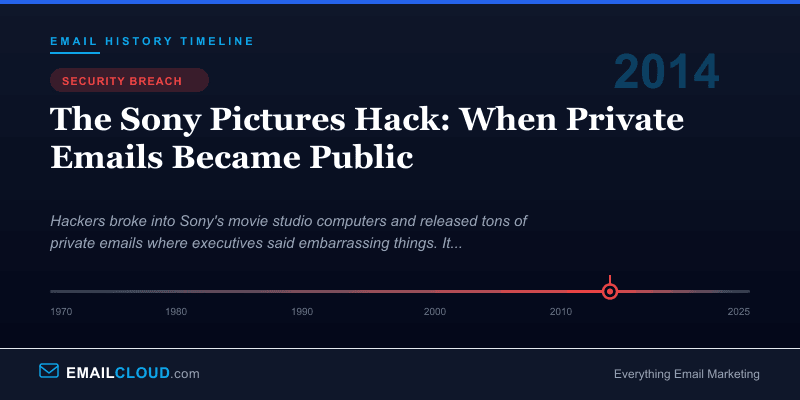
2014: The Sony Pictures Hack: When Private Emails Became Public
On November 24, 2014, employees at Sony Pictures Entertainment arrived at work to find their computer screens displaying a red skeleton and a message from a group calling itself the “Guardians of Peace.” Their files were encrypted. Their systems were down. And over the following weeks, the world would get an unprecedented, unfiltered look into the private email conversations of Hollywood executives — conversations that were never meant to be public, but would become some of the most widely read emails in history.
The Attack
The breach was devastating in its scope. The attackers had exfiltrated approximately 100 terabytes of data from Sony Pictures’ network before deploying destructive malware that wiped the company’s systems. The stolen data included unreleased films (five movies, including “Annie” and “Fury,” were leaked online before their theatrical release), employee personal information for approximately 47,000 current and former workers (Social Security numbers, medical records, salary data), financial records, and — most damaging to Sony’s reputation — thousands upon thousands of internal emails.
The attackers released the stolen data in waves over several weeks, each dump generating new headlines. Journalists, gossip columnists, and the general public pored over the emails with a mix of journalistic purpose and voyeuristic fascination.
The Emails
The leaked emails were a masterclass in why you should never put anything in an email that you wouldn’t want on the front page of a newspaper. Several exchanges became instant front-page news.
Sony Pictures co-chairman Amy Pascal and producer Scott Rudin exchanged emails containing racially insensitive jokes about President Barack Obama, speculating about what movies the President might enjoy based on racial stereotypes. Both Pascal and Rudin issued public apologies, and Pascal ultimately left Sony in February 2015, though the company characterized her departure as a planned transition.
Rudin’s emails revealed a pattern of abrasive communication, including calling Angelina Jolie a “minimally talented spoiled brat” and expressing frustration with various creative partners in terms that, while perhaps common in private Hollywood conversations, were deeply embarrassing in public.
The salary data revealed significant gender pay gaps. Jennifer Lawrence and Amy Adams were paid substantially less than their male co-stars in “American Hustle” — a revelation that fueled the broader conversation about pay equity in Hollywood and prompted Lawrence to write a widely shared essay about the gender pay gap.
Confidential business negotiations, film budgets, strategic plans, and legal discussions were all exposed. Competitors, agents, and journalists suddenly had access to Sony’s most sensitive business information.
The Attribution
The FBI formally attributed the attack to North Korea in December 2014, stating that the hack was motivated by Sony’s planned release of “The Interview,” a comedy starring Seth Rogen and James Franco that depicted the assassination of North Korean leader Kim Jong-un. North Korea had publicly condemned the film and threatened “merciless” retaliation.
The attribution was not without controversy. Some cybersecurity researchers questioned the FBI’s evidence and suggested alternative theories. But the FBI and the broader U.S. intelligence community maintained their assessment, and President Obama publicly attributed the attack to North Korea in a December 2014 press conference.
The geopolitical dimension elevated the Sony hack from a corporate security incident to an international crisis. Sony initially pulled “The Interview” from theatrical release under pressure, then reversed course and released it in independent theaters and online. President Obama criticized Sony’s initial decision, saying, “We cannot have a society in which some dictator someplace can start imposing censorship here in the United States.”
The Email Lesson
Beyond the geopolitics, the Sony hack delivered a lesson that resonated far beyond Hollywood: email is not private. Every email you send exists on servers, in backups, on the recipient’s system, and potentially in archives. It can be subpoenaed, hacked, forwarded, leaked, or discovered through legal proceedings. The conversational, informal tone that people adopt in email — the tone that makes it feel like a private conversation — is dangerously misleading.
Corporate communications professionals had been saying this for years, but the Sony hack made it viscerally, headline-grabbingly real. After the breach, companies across every industry reported increased demand for email encryption, ephemeral messaging, and employee training on email communication policies.
Impact on Corporate Email Culture
The Sony hack had a measurable chilling effect on corporate email communication. Surveys conducted after the breach found that executives were more cautious about what they put in writing. Some companies adopted “phone-first” policies for sensitive discussions. Others invested in encrypted messaging platforms.
The legal profession took particular notice. Lawyers had long warned clients about email discoverability — the risk that emails could be subpoenaed in litigation. The Sony hack demonstrated that even without a lawsuit, private emails could become public through security breaches.
Why It Matters
The Sony Pictures hack remains the most dramatic demonstration of email’s permanence and vulnerability. For email marketers and business professionals, the lesson is straightforward: every email you send could, theoretically, become public. Write accordingly.
For organizations, the breach underscored the importance of email security at every level — from employee training to network security to incident response planning. The best email practices start with strong authentication. Learn how modern email security protocols evolved in our SPF, DKIM, and DMARC history.
Infographic
Share this visual summary. Right-click to save.
Related Events
Frequently Asked Questions
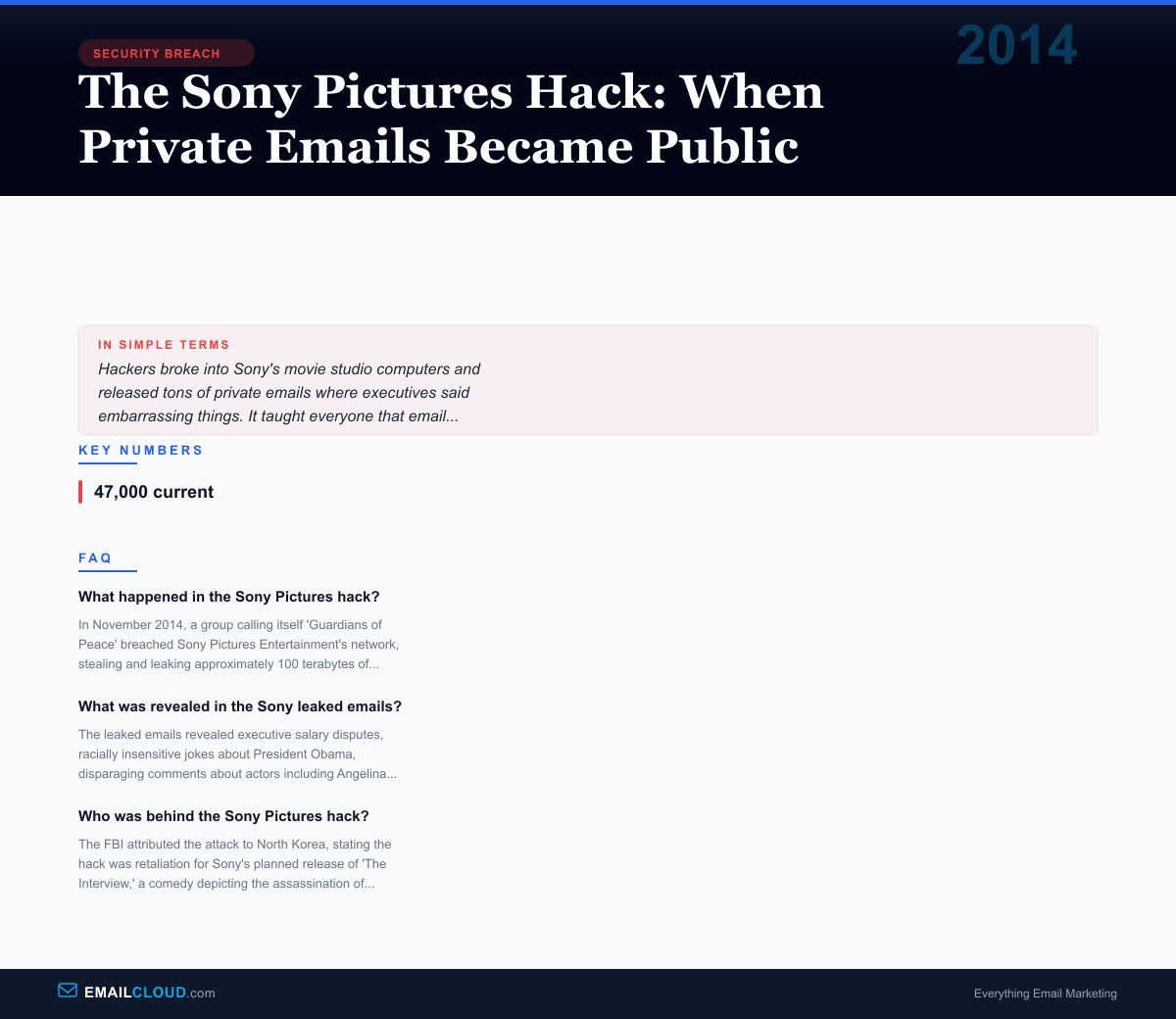
What happened in the Sony Pictures hack?
In November 2014, a group calling itself 'Guardians of Peace' breached Sony Pictures Entertainment's network, stealing and leaking approximately 100 terabytes of data including thousands of internal emails, unreleased films, financial records, and employee personal data.
What was revealed in the Sony leaked emails?
The leaked emails revealed executive salary disputes, racially insensitive jokes about President Obama, disparaging comments about actors including Angelina Jolie, confidential salary data showing gender pay gaps, and private negotiations over film deals.
Who was behind the Sony Pictures hack?
The FBI attributed the attack to North Korea, stating the hack was retaliation for Sony's planned release of 'The Interview,' a comedy depicting the assassination of North Korean leader Kim Jong-un. North Korea denied involvement.