2003: The Day AOL Accidentally Became the Biggest Spammer
There are few things more embarrassing than becoming the exact thing you’ve spent years crusading against. In 2003, AOL — the company that had positioned itself as the internet’s foremost spam fighter, the company that had filed lawsuit after lawsuit against spammers, the company whose CEO had called unsolicited email “the scourge of the internet” — accidentally blasted millions of its own subscribers with a torrent of duplicate promotional emails.
The fire department had set the fire. And the internet was not about to let them forget it.
AOL’s Anti-Spam Credentials
To understand why the incident was so spectacularly humiliating, you need to understand how central anti-spam crusading was to AOL’s identity in the early 2000s.
AOL’s user base — which peaked at roughly 26 million subscribers in 2002 — was overwhelmingly non-technical. These were people who used AOL’s walled-garden interface for their email, web browsing, and instant messaging. They didn’t understand spam filters, whitelists, or email headers. When their inboxes filled with pharmaceutical ads and Nigerian prince solicitations, they called AOL’s customer service line and demanded the company do something about it.
AOL responded aggressively. The company implemented increasingly sophisticated spam filters, blocking an estimated 75-80% of inbound spam before it reached subscriber inboxes. It filed dozens of lawsuits against known spammers, winning multimillion-dollar judgments. It lobbied Congress for anti-spam legislation and was a vocal supporter of what would become the CAN-SPAM Act of 2003.
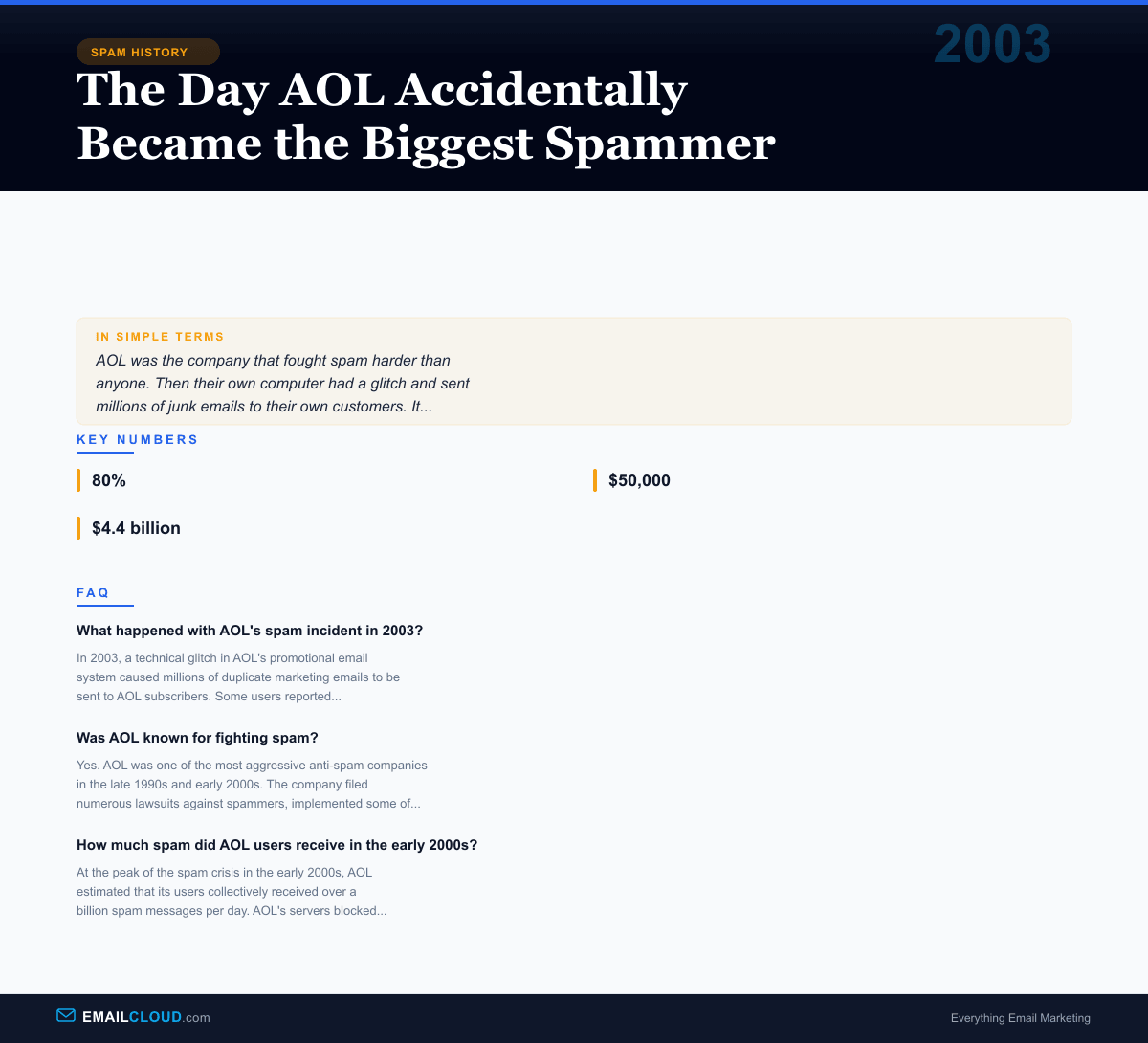
AOL even offered a $50,000 bounty for information leading to the conviction of spammers. The company wasn’t just fighting spam — it was building a brand identity around fighting spam. “AOL protects you from spam” was a selling point in an era when competing ISPs offered little spam protection.
The Glitch
The details of exactly what went wrong in 2003 vary depending on the source, but the broad strokes are consistent. AOL’s internal marketing team maintained systems for sending promotional emails to subscribers — notifications about new AOL features, service upgrades, partner offers, and other commercial messages. These were opt-in (or at least allegedly opt-in) communications from AOL itself, distinct from the third-party spam that AOL’s filters were designed to block.
A technical malfunction in the promotional email system caused messages to be duplicated and re-sent multiple times. Some subscribers reported receiving dozens of copies of the same promotional email. Others reported receiving hundreds. The volume was staggering — millions of duplicate messages flooding the inboxes of the very users AOL had promised to protect from exactly this kind of experience.
The problem compounded because AOL’s own spam filters were not configured to block email from AOL’s internal sending systems. Why would they be? AOL’s own promotional emails were, by definition, not spam — or at least, that was the theory before the system started replicating them uncontrollably.
The Irony Was Not Lost
The internet’s response was a mixture of outrage and glee. Tech journalists, who had covered AOL’s anti-spam efforts extensively, now had the delicious irony of writing about AOL spamming its own users. Forum posts, blog entries, and usenet threads mocked the situation mercilessly.
The incident highlighted an uncomfortable truth that the email industry was still grappling with: the line between “legitimate marketing email” and “spam” is often in the eye of the recipient. AOL’s promotional emails were technically opt-in. They were from a company the subscribers had a relationship with. They were promoting services and features that AOL believed were relevant. By most legal and industry definitions, they weren’t spam.
But when you receive 50 copies of the same email in a single day, the distinction between “legitimate marketing” and “spam” becomes academic. The experience was identical to being spammed, regardless of the sender’s intent or the technical classification of the messages.
The Broader Lesson
AOL’s accidental spam incident was a microcosm of a larger problem that email marketing would spend the next two decades navigating: volume control and sender responsibility.
The incident demonstrated that even well-intentioned senders with sophisticated systems could cause spam-like experiences through technical failures. It underscored the importance of sending infrastructure reliability, duplicate detection, and rate limiting — not just for fighting external spam, but for preventing internal systems from becoming spam sources.
More fundamentally, it illustrated that spam is defined by the recipient’s experience, not the sender’s intent. A promotional email isn’t automatically “not spam” just because it comes from a company you’ve done business with. If the volume is overwhelming, the content is irrelevant, or the experience is annoying, the recipient experiences it as spam — legal definitions notwithstanding.
AOL’s Decline
The spam incident was a footnote in a much larger story: AOL’s decline from internet gatekeeper to irrelevant brand. The company’s subscriber count peaked in 2002 and fell steadily as broadband internet eliminated the need for AOL’s dial-up service and walled-garden approach. By 2007, AOL had dropped from 26 million to 10 million subscribers. By 2015, AOL was acquired by Verizon for $4.4 billion — a fraction of its peak valuation.
AOL’s email service survived the company’s decline. AOL Mail continues to operate, and millions of users — many of them older Americans who created their addresses in the 1990s — still use aol.com email addresses. The addresses have become something of a generational marker, instantly dating their owners to the dial-up era.
The spam incident of 2003 didn’t cause AOL’s decline — that was driven by much larger market forces. But it captured, in a single embarrassing episode, the fundamental challenge that every email sender faces: maintaining the trust of the people in your inbox. AOL had built its reputation on protecting users from unwanted email. When its own systems violated that trust, even accidentally, the damage was both technical and reputational.
The lesson for every email marketer: you are always one glitch away from becoming the spammer you promised your subscribers you’d protect them from. Build your systems accordingly.
Infographic
Share this visual summary. Right-click to save.
Related Events
Frequently Asked Questions
What happened with AOL's spam incident in 2003?
In 2003, a technical glitch in AOL's promotional email system caused millions of duplicate marketing emails to be sent to AOL subscribers. Some users reported receiving dozens or even hundreds of copies of the same promotional message. The incident was deeply ironic given AOL's aggressive anti-spam reputation.
Was AOL known for fighting spam?
Yes. AOL was one of the most aggressive anti-spam companies in the late 1990s and early 2000s. The company filed numerous lawsuits against spammers, implemented some of the earliest spam filtering technology, and lobbied for anti-spam legislation. AOL's anti-spam stance made the accidental mass-emailing incident especially embarrassing.
How much spam did AOL users receive in the early 2000s?
At the peak of the spam crisis in the early 2000s, AOL estimated that its users collectively received over a billion spam messages per day. AOL's servers blocked an estimated 75-80% of inbound spam before it reached inboxes, but the remaining volume was still overwhelming for many users.