2000: How CAPTCHAs Were Invented to Fight Email Spam
Around the year 2000, the email spam problem collided with the free email account problem, and the collision produced one of the most recognizable (and most annoying) features of the modern internet: the CAPTCHA.
The story starts with a simple reality. Spammers need email accounts to send spam. Creating those accounts manually — typing in names, passwords, and personal information one at a time — is slow and expensive. Automating the process with bots is fast and free. By the late 1990s, spammers had written software that could create hundreds or thousands of free email accounts per hour at services like Yahoo Mail, Hotmail, and Excite Mail, then use those accounts to blast millions of spam messages before the accounts were shut down.
The email providers needed a way to tell whether a registration was being completed by a human or a bot. The solution they developed — a distorted text image that humans could read but computers couldn’t — would eventually be given the unwieldy name CAPTCHA and become one of the internet’s most ubiquitous security measures.
The Arms Race Begins
The earliest implementations of challenge-response tests for email registration appeared around 1997-2000. AltaVista, the search engine, is often credited with one of the first implementations, developed by Andrei Broder and colleagues. Their system presented users with a distorted image of text during account registration and required them to type the characters correctly. The distortion was designed to be easy for human visual processing but difficult for the optical character recognition (OCR) software available at the time.
Yahoo, facing an epidemic of bot-created accounts being used for spam, implemented similar challenges for Yahoo Mail registration. Hotmail (by then owned by Microsoft) followed. The pattern spread across free email providers, each implementing their own version of “prove you’re human.”
The term “CAPTCHA” itself — Completely Automated Public Turing test to tell Computers and Humans Apart — was coined in 2003 by Luis von Ahn, Manuel Blum, Nicholas Hopper, and John Langford at Carnegie Mellon University. The acronym was deliberately chosen as a play on “capture,” and the concept explicitly referenced Alan Turing’s famous test for machine intelligence, inverted: instead of a computer trying to prove it’s human, a human was proving it’s not a computer.
The Email Connection
The CAPTCHA’s origin story is inseparable from email spam. The primary use case that drove development wasn’t protecting online polls or preventing comment spam (those came later). It was stopping bots from creating fake email accounts.
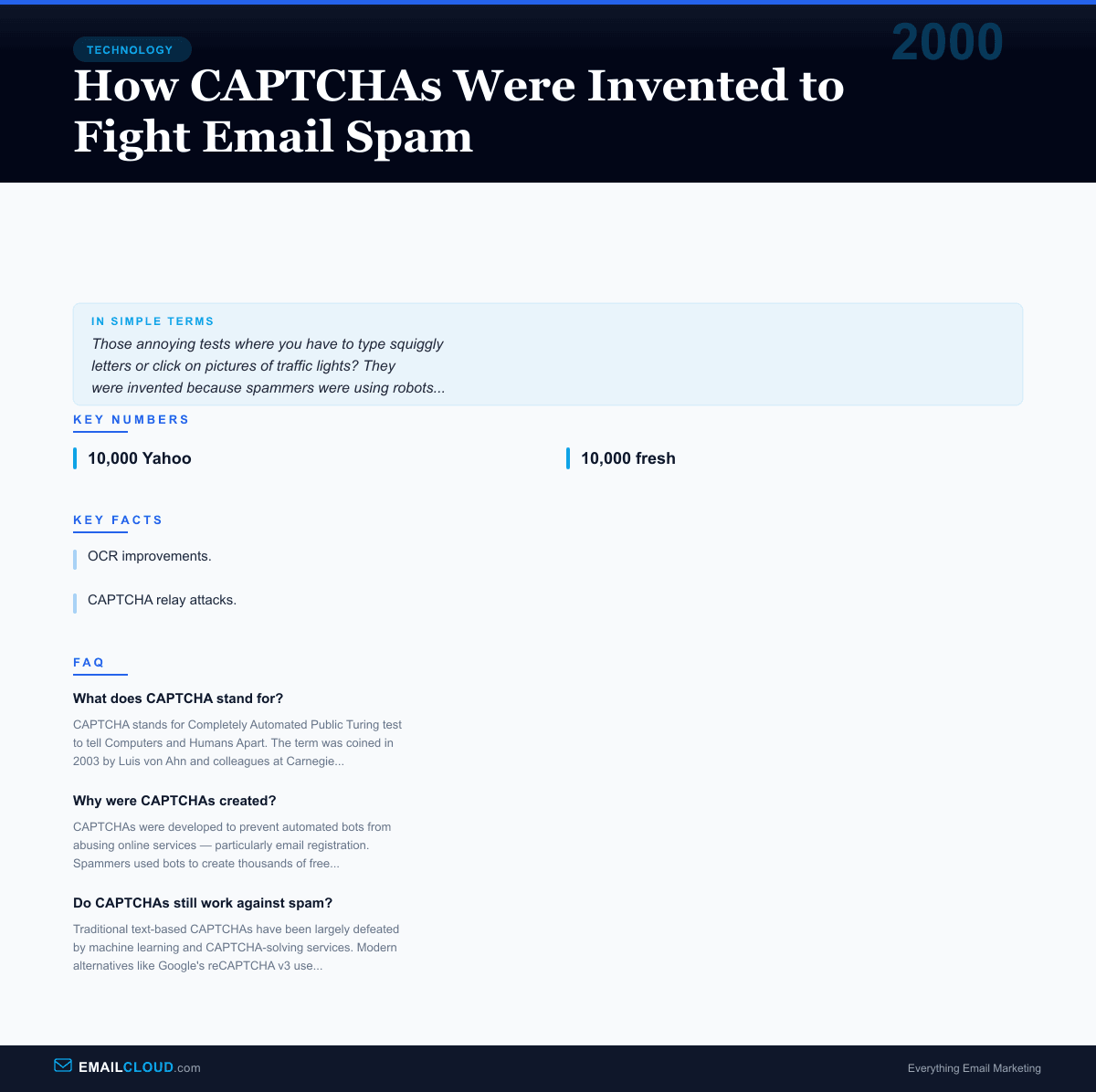
The economics were clear. A spammer who could create 10,000 Yahoo Mail accounts in a day had 10,000 fresh, unbanned sending addresses. Each account could send dozens or hundreds of messages before Yahoo detected the spam activity and shut it down. By then, the spammer had already moved on to the next batch of bot-created accounts.
CAPTCHAs broke this cycle by injecting a task that required human cognition into the account creation process. A bot could fill in a registration form in milliseconds, but it couldn’t read distorted text in an image. Suddenly, creating fake email accounts required human labor — or at least, software sophisticated enough to mimic human visual processing.
The immediate impact was significant. Email providers reported sharp drops in automated account creation after implementing CAPTCHAs. Spammers who had been creating accounts at industrial scale were forced to slow down dramatically.
The Counter-Evolution
Spammers are nothing if not adaptive. The CAPTCHA challenge spawned an entire ecosystem of counter-measures.
OCR improvements. Researchers (both academic and criminal) developed increasingly sophisticated optical character recognition software capable of reading distorted CAPTCHA text. As OCR improved, CAPTCHA designers added more distortion — warped letters, background noise, overlapping characters, color confusion. The visual quality of CAPTCHAs degraded steadily as designers prioritized bot-resistance over human readability.
CAPTCHA farms. Perhaps the most ingenious (and depressing) counter-measure was the CAPTCHA farm — operations in developing countries where workers were paid fractions of a cent to solve CAPTCHAs in real time. A bot would encounter a CAPTCHA, forward the image to a human worker, receive the solution within seconds, and continue the automated registration. This turned the CAPTCHA from a computer science problem into a labor arbitrage problem.
CAPTCHA relay attacks. Some spammers set up their own websites that displayed CAPTCHAs from email registration pages, tricked their own visitors into solving them, and used the solutions to complete automated registrations in real time.
Each escalation prompted a counter-escalation. CAPTCHAs got harder. Spammers got more creative. Legitimate users got more frustrated. The arms race had begun, and it continues to this day.
reCAPTCHA and the Pivot
In 2007, Luis von Ahn (the Carnegie Mellon researcher who had coined the CAPTCHA term) launched reCAPTCHA with an inspired twist. Instead of using randomly generated distorted text, reCAPTCHA displayed words from books that OCR software had failed to digitize. Users solving CAPTCHAs were simultaneously helping to digitize the world’s printed knowledge.
Google acquired reCAPTCHA in 2009 and expanded its application far beyond email registration. reCAPTCHA became the default CAPTCHA system for millions of websites. The system evolved from distorted text to image recognition challenges (“click all the images with traffic lights”) and eventually to invisible behavioral analysis (reCAPTCHA v3), which scores user behavior without requiring any explicit challenge.
The Legacy
CAPTCHAs were born from the email spam crisis and grew into a fundamental internet security mechanism. They protect not just email registration but login pages, comment sections, checkout processes, and virtually any online form vulnerable to automated abuse.
The relationship between CAPTCHAs and email remains important. Email providers still use CAPTCHA-like verification during account creation. Spam prevention still relies on distinguishing human users from bots. And the arms race that started with distorted text on Yahoo Mail registration pages has evolved into a sophisticated field of research spanning computer science, security, and usability.
Those annoying puzzles asking you to identify crosswalks and fire hydrants? They exist because, two decades ago, spammers figured out how to create fake email accounts faster than email providers could shut them down. The solution wasn’t elegant. It wasn’t fun. But it worked well enough to slow the flood — and it spawned a technology that now protects the entire internet, not just email.
Infographic
Share this visual summary. Right-click to save.
Related Events
Frequently Asked Questions
What does CAPTCHA stand for?
CAPTCHA stands for Completely Automated Public Turing test to tell Computers and Humans Apart. The term was coined in 2003 by Luis von Ahn and colleagues at Carnegie Mellon University, though similar challenge-response tests existed before the term was formalized.
Why were CAPTCHAs created?
CAPTCHAs were developed to prevent automated bots from abusing online services — particularly email registration. Spammers used bots to create thousands of free email accounts at services like Yahoo Mail and Hotmail, then used those accounts to send spam. CAPTCHAs forced registration to require human interaction.
Do CAPTCHAs still work against spam?
Traditional text-based CAPTCHAs have been largely defeated by machine learning and CAPTCHA-solving services. Modern alternatives like Google's reCAPTCHA v3 use behavioral analysis rather than explicit challenges. The arms race between CAPTCHA designers and bot operators continues.