2015: Email vs. Social Media: Why Owned Audience Always Wins
Every few years, someone declares that email is dead. They said it when Facebook launched. They said it when Twitter took off. They said it when Instagram became the dominant visual platform. They said it when TikTok captured the attention of an entire generation. And every time, they were wrong. Not just wrong in hindsight, but wrong in a way that reveals a fundamental misunderstanding of the difference between owned and rented audience.
The distinction between email and social media is not a matter of preference or generational habit. It is a structural difference in power, and it has been proven by two decades of platform upheaval that has left email standing while social networks have risen, peaked, declined, and sometimes disappeared entirely.
The Rented Audience Problem
When you build a following on a social media platform, you don’t own that audience. The platform does. You have been given permission — by the platform, revocable at any time — to post content that the platform’s algorithm may or may not show to the people who chose to follow you.
This distinction might seem academic when a platform is growing and your content is reaching people. It becomes painfully concrete when the platform changes its algorithm, shifts its business model, or simply declines in relevance.
Facebook’s organic reach collapse is the most instructive example. In the early 2010s, businesses and media organizations invested heavily in building Facebook Pages. They ran campaigns, spent advertising money, and directed their audiences to follow them on Facebook. At its peak, a Facebook Page post would organically reach a significant percentage of its followers — 15-20% was common.
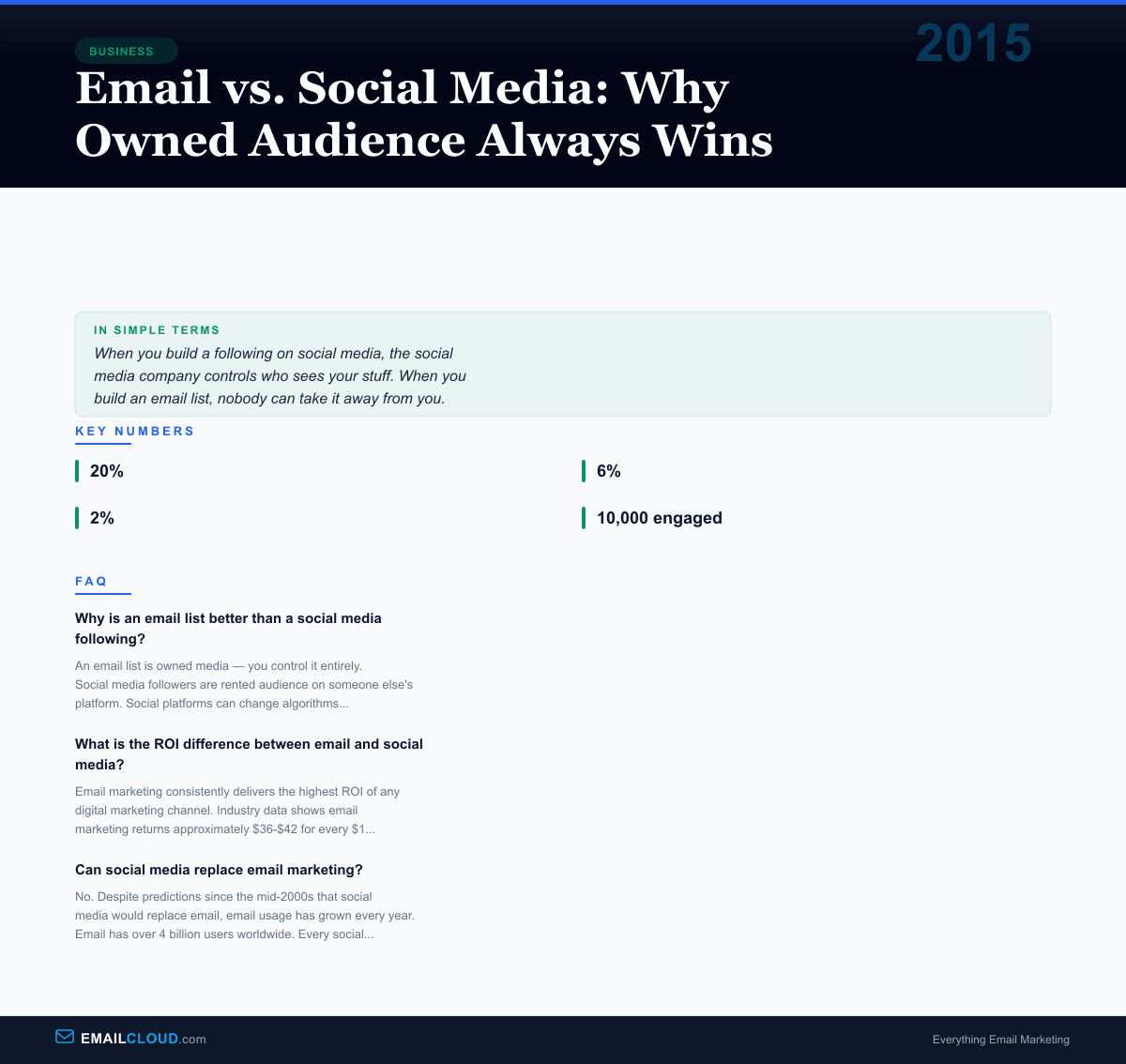
Then Facebook changed its algorithm. Organic reach dropped. And dropped. And dropped again. By 2014, organic reach for Facebook Pages had fallen to roughly 5-6%. By 2016, it was below 2% for most pages. Businesses that had invested years in building a Facebook following found that their posts were shown to a fraction of their audience — unless they paid to boost them.
The audience hadn’t left. The followers were still there. But Facebook had decided to show them less of your content and more of other things — paid advertising, posts from friends, and content from other pages. The platform had changed the terms of the relationship, and the businesses had no recourse.
The Email Guarantee
Email operates on fundamentally different terms. When someone gives you their email address and subscribes to your list, they have entered into a direct relationship with you. Their email address lives in your database, managed by your email service provider. No algorithm decides whether they see your next email — it goes to their inbox. Every time.
The delivery might land in the promotions tab rather than the primary inbox. Spam filters might occasionally interfere. But the structural guarantee is fundamentally different from social media: your email reaches the subscriber’s mailbox, and they decide whether to open it. No middleman is making that decision for them.
This guarantee has profound business implications. An email list of 10,000 engaged subscribers is more valuable than a social media following of 100,000, because the email list delivers consistent, direct access to every subscriber, while the social media following delivers algorithmically filtered access to a fraction of followers.
The Numbers
The data consistently supports email’s superiority as a marketing and engagement channel. Email marketing’s average ROI is approximately $36-$42 for every dollar spent, depending on the study and industry. This is the highest return of any digital marketing channel.
Email open rates for well-maintained lists typically range from 15-25%, with some niches significantly higher. Click-through rates average 2-5%. These numbers have remained relatively stable for years, even as social media engagement rates have declined.
Social media’s engagement rates, by contrast, have been falling steadily. Instagram engagement rates, once above 3%, have dropped below 1% for most accounts. Twitter/X engagement rates hover around 0.05% for tweets from accounts with large followings. TikTok’s engagement rates are higher but concentrated in the first hours after posting, and the platform’s algorithm is notoriously unpredictable.
Conversion rates tell an even clearer story. Email consistently converts at rates 3-5 times higher than social media. A subscriber who joined your email list has demonstrated a higher level of interest and commitment than someone who followed your social media account (which often requires just a single click with no intention of ongoing engagement).
The Platform Graveyard
The argument for email over social media is not just about current metrics — it’s about durability. Social media platforms are not permanent. They rise, they peak, they decline, and some disappear. Email has outlasted every social platform ever created.
MySpace was once the world’s largest social network. Its decline left businesses and musicians who had built their presence there with nothing. Google+ was a major social platform backed by the world’s most powerful technology company. It shut down entirely. Vine was enormous — then it was gone. Tumblr went from a vibrant community to a ghost town. Twitter’s acquisition by Elon Musk in 2022 triggered an exodus of users and advertisers, demonstrating how quickly a platform’s value could shift.
Every one of these platform disruptions left businesses, creators, and organizations scrambling. Those who had built their audience primarily on the disrupted platform lost access to that audience. Those who had used the platform to drive email sign-ups retained their direct relationship with their audience regardless of what happened to the platform.
The lesson has been repeated so many times that it should be self-evident, yet businesses continue to invest disproportionately in building social media followings while neglecting email list growth.
The Social Email Symbiosis
The smartest operators don’t choose between email and social media — they use social media to build their email list. Social platforms are excellent for discovery. Their viral mechanics, recommendation algorithms, and share features help content reach new audiences. But the goal of that discovery should be conversion to email: getting a social media follower to become an email subscriber.
This approach treats social media as a top-of-funnel acquisition channel and email as the bottom-of-funnel retention and monetization channel. Social media finds new people. Email keeps them and converts them.
The strategy is resilient because it doesn’t depend on any single social platform. If Instagram changes its algorithm, you’ve already converted your best followers to email subscribers. If TikTok gets banned (as has been repeatedly threatened), your audience is safe on your email list. Social platforms come and go; the email list endures.
The Counterarguments
Fairness requires acknowledging social media’s strengths. Social platforms offer discovery at a scale that email cannot match. A piece of content can go viral on TikTok or Twitter and reach millions of people overnight. Email has no equivalent viral mechanic — your email list grows one subscriber at a time.
Social media also offers community interaction in ways that email does not natively support. Comments, shares, discussions, and real-time conversation happen naturally on social platforms. Email is fundamentally a one-to-many broadcast medium (or one-to-one communication), not a community platform.
These are real advantages. But they do not change the fundamental power dynamic: social media reach is rented, and email reach is owned. When forced to choose where to invest limited resources, the businesses and creators who prioritize email consistently outperform those who prioritize social media over the long term.
The Verdict
The email vs. social media debate is not really a debate at all. It’s a misframing. The question is not which is better — both have roles. The question is which you should own, and the answer is unambiguous: build your email list. Use social media, enjoy social media, invest in social media — but always, always, convert social media attention into email subscribers. Because when the next platform disruption comes — and it will — your email list will still be there.
Infographic
Share this visual summary. Right-click to save.
Related Events
Frequently Asked Questions
Why is an email list better than a social media following?
An email list is owned media — you control it entirely. Social media followers are rented audience on someone else's platform. Social platforms can change algorithms (reducing your reach), ban your account, go out of business, or change their rules at any time. Your email list can't be taken away, and every subscriber opted in to hear from you.
What is the ROI difference between email and social media?
Email marketing consistently delivers the highest ROI of any digital marketing channel. Industry data shows email marketing returns approximately $36-$42 for every $1 spent, while social media advertising returns vary widely but typically range from $2-$5 per $1 spent. Email's advantage comes from its direct delivery, higher engagement rates, and lower cost per conversion.
Can social media replace email marketing?
No. Despite predictions since the mid-2000s that social media would replace email, email usage has grown every year. Email has over 4 billion users worldwide. Every social media account requires an email address to create. Email delivers consistently higher conversion rates, and unlike social media, email reach doesn't depend on algorithmic decisions made by platform companies.