2021: Mailchimp: From Side Project to $12 Billion Exit
On September 13, 2021, Intuit announced it was acquiring Mailchimp for approximately $12 billion. The deal was staggering on multiple levels. It was one of the largest all-cash technology acquisitions in history. It made Mailchimp’s co-founders, Ben Chestnut and Dan Kurzius, billionaires several times over. And it validated one of the most improbable success stories in the email industry: a bootstrapped side project, founded during the dot-com bust, that never took a dollar of venture capital and grew into the dominant email marketing platform in the world.
The Accidental Email Company
Mailchimp was not supposed to be an email company. In 2001, Chestnut and Kurzius were running a web design agency called Rocket Science Group. They built websites for small businesses — restaurants, shops, local service providers. Their clients kept asking for email newsletters, and building custom email sending solutions for each client was tedious and repetitive.
So they built a tool to make it easier. Mailchimp — named after a chimpanzee doodle that Chestnut had drawn for a rejected greeting card project — was a web-based application that let their design clients send email newsletters without custom development. It was a side project, a tool to support their real business.
But the side project kept growing. New customers found Mailchimp through search engines and word of mouth. The tool was simpler and cheaper than the enterprise email platforms that dominated the market (Constant Contact, ExactTarget, Responsys), and it appealed to small businesses and individuals who didn’t need (or couldn’t afford) enterprise features.
By 2007, Chestnut and Kurzius made a decision that defined Mailchimp’s trajectory: they shut down the web design agency and went all-in on email marketing. It was a bet on the product that their customers were actually willing to pay for.
The Freemium Revolution
Mailchimp’s defining strategic move came in September 2009, when the company launched its “Forever Free” plan. Users could send up to 12,000 emails per month to up to 2,000 subscribers, completely free. No trial period. No credit card required. Free forever.
The email marketing industry thought Chestnut and Kurzius had lost their minds. Giving away the core product seemed suicidal. Mailchimp’s competitors charged for every subscriber and every send. The idea that you could build a sustainable business by giving the basic product away was counterintuitive.
The results proved the skeptics wrong spectacularly. Before the free plan, Mailchimp had approximately 85,000 users. Within a year, that number exceeded 1 million. The free plan attracted a massive base of small businesses, bloggers, nonprofits, and creators who would never have paid for an email marketing tool at the outset. As their email lists grew beyond the free tier’s limits, they upgraded to paid plans. The freemium model created a self-sustaining growth engine.
The user growth also created a powerful network effect. As millions of recipients saw “Sent with Mailchimp” at the bottom of emails, the brand became ubiquitous. Mailchimp became synonymous with email marketing in the way that Google became synonymous with search.
The Brand
Mailchimp’s brand was another key differentiator. In an industry dominated by bland enterprise marketing, Mailchimp was playful, irreverent, and distinctly human. The mascot — Freddie, a winking chimpanzee in a postal worker’s hat — was instantly recognizable. The website copy was warm and funny. The high-five animation that appeared after sending a campaign became a beloved ritual.
This brand personality was strategic. Small business owners and creators — Mailchimp’s core audience — didn’t want an enterprise tool that made them feel small. They wanted a tool that felt approachable, friendly, and designed for people like them. Mailchimp’s brand communicated exactly that.
The company invested in cultural marketing that extended far beyond the email industry. Mailchimp sponsored the wildly popular “Serial” podcast in 2014, creating one of the most memorable podcast ad reads in history. The sponsorship introduced Mailchimp to millions of people who had never thought about email marketing, and the mispronunciation (“Mail…Kimp?”) became a cultural moment.
The Bootstrapping Philosophy
Perhaps the most remarkable aspect of Mailchimp’s story was what didn’t happen: venture capital. Throughout its twenty-year run as an independent company, Mailchimp never raised outside funding. No Series A. No growth round. No investors demanding hockey-stick growth or an IPO timeline.
This was a deliberate philosophical choice. Chestnut and Kurzius believed that outside investors would pressure them to optimize for growth at the expense of customer experience. They wanted to build a company that served small businesses well, grew sustainably, and remained profitable every year. Venture capital’s incentive structure — invest aggressively, grow at all costs, and achieve a massive exit — was incompatible with that vision.
The bootstrapping approach meant slower growth in the early years. It also meant that Chestnut and Kurzius retained 100% ownership. When the Intuit acquisition closed, they didn’t have to split the $12 billion with investors. The majority went to the two co-founders and was partially shared with employees through a distribution that reportedly gave thousands of Mailchimp employees significant payouts.
The Expansion (and the Controversy)
In the late 2010s, Mailchimp began expanding beyond email marketing. The company added landing pages, social media scheduling, postcards, website building, and CRM features. The vision was to become an all-in-one marketing platform for small businesses — not just email, but everything.
This expansion was not universally welcomed. Some users and industry observers felt that Mailchimp was losing focus — becoming a mediocre everything-platform instead of an excellent email platform. The interface, once clean and simple, became more complex. Pricing changes alienated some longtime customers.
The expansion also led to a high-profile conflict with Shopify. In 2019, Mailchimp ended its integration with Shopify, the largest e-commerce platform for small businesses, over a data-sharing dispute. The breakup forced thousands of merchants to choose between the two platforms and created an opening for competitors like Klaviyo, which built its business specifically around Shopify integration and e-commerce email marketing.
The Intuit Acquisition
Intuit’s $12 billion acquisition of Mailchimp was driven by strategic logic: Intuit’s QuickBooks served small businesses’ financial needs, and Mailchimp served their marketing needs. Combining them would create a more comprehensive platform for the small business market.
For Mailchimp, the acquisition ended two decades of independence. The brand, the product, and the team continued under Intuit’s ownership, but the scrappy, bootstrapped identity that had defined Mailchimp inevitably shifted. Price increases followed the acquisition. The free tier became less generous. The company became a division of a publicly traded enterprise software company.
Whether the Intuit acquisition was good for Mailchimp’s customers is debated. But the Mailchimp story — from web design side project to $12 billion exit without a dollar of outside investment — remains one of the most remarkable entrepreneurial journeys in the email industry. It proved that email marketing was not just a feature or a commodity but a market large enough to build one of the most valuable private technology companies in the world.
Infographic
Share this visual summary. Right-click to save.
Related Events
Frequently Asked Questions
How much did Intuit pay for Mailchimp?
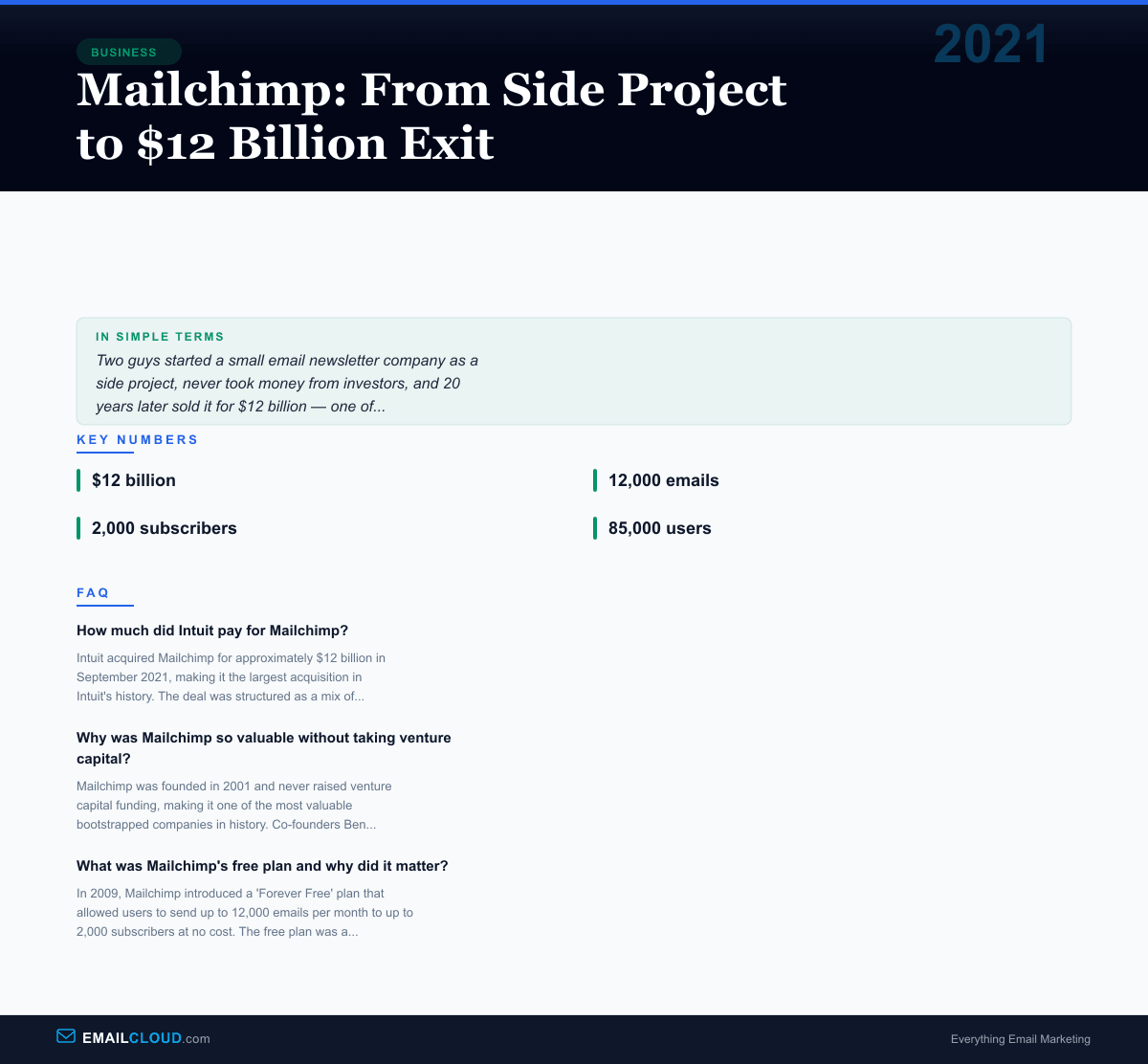
Intuit acquired Mailchimp for approximately $12 billion in September 2021, making it the largest acquisition in Intuit's history. The deal was structured as a mix of cash and stock — roughly $300 million in stock and the rest in cash. At the time, it was one of the largest all-cash technology acquisitions ever.
Why was Mailchimp so valuable without taking venture capital?
Mailchimp was founded in 2001 and never raised venture capital funding, making it one of the most valuable bootstrapped companies in history. Co-founders Ben Chestnut and Dan Kurzius owned the company entirely and grew it through profitability. By the time of the acquisition, Mailchimp had approximately $800 million in annual revenue and 13 million users.
What was Mailchimp's free plan and why did it matter?
In 2009, Mailchimp introduced a 'Forever Free' plan that allowed users to send up to 12,000 emails per month to up to 2,000 subscribers at no cost. The free plan was a growth engine that attracted millions of small businesses and creators who eventually upgraded to paid plans as their lists grew. It helped Mailchimp grow from 85,000 users to over 1 million within a year.