1986: From LISTSERV to Substack: The Evolution of One-to-Many Email
In 1986, a graduate student named Eric Thomas at the Ecole Centrale de Paris wrote a piece of software that would, in its quiet, unglamorous way, invent a media category worth billions. The software was called LISTSERV, and it automated something that had previously been done by hand: sending one email to many recipients at once.
The LISTSERV Era
Before LISTSERV, mailing lists existed on ARPANET, but they were managed manually. Someone (the “list owner”) maintained a list of email addresses and either sent messages to each one individually or used crude forwarding mechanisms. Adding subscribers, removing them, handling bounces — it was all manual labor.
Thomas’s LISTSERV ran on BITNET, the academic network that connected universities worldwide. It automated everything: subscription management (users could subscribe and unsubscribe by sending commands via email), message distribution, digest mode (receiving a daily compilation instead of individual messages), and archive access. It was, in essence, the first email platform.
LISTSERV proliferated rapidly across academia. By the early 1990s, there were thousands of LISTSERV lists on topics ranging from medieval literature to particle physics. The format established patterns that persist today: one central sender (or a moderated group), many recipients, the ability to opt in and opt out, and archived back issues.
Majordomo and the Open-Source Wave
LISTSERV was proprietary software. In 1992, Brent Chapman wrote Majordomo, an open-source alternative that ran on Unix systems. Majordomo (the name means “chief of the household” in Latin) lacked some of LISTSERV’s features but was free and ran on the rapidly growing internet rather than just BITNET.
Majordomo was followed by other open-source mailing list managers: GNU Mailman (first released in 1998 by John Viega, later maintained by Barry Warsaw) became the most popular, and remains in widespread use today. These tools democratized mailing lists beyond academia — anyone with a Unix server could run a mailing list on any topic.
The late 1990s saw an explosion of mailing lists on every conceivable subject. Technical communities ran lists for discussing programming languages and open-source projects. Hobby communities organized around interests from birdwatching to home brewing. Professional associations used lists for member communication. The mailing list was the internet’s first social medium — participatory, community-driven, and entirely email-based.
The First Commercial Newsletters
The idea of using email as a publishing medium — one-to-many, editorial-driven, on a regular schedule — emerged in the mid-1990s as the commercial internet took shape.
The Motley Fool, founded in 1993 by David and Tom Gardner, was among the earliest to use email newsletters as a core distribution strategy. Their investment advice emails built a loyal audience that eventually supported a media company valued at hundreds of millions of dollars. Similarly, Salon.com, TheStreet.com, and other early web publications used email newsletters to drive traffic and build reader loyalty.
These early newsletters were primitive by modern standards — plain text, manually assembled, sent through basic SMTP servers. But they established the fundamental value proposition that would drive the entire newsletter industry: email delivers content directly to an audience you own, without depending on a platform’s algorithm or distribution decisions.
The Platform Era: Mailchimp and Constant Contact
The early 2000s saw the rise of email marketing platforms that made newsletters accessible to anyone, not just technically sophisticated publishers. Constant Contact (founded 1998), Mailchimp (founded 2001), and AWeber (founded 1998) offered drag-and-drop email builders, subscriber management, analytics, and deliverability infrastructure — all through a web browser.
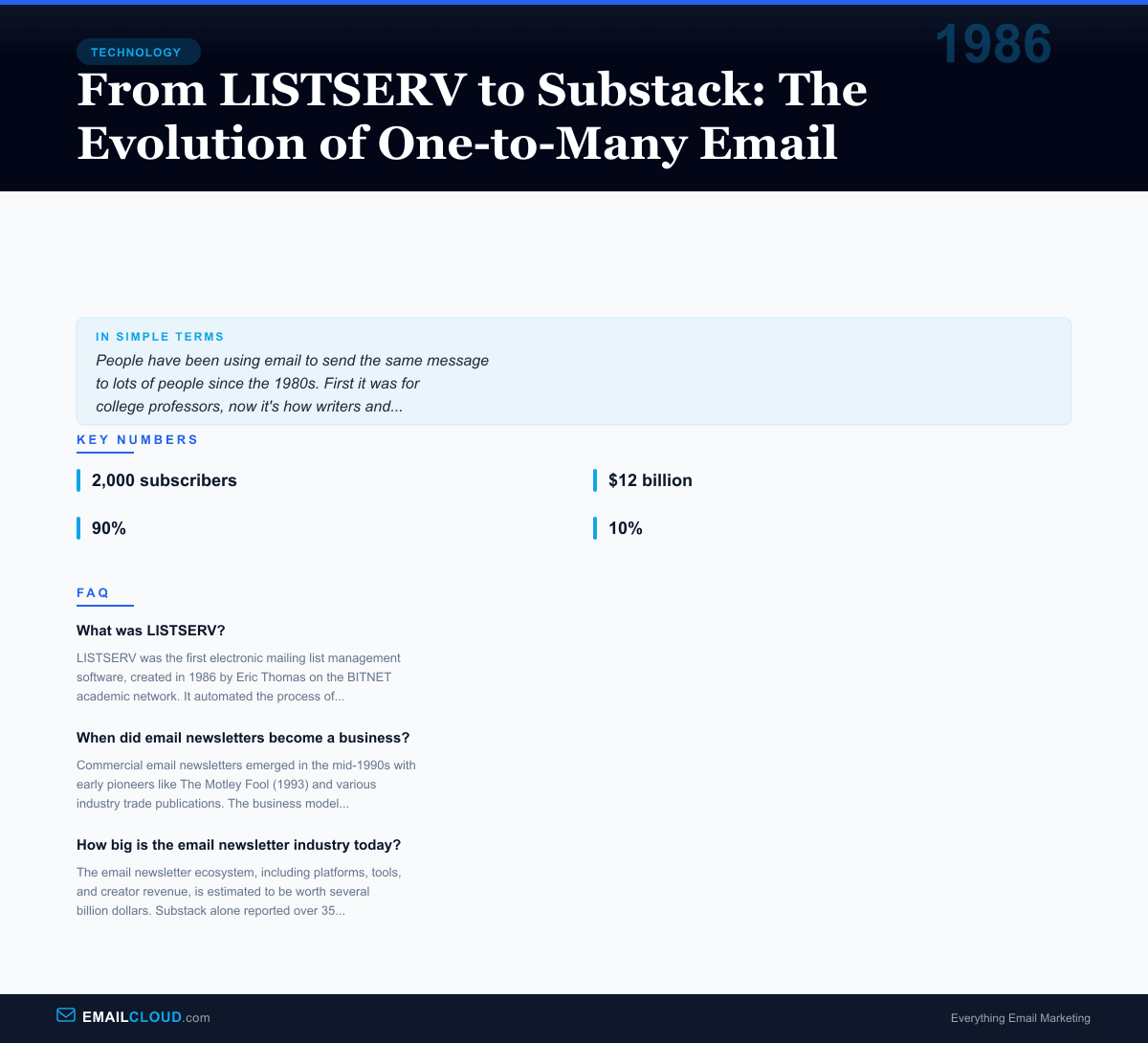
Mailchimp, in particular, democratized email newsletters with its 2009 introduction of a free tier (the “Forever Free” plan for up to 2,000 subscribers). Suddenly, a blogger, a local business, or a hobbyist with a passion project could run a professional-looking newsletter at zero cost. Mailchimp grew from a bootstrapped side project to a company that Intuit acquired for $12 billion in 2021 — the largest acquisition in Intuit’s history.
The Newsletter Renaissance
Two events in the 2010s set the stage for what would become the modern newsletter boom.
First, Google killed Google Reader in July 2013. Reader was the most popular RSS feed reader, used by millions to follow blogs and publications. Its death left a distribution vacuum — how would people keep up with their favorite writers? Email newsletters, which had never stopped working, filled the gap.
Second, social media platforms began aggressively throttling organic reach. Facebook’s news feed algorithm, in particular, made it progressively harder for publishers to reach their followers without paying for ads. Email, by contrast, offered direct delivery with no algorithmic intermediary. A subscriber was a subscriber — no platform could decide whether they saw your content.
These shifts created fertile ground for Substack.
Substack and the Creator Economy
In 2017, Chris Best, Hamish McKenzie, and Jairaj Sethi launched Substack with a simple proposition: writers should be able to start a paid email newsletter with zero upfront cost and minimal technical effort. Substack handled the publishing platform, payment processing, email delivery, and subscriber management. Writers kept 90% of subscription revenue (Substack took 10% plus payment processing fees).
The platform attracted early adopters from journalism, where layoffs and shrinking newsrooms had left many experienced writers looking for alternatives. When established journalists like Casey Newton, Matt Yglesias, and Emily Atkin moved their work to Substack, they proved that individual writers could build sustainable businesses through email alone.
By 2024, Substack reported over 35 million active subscriptions and more than 2 million active publications. Top writers were earning seven figures annually from paid subscribers alone. The model spawned competitors: Ghost, Beehiiv, ConvertKit (now Kit), and Buttondown all offered variations on the newsletter-as-business platform.
The Full Circle
The journey from LISTSERV to Substack spans nearly four decades, but the core mechanic hasn’t changed. One person (or a small team) writes something. They send it via email to people who asked to receive it. The recipients read it in their inbox. No algorithm decides who sees it. No platform owns the relationship between writer and reader.
What changed is the business model. LISTSERV lists were free and community-driven. Early newsletters were advertising-supported. Modern newsletter platforms enable direct reader payment, turning email from a distribution channel into a revenue channel.
Email’s endurance as a publishing medium is, in retrospect, obvious. It’s the only digital communication channel where the creator maintains a direct, portable, platform-independent connection to their audience. Social media followers belong to the platform. Email subscribers belong to the creator. In an era of algorithmic uncertainty and platform risk, that ownership is worth everything.
Infographic
Share this visual summary. Right-click to save.
Related Events
Frequently Asked Questions
What was LISTSERV?
LISTSERV was the first electronic mailing list management software, created in 1986 by Eric Thomas on the BITNET academic network. It automated the process of managing subscriber lists and distributing messages to groups, pioneering the concept of one-to-many email distribution.
When did email newsletters become a business?
Commercial email newsletters emerged in the mid-1990s with early pioneers like The Motley Fool (1993) and various industry trade publications. The business model matured through the 2010s with platforms like Mailchimp and exploded in the late 2010s with Substack and similar creator platforms.
How big is the email newsletter industry today?
The email newsletter ecosystem, including platforms, tools, and creator revenue, is estimated to be worth several billion dollars. Substack alone reported over 35 million active subscriptions as of 2024, with top writers earning millions annually from paid subscribers.