1970: Spam the Meat vs Spam the Email: Yes, Hormel Has a Museum
In Austin, Minnesota — population 25,000, two hours south of Minneapolis — there is a museum dedicated entirely to canned meat. The SPAM Museum, operated by Hormel Foods, celebrates the history of the brand that has been feeding the world since 1937. Inside, you can learn about SPAM’s role in World War II (it fed Allied troops across the Pacific), its enduring popularity in Hawaii and South Korea (where SPAM gift sets are exchanged during holidays), and its status as one of the most recognizable food brands on the planet.
What the museum handles with somewhat less enthusiasm is the question that every visitor eventually asks: “So… is this why junk email is called spam?”
The answer involves a British comedy troupe, a group of Viking actors, the early internet, and one of the strangest naming accidents in technology history.
The Monty Python Connection
On December 15, 1970, the BBC aired episode 25 of Monty Python’s Flying Circus, featuring a sketch set in a cafe. A couple enters and asks the waitress what’s on the menu. Every item includes SPAM: egg and SPAM, egg bacon and SPAM, SPAM SPAM SPAM egg and SPAM. A group of Vikings in the corner periodically break into song: “SPAM SPAM SPAM SPAM, lovely SPAM, wonderful SPAM…”
The sketch escalates. The wife protests that she doesn’t like SPAM. The Vikings sing louder. The waitress lists more SPAM options. The Vikings drown out all conversation with their SPAM chorus. The sketch’s humor lies in the inescapable, overwhelming repetition of a single word — SPAM is everywhere, in everything, impossible to avoid, drowning out all meaningful communication.
Twenty years later, the earliest internet users would find this description uncomfortably accurate for a very different phenomenon.
From MUDs to Email
The connection between Monty Python’s SPAM and unwanted electronic messages was forged in the text-based virtual worlds of the late 1980s and early 1990s. MUDs (Multi-User Dungeons) and early internet chat rooms had a persistent problem: users who flooded chat with repetitive, unwanted messages, drowning out legitimate conversation.
These message floods were called “spamming” — a direct reference to the Monty Python sketch. Just as the Vikings’ SPAM chanting drowned out the cafe conversation, the repetitive messages drowned out chat room discussion. The term was perfect: it captured the repetitive, overwhelming, unwanted nature of the behavior in a single culturally resonant word.
As unsolicited email became a problem in the mid-1990s, the term migrated naturally. Mass junk email shared the essential characteristic of chat spam: it was repetitive, unwanted, and it drowned out legitimate messages. By 1996-1997, “spam” was the universally understood term for unsolicited commercial email. No one ever proposed an alternative that stuck. The word was too perfect.
Hormel’s Reaction
Hormel Foods, the maker of SPAM luncheon meat, watched this linguistic evolution with increasing alarm. Their beloved brand name — a trademark registered since 1937, a product consumed in over 40 countries — was being associated with one of the most annoying aspects of internet life.
The company’s initial response was protective. Hormel sent cease-and-desist letters to software companies and websites that used “SPAM” (in all caps) to refer to junk email. They argued that using their trademark in connection with something universally reviled was damaging to the brand.
But language is a force that even trademark lawyers can’t contain. By the early 2000s, “spam” (lowercase) as a synonym for junk email was so deeply embedded in global vocabulary that fighting it was like trying to hold back the tide. The word appeared in legislation (the CAN-SPAM Act of 2003), in technical standards, in dictionaries, and in everyday conversation.
Hormel eventually adopted a more pragmatic stance. The company’s official position, published on their website, draws a clear typographical distinction: SPAM (uppercase) is the trademarked canned meat product. spam (lowercase) is junk email. Hormel asks media outlets, publications, and tech companies to respect the capitalization difference, and most do.
“We do not object to use of this slang term to describe unsolicited commercial email,” Hormel’s statement reads, “but we do ask that our trademark be respected by always using ‘SPAM’ in uppercase and lower case ‘spam’ to refer to unwanted email.”
The Museum’s Take
The SPAM Museum in Austin, Minnesota handles the email connection with good humor. Exhibits acknowledge the Monty Python sketch and its influence on internet terminology. Visitors can find nods to the email association throughout the museum, treated with the self-deprecating wit of a company that has accepted its unusual linguistic legacy.
The museum itself is a substantial attraction. It covers SPAM’s 1937 introduction (originally “Hormel Spiced Ham,” shortened to SPAM through a naming contest), its critical role as a protein source for Allied troops in World War II (over 150 million pounds shipped overseas), and its post-war cultural status in countries like South Korea, the Philippines, and Hawaii, where SPAM remains a genuinely beloved food item.
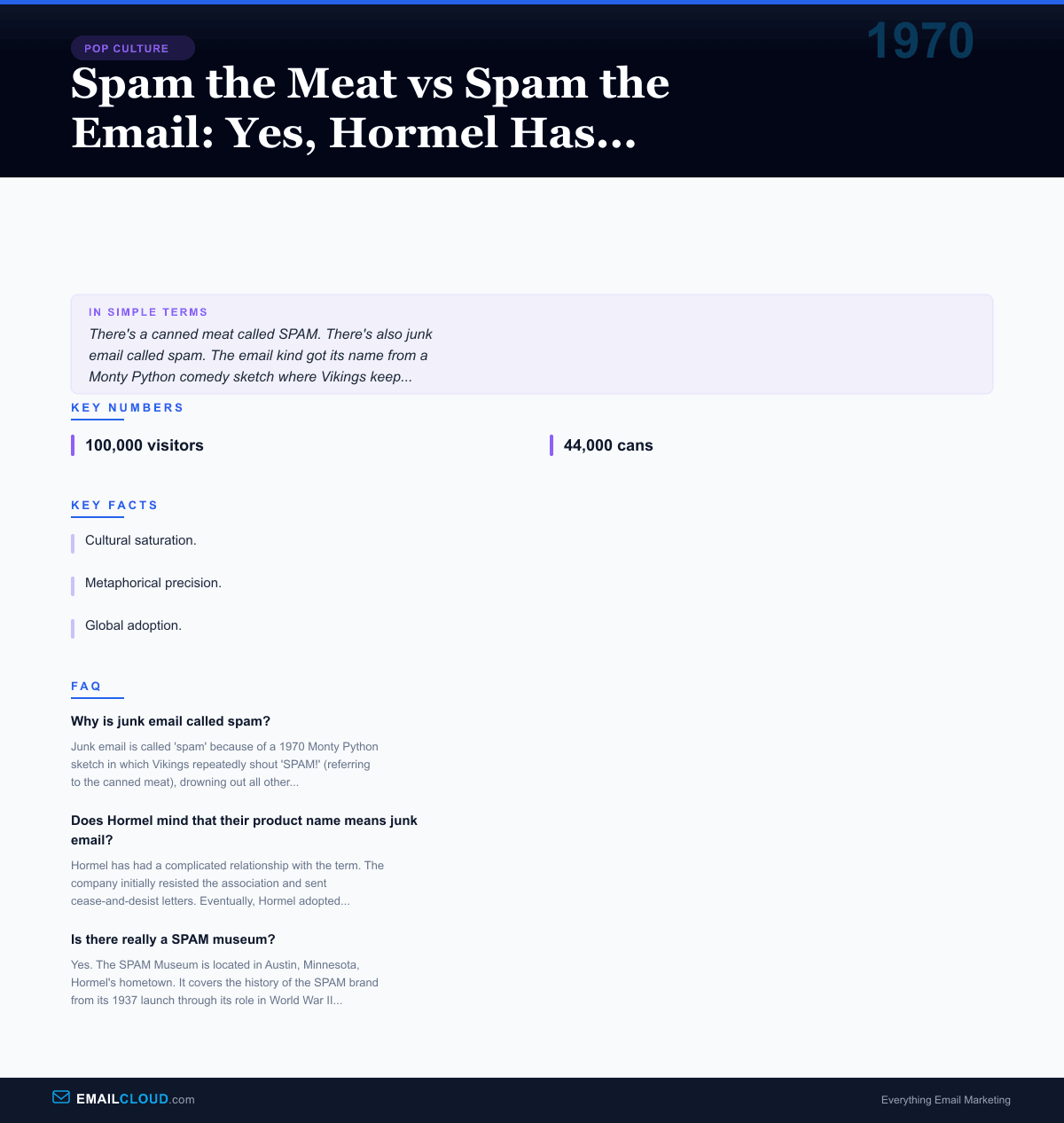
The museum draws an estimated 100,000 visitors per year — some for the nostalgia, some for the kitsch factor, and more than a few because they googled “spam” and were surprised to discover it was meat first.
Why the Name Stuck
The linguistic takeover of “spam” by the email world is a fascinating case study in how language evolves. Several factors made the connection permanent.
Cultural saturation. Monty Python had a huge following among the early internet’s user base — primarily engineers, programmers, and academics in the 1980s and early 1990s. Monty Python references were common in early internet culture (the programming language Python was named after the troupe). The SPAM sketch was among the group’s most well-known bits.
Metaphorical precision. The sketch captured the essential quality of junk email so perfectly that no alternative term could compete. “Spam” communicated repetition, unwantedness, and overwhelming volume in a single syllable. “Unsolicited commercial email” or “junk mail” were accurate but lacked the visceral punch.
Global adoption. The term crossed language barriers remarkably well. “Spam” as junk email is understood in dozens of languages worldwide, often used as a loanword even when the Monty Python reference is unknown to the speaker.
The result is one of the strangest brand stories in corporate history. A company that has been selling canned meat since 1937 now shares its name with one of the internet’s most persistent problems — not because of any connection between the product and the practice, but because a group of British comedians dressed as Vikings couldn’t stop singing about it.
Hormel sells approximately 44,000 cans of SPAM every hour. The internet sends approximately 15 billion spam emails every hour. Both meanings of the word are thriving. Neither is going anywhere.
Infographic
Share this visual summary. Right-click to save.
Related Events
Frequently Asked Questions
Why is junk email called spam?
Junk email is called 'spam' because of a 1970 Monty Python sketch in which Vikings repeatedly shout 'SPAM!' (referring to the canned meat), drowning out all other conversation. Early internet users applied the term to repetitive, unwanted messages that drowned out legitimate communication — first in chat rooms and MUDs, then in email.
Does Hormel mind that their product name means junk email?
Hormel has had a complicated relationship with the term. The company initially resisted the association and sent cease-and-desist letters. Eventually, Hormel adopted a pragmatic position: SPAM (all caps) is their trademarked meat product; spam (lowercase) is junk email. They ask that media and publications respect the capitalization distinction.
Is there really a SPAM museum?
Yes. The SPAM Museum is located in Austin, Minnesota, Hormel's hometown. It covers the history of the SPAM brand from its 1937 launch through its role in World War II and its cultural impact. The museum acknowledges the email connection with self-deprecating humor.