1971: The First Email Ever Sent
In late 1971, in a quiet office at Bolt Beranek and Newman (BBN) in Cambridge, Massachusetts, a programmer named Ray Tomlinson typed a short string of characters into a computer terminal and hit send. The message traveled from one DEC PDP-10 computer to another PDP-10 sitting literally right next to it. The content? Something utterly forgettable — Tomlinson himself later admitted it was probably “QWERTYUIOP” or a similarly meaningless test string. But that forgettable message became the most consequential piece of digital communication in history.
The Problem Tomlinson Was Solving
Before Tomlinson’s breakthrough, electronic messaging already existed — sort of. Users on the same computer could leave messages for each other using a program called SNDMSG, which basically appended text to a file that another user could read. Think of it as a shared notebook that lived on one machine. If you and your colleague both had accounts on the same PDP-10, you could swap messages. But if your colleague was on a different computer? Tough luck.
Tomlinson was working on ARPANET, the U.S. Department of Defense’s experimental network connecting research computers across the country. He had already written a file transfer protocol called CPYNET that could move files between machines. One day, he had the insight that would change everything: what if he combined SNDMSG’s messaging ability with CPYNET’s machine-to-machine transfer?
The result was a modified version of SNDMSG that could send messages not just to users on the same computer, but to users on any computer on the network.
The @ Sign: A Stroke of Genius
There was one practical problem to solve. If you could now send messages to users on other machines, you needed a way to specify which machine they were on. Tomlinson needed a separator — a character that would sit between the user’s name and the computer’s name, something that would never appear in a person’s name.
He looked at his Model 33 Teletype keyboard and spotted the @ symbol. It was perfect. Rarely used in programming, it already carried the meaning of “at” in common English. user@computer. Simple. Obvious. Elegant.
That single character choice has proven remarkably durable. More than five decades later, every one of the estimated 4.5 billion email addresses in the world uses Tomlinson’s @ symbol exactly as he intended it.
The Reaction (Or Lack Thereof)
Tomlinson showed his work to his colleague Jerry Burchfiel, telling him, “Don’t tell anyone. This isn’t what we’re supposed to be working on.” BBN had government contracts for ARPANET development, and personal messaging wasn’t exactly on the deliverables list.
But the genie was out of the bottle. Within two years, a study by ARPA found that 75% of all ARPANET traffic was email. The network that had been built to share computing resources and scientific data was being used primarily for people to talk to each other. The killer app of the internet wasn’t computation — it was conversation.
Why It Matters
Tomlinson’s invention wasn’t just a technical achievement. It was a fundamental shift in human communication. For the first time in history, a person could send a written message to another person and have it arrive in seconds rather than days — without requiring both people to be present at the same time (like a phone call) or at the same place (like a conversation).
Email combined the permanence and thoughtfulness of written letters with the speed of telephone calls, and it added a new superpower: asynchronous communication. You send when it’s convenient for you. The recipient reads when it’s convenient for them. That simple concept underpins how the modern world works.
Today, more than 350 billion emails are sent every single day. Email generates an estimated $36 in revenue for every $1 spent on email marketing — making it the highest-ROI channel in digital marketing. Entire industries, from e-commerce to SaaS to media, run on the protocol that Tomlinson cobbled together from two existing programs on a pair of side-by-side computers.
Ray Tomlinson continued working at BBN (later Raytheon BBN Technologies) for the rest of his career. He received the Webby Award, the Internet Hall of Fame induction, and numerous other honors. He passed away on March 5, 2016, at age 74. He remained characteristically modest about his invention, once telling a reporter, “I’m often asked if I had any idea what I was unleashing on the world. The answer is no.”
The first email was meaningless. Every email since has proven the opposite.
If you’re sending emails today that need to actually reach the inbox, make sure your technical foundations are solid. Check your setup with our free Spam Word Checker to ensure your messages don’t end up in junk folders — something Tomlinson never had to worry about.
Infographic
Share this visual summary. Right-click to save.
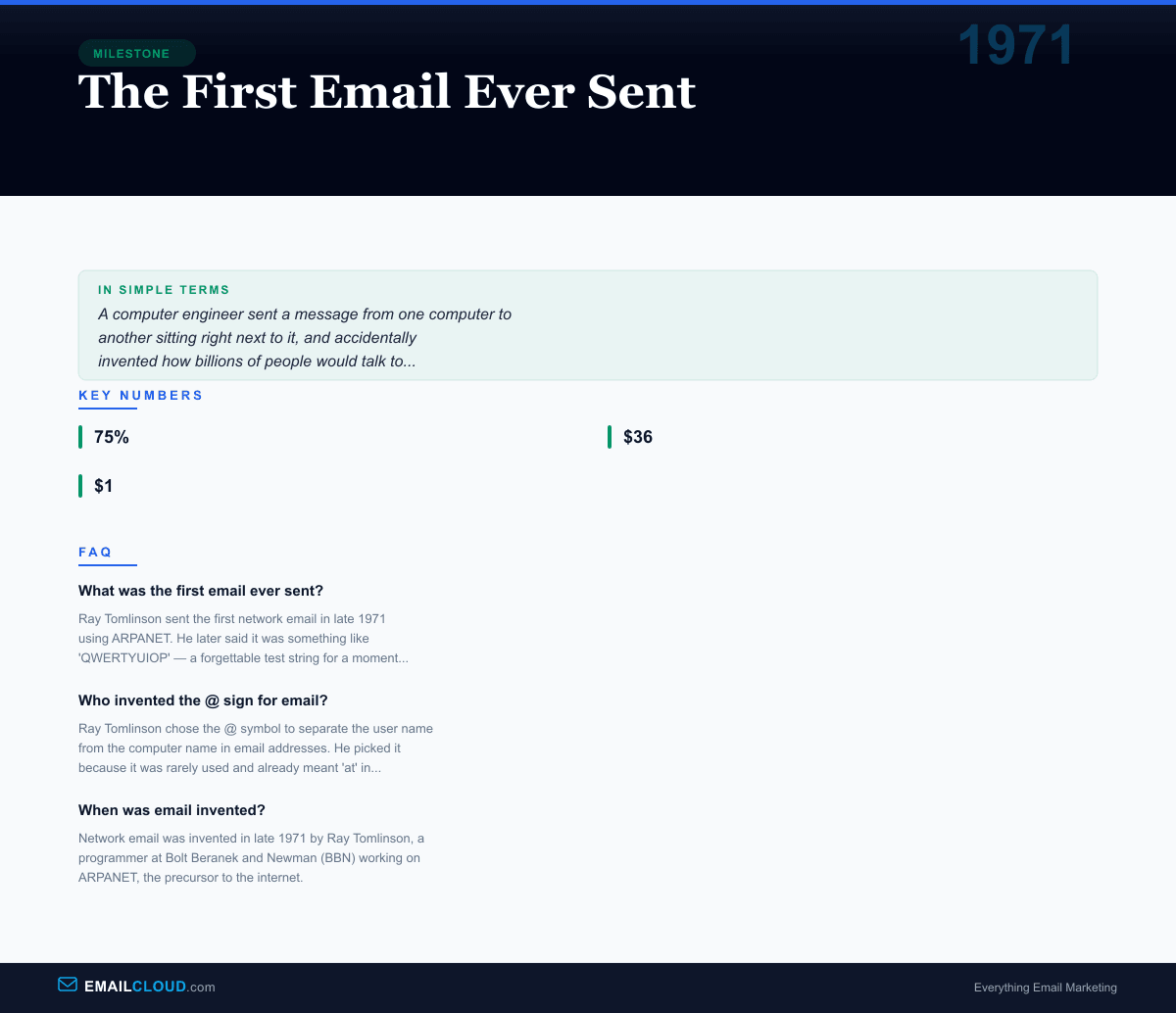
Related Events
Frequently Asked Questions
What was the first email ever sent?
Ray Tomlinson sent the first network email in late 1971 using ARPANET. He later said it was something like 'QWERTYUIOP' — a forgettable test string for a moment that would reshape global communication.
Who invented the @ sign for email?
Ray Tomlinson chose the @ symbol to separate the user name from the computer name in email addresses. He picked it because it was rarely used and already meant 'at' in common English.
When was email invented?
Network email was invented in late 1971 by Ray Tomlinson, a programmer at Bolt Beranek and Newman (BBN) working on ARPANET, the precursor to the internet.