1978: The First Spam Email That Made $13 Million
On May 3, 1978, a Digital Equipment Corporation marketing manager named Gary Thuerk sat at a terminal and did something no one had done before: he sent a single email to roughly 400 people on ARPANET, none of whom had asked to hear from him. That email — clunky, badly formatted, and thoroughly unwelcome — generated an estimated $13 million in computer sales and gave birth to the most persistent nuisance in digital history: spam.
The Email That Started It All
Thuerk wanted to promote DEC’s new DECSYSTEM-2020, 2020T, 2060, and 2060T computers to the ARPANET community on the West Coast. Rather than contact potential buyers one by one, he had an idea that seemed brilliantly efficient at the time: why not just email all of them at once?
The email itself was a masterpiece of awkwardness. Thuerk’s assistant, Carl Gartley, crammed all the recipient addresses into the header, which was so long it broke the formatting. The message spilled addresses into the body text. The actual pitch invited recipients to product demonstrations in Los Angeles and San Mateo. It read less like a polished sales letter and more like a confused memo — but it worked.
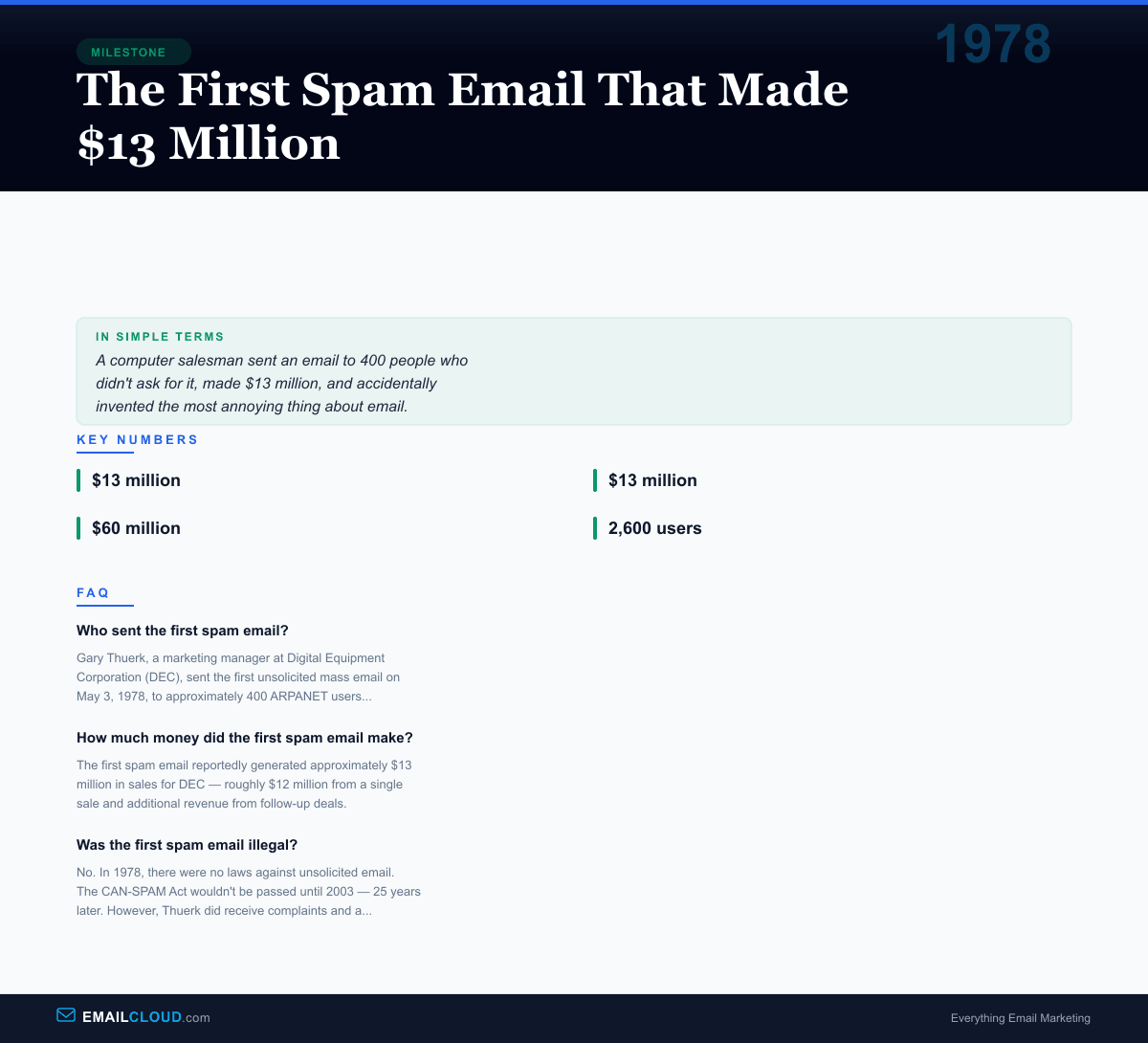
The result? DEC reportedly sold $13 million worth of computers, largely from a single massive sale directly attributed to the email campaign. In 1978 dollars, that was a staggering sum. Adjusted for inflation, it would be over $60 million today.
The Backlash
The reaction from the ARPANET community was swift and furious. ARPANET was a government-funded research network, and its acceptable use policies explicitly prohibited commercial activity. Major Richard Liebhaber, the head of ARPANET’s management at the Defense Communications Agency, sent Thuerk a stern reprimand, making it clear that this kind of mass mailing was a violation of network guidelines.
Users who received the email were outraged. Remember, in 1978, the ARPANET community was small — perhaps 2,600 users total — and mostly composed of researchers, engineers, and military personnel. Email was their carefully maintained professional communication tool. Thuerk’s blast felt like someone had burst into a library with a megaphone.
Despite the backlash, no formal punishment was ever imposed. There were no laws to break, no regulations to cite. The most Thuerk got was a scolding and a request not to do it again.
The Term “Spam” Came Later
Thuerk’s email wouldn’t be called “spam” for another decade and a half. The term was popularized in the early 1990s, borrowed from a 1970 Monty Python sketch where a group of Vikings in a restaurant drown out all conversation by chanting “Spam, spam, spam, spam…” over and over. Early internet users saw the parallel: unsolicited bulk messages drowning out legitimate communication, just like the Vikings drowned out everything else.
The first recorded use of “spam” to describe unwanted messages appeared on Usenet in the early 1990s. By the mid-1990s, when the commercial internet was booming, the term was firmly established.
The Dam Breaks
Through the 1980s, unsolicited email remained rare — ARPANET’s community was too small and its norms too strong. But when the internet opened to commercial use in the early 1990s, the floodgates opened. By 1996, spam was a serious problem. By 2004, it accounted for roughly 80% of all email traffic worldwide. At its peak around 2008-2012, spam represented over 90% of all email sent globally — hundreds of billions of messages per day.
The economics were irresistible. Sending email was essentially free. Even if only one in a million recipients responded, the sender still made money. Thuerk had proven the fundamental equation in 1978: the cost of reaching an audience via email is so close to zero that even tiny conversion rates produce enormous returns.
Why It Matters
Gary Thuerk’s email established a tension that still defines email marketing today: the incredible effectiveness of reaching people’s inboxes versus the responsibility not to abuse that access. Every email marketer alive operates in the space between Thuerk’s $13 million success and the angry replies he received.
That tension led directly to the CAN-SPAM Act of 2003, GDPR in 2018, and the ever-evolving authentication standards that modern email marketers must follow. It’s why deliverability is now a profession unto itself, why spam filters use sophisticated algorithms, and why legitimate senders spend enormous effort ensuring their messages don’t get lumped in with the junk.
Thuerk, for his part, has leaned into his legacy. He’s embraced the title “Father of Spam” and has appeared at marketing conferences telling his story. He’s never apologized for the email, and frankly, with $13 million in results, it’s hard to argue with the outcome — even if the method created decades of headaches for everyone else.
Today, if you’re sending marketing emails, you can learn from Thuerk’s results without repeating his mistakes. Run your copy through our Spam Word Checker to make sure your language doesn’t trigger modern spam filters — filters that exist, in large part, because of what Gary Thuerk started in May 1978.
Infographic
Share this visual summary. Right-click to save.
Related Events
Frequently Asked Questions
Who sent the first spam email?
Gary Thuerk, a marketing manager at Digital Equipment Corporation (DEC), sent the first unsolicited mass email on May 3, 1978, to approximately 400 ARPANET users promoting DEC's new VAX computer systems.
How much money did the first spam email make?
The first spam email reportedly generated approximately $13 million in sales for DEC — roughly $12 million from a single sale and additional revenue from follow-up deals.
Was the first spam email illegal?
No. In 1978, there were no laws against unsolicited email. The CAN-SPAM Act wouldn't be passed until 2003 — 25 years later. However, Thuerk did receive complaints and a warning from ARPANET administrators.