1993: AOL Brings Email to the Masses
There’s a sound that an entire generation of Americans associates with the thrill of connection: a cheerful male voice announcing, “You’ve got mail!” For millions of people in the 1990s, that phrase — delivered through a screeching dial-up modem connection — was their very first experience with email. And the company behind it, America Online, did more to bring email to ordinary people than any technology company before or since.
From Geeks to Grandparents
Before AOL’s intervention, email was the province of university researchers, government employees, and corporate workers whose companies ran internal email systems. Using email required access to a Unix terminal or a corporate network, knowledge of arcane commands, and a tolerance for text-only interfaces. The average American in 1990 had never sent an email and had no idea how to start.
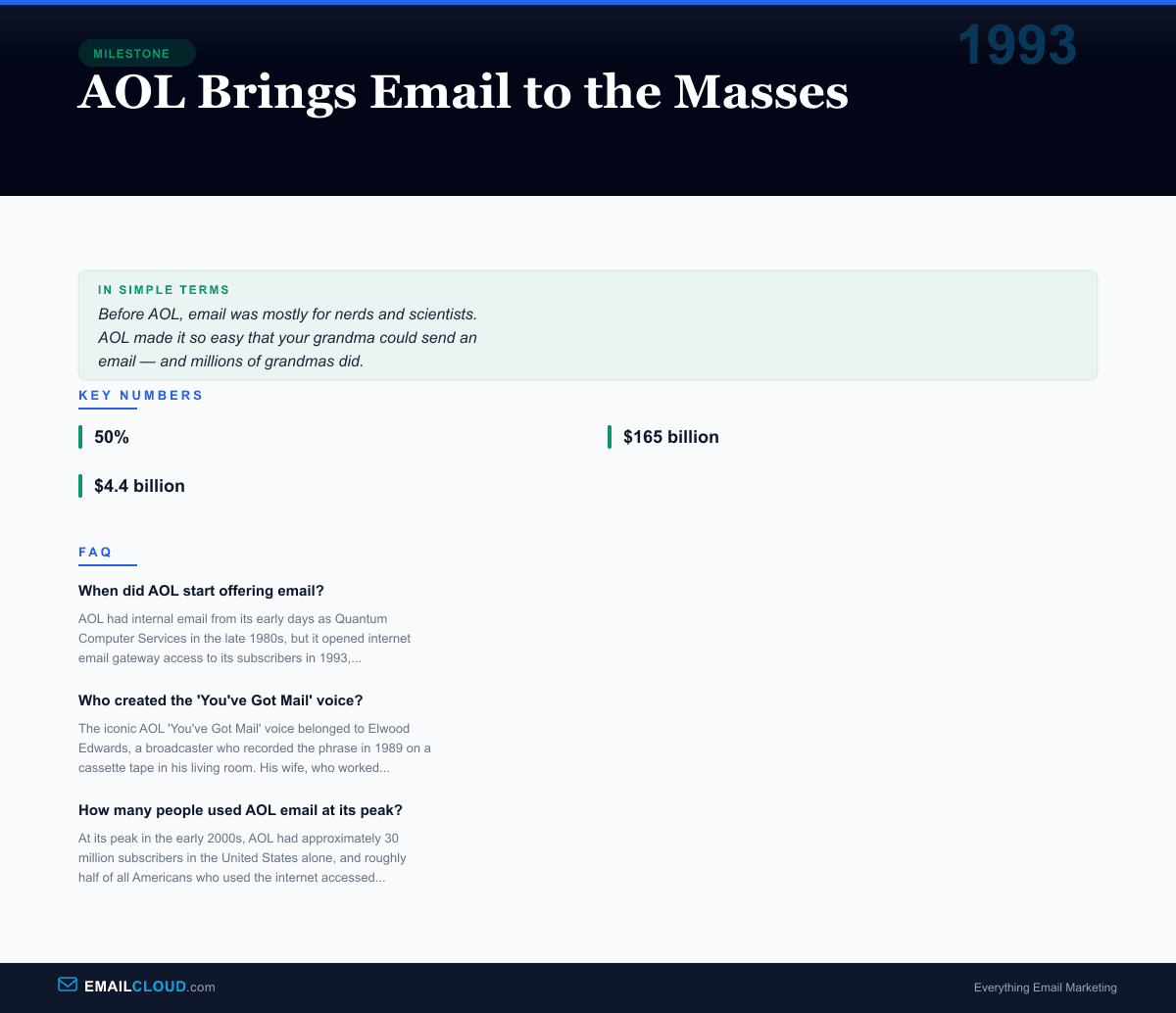
AOL changed that equation entirely. Founded as Control Video Corporation in 1983 and rebranded as America Online in 1991, the company’s genius wasn’t technical — it was commercial. AOL carpet-bombed America with free trial disks. By some estimates, AOL produced and distributed over 1 billion CD-ROMs during the 1990s, and at one point, 50% of all CDs manufactured worldwide were AOL trial disks.
Pop one into your computer, follow the prompts, plug your phone line into the modem, and within minutes you had an email address, a chat room, and access to the World Wide Web — all wrapped in a friendly graphical interface that required zero technical knowledge.
The Internet Gateway
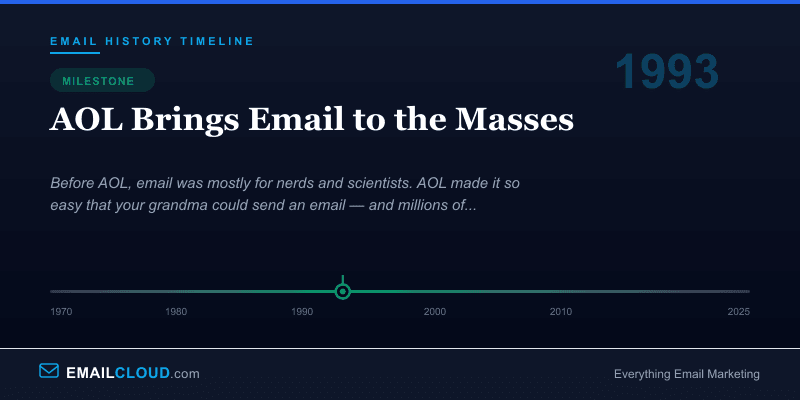
The pivotal moment came in 1993 when AOL opened its email gateway to the broader internet. Before this, AOL users could only email other AOL users. Now, someone with a friendly @aol.com address could send messages to anyone with any email address on the internet. And anyone on the internet could reach them.
This was transformational. Suddenly, millions of non-technical Americans were participating in the global email ecosystem. AOL’s user base exploded. By 1997, AOL had 9 million subscribers. By 2000, it had 23 million. At its absolute peak in 2002, AOL had roughly 30 million subscribers, and according to various estimates, nearly half of all Americans online were accessing the internet through AOL.
The “You’ve Got Mail” Phenomenon
The voice behind the iconic phrase belonged to Elwood Edwards, an Ohio broadcaster whose wife, Karen Edwards, worked at Quantum Computer Services (AOL’s predecessor). In 1989, she mentioned that the company needed voice files for its online service. Edwards recorded “Welcome,” “You’ve got mail,” “File’s done,” and “Goodbye” on a cassette tape in his living room using a simple tape recorder.
Those recordings became possibly the most-heard sound bites of the 1990s. “You’ve got mail” wasn’t just a notification — it was a cultural moment. It represented connection, surprise, and the novelty of digital communication. For many users, the anticipation of hearing that phrase was the entire reason they logged on. The sound was so culturally embedded that it became the title of a 1998 Tom Hanks and Meg Ryan romantic comedy.
The AOL Email Experience
AOL’s email interface was simple by design. A big “Write” button. An inbox that showed who sent you mail. No command-line interface, no SMTP configuration, no DNS settings. AOL handled everything behind the scenes. This simplicity was revolutionary.
AOL also introduced features that helped define modern email expectations. Buddy lists showed you which of your contacts were online. The distinction between “New Mail” and “Old Mail” taught users to think of their inbox as a queue to be processed. Read receipts and away messages prefigured features that would later appear in every messaging platform.
The Downfall
AOL’s dominance didn’t last. The company’s walled-garden approach — which had been its greatest strength when users needed hand-holding — became its greatest weakness as the internet matured. Broadband internet made dial-up obsolete. Free webmail services like Hotmail (1996) and Gmail (2004) offered better email without monthly subscription fees. Social networks pulled casual communication away from email entirely.
AOL’s subscriber base cratered through the 2000s. The company’s ill-fated merger with Time Warner in 2000 — at the time the largest merger in American history at $165 billion — is widely considered one of the worst corporate deals ever made. By 2009, AOL was spun off from Time Warner. Verizon acquired it in 2015 for $4.4 billion, a fraction of its former valuation.
Why It Matters
AOL’s lasting legacy isn’t the company itself — it’s the behavior change it created. AOL taught tens of millions of people what email was, how to use it, and why it mattered. The company proved that email wasn’t inherently technical; it was inherently human. Given the right interface, anyone could send and receive messages.
That insight — that email’s power lies in its accessibility — drives the email industry to this day. Every email marketing platform that offers drag-and-drop editors, every webmail service with a clean interface, every mobile email app that makes composing a message feel effortless, owes a philosophical debt to AOL’s “You’ve got mail” philosophy.
Today, writing great email is about more than simplicity — it’s about cutting through a crowded inbox. Test your subject lines with our free Subject Line Grader to make sure your messages get the same excited reaction that AOL’s notification once inspired.
Infographic
Share this visual summary. Right-click to save.
Related Events
Frequently Asked Questions
When did AOL start offering email?
AOL had internal email from its early days as Quantum Computer Services in the late 1980s, but it opened internet email gateway access to its subscribers in 1993, allowing AOL users to email anyone on the internet.
Who created the 'You've Got Mail' voice?
The iconic AOL 'You've Got Mail' voice belonged to Elwood Edwards, a broadcaster who recorded the phrase in 1989 on a cassette tape in his living room. His wife, who worked at Quantum Computer Services (later AOL), suggested him for the job.
How many people used AOL email at its peak?
At its peak in the early 2000s, AOL had approximately 30 million subscribers in the United States alone, and roughly half of all Americans who used the internet accessed it through AOL.