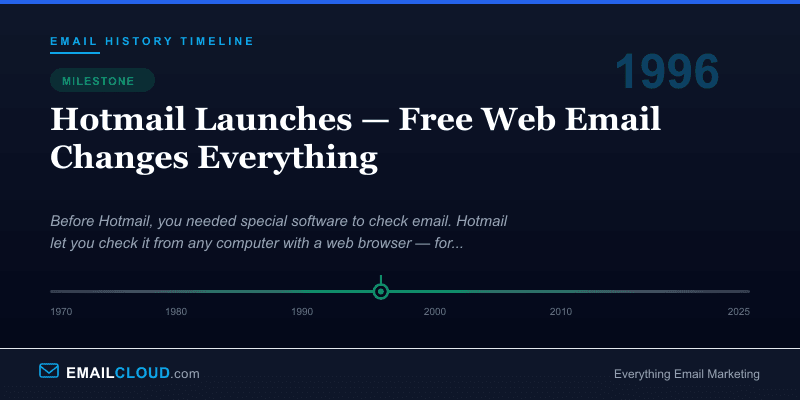
1996: Hotmail Launches — Free Web Email Changes Everything
On July 4, 1996 — Independence Day — two former Apple engineers launched a web service that would free email from the desktop forever. Sabeer Bhatia and Jack Smith called it Hotmail, and they chose that launch date deliberately. Their product offered independence from ISP-provided email accounts, independence from desktop software, and independence from any single computer. Within 18 months, they had 8.5 million users and a $400 million buyout from Microsoft.
The Problem with 1996 Email
In the mid-1990s, checking your email was a chore tied to a specific machine. You needed email client software — Eudora, Pegasus Mail, or Netscape Mail — installed on your computer and configured with your ISP’s mail server settings (POP3 server, SMTP server, port numbers, authentication credentials). Your email lived on that computer. If you wanted to check it from somewhere else, you were out of luck.
This created a particularly frustrating situation for workers who had both a home and an office computer, for travelers, and for anyone who used computers at libraries or universities. Your email was trapped wherever your email client was installed.
The Insight
Jack Smith had the idea first. He and Bhatia were colleagues at Apple, working on a business plan for a different startup called JavaSoft. They needed to communicate by email, but their employer’s network made it difficult to access personal email at work. Smith realized that if email could be accessed through a web browser — which was available on virtually every computer — the whole problem disappeared.
He called Bhatia and said something along the lines of: “What if we built email that you could access from any web browser in the world?” Bhatia immediately recognized the potential. They shelved their JavaSoft plans and built Hotmail.
The name itself was a clever nod to the technology that made it possible. Originally styled as “HoTMaiL,” the capitalized letters spelled out HTML — the language of the web. The service was built on FreeBSD and ran on a cluster of servers that the founders maintained themselves in the early days.
Viral Growth Before “Viral” Was a Word
Hotmail’s growth strategy was legendary — and it happened almost by accident. At the bottom of every outgoing email sent from a Hotmail account, the service automatically appended a small tagline: “Get your free email at Hotmail.” Every Hotmail user became an unwitting ambassador, advertising the service to every person they emailed.
This was one of the first examples of what would later be called “viral marketing,” though the term didn’t exist yet. The growth was extraordinary. Hotmail launched with zero marketing budget and no advertising. Word of mouth — amplified by that email footer — drove signups from zero to 1 million users in the first six months. By the end of 1997, Hotmail had 8.5 million registered accounts.
The growth pattern was particularly striking in geographic terms. Hotmail exploded in India, where Bhatia had personal connections and where the appeal of a free, universally accessible email service was especially strong. India became one of Hotmail’s largest markets, a pattern that would repeat with later free webmail services.
The Microsoft Acquisition
Microsoft had been watching Hotmail’s meteoric rise with increasing concern. The software giant had its own online strategy — MSN — but it didn’t have a competitive webmail product. In December 1997, Microsoft acquired Hotmail for approximately $400 million in stock.
The acquisition was not smooth. Microsoft migrated Hotmail from its FreeBSD/Unix infrastructure to Windows NT servers — a transition that was plagued with technical problems and performance issues. Many of Hotmail’s original engineers left. The service went through multiple redesigns and rebrands: Windows Live Hotmail, then Outlook.com in 2013.
But the strategic value was undeniable. Hotmail gave Microsoft a foothold in web-based services and an enormous user base. The Hotmail acquisition was a precursor to Microsoft’s broader pivot toward cloud services, a transformation that would eventually produce Microsoft 365 and Azure.
The Competition It Sparked
Hotmail proved that free webmail was a viable business model — one supported by advertising rather than subscriptions. This validation triggered an arms race. Yahoo launched Yahoo Mail in 1997. Lycos, Excite, and other portal sites added free email. And in 2004, Google launched Gmail with a storage offer (1 GB) so generous that it made every existing webmail service look stingy by comparison.
The free webmail model also had a profound effect on the email marketing industry. As millions of consumers abandoned ISP email for Hotmail, Yahoo, and later Gmail, these three providers gained enormous influence over email deliverability. Today, the decisions made by Google, Microsoft, and Yahoo about spam filtering and inbox placement determine the success or failure of email marketing campaigns worldwide.
Why It Matters
Hotmail established three ideas that still define email today. First, email should be free. Second, email should be accessible from anywhere. Third, email services can be profitable through advertising and data, not subscription fees.
Bhatia and Smith’s $400 million exit also established webmail as a legitimate business category, inspiring a generation of founders to build products in the email space. The tools, platforms, and services that email marketers use today all trace their lineage back to that July 4, 1996 launch.
If you’re building email campaigns today on any platform, make sure every message counts. Our Subject Line Grader helps you craft subject lines that get opened in the crowded inboxes that Hotmail helped create.
Infographic
Share this visual summary. Right-click to save.
Related Events
Frequently Asked Questions
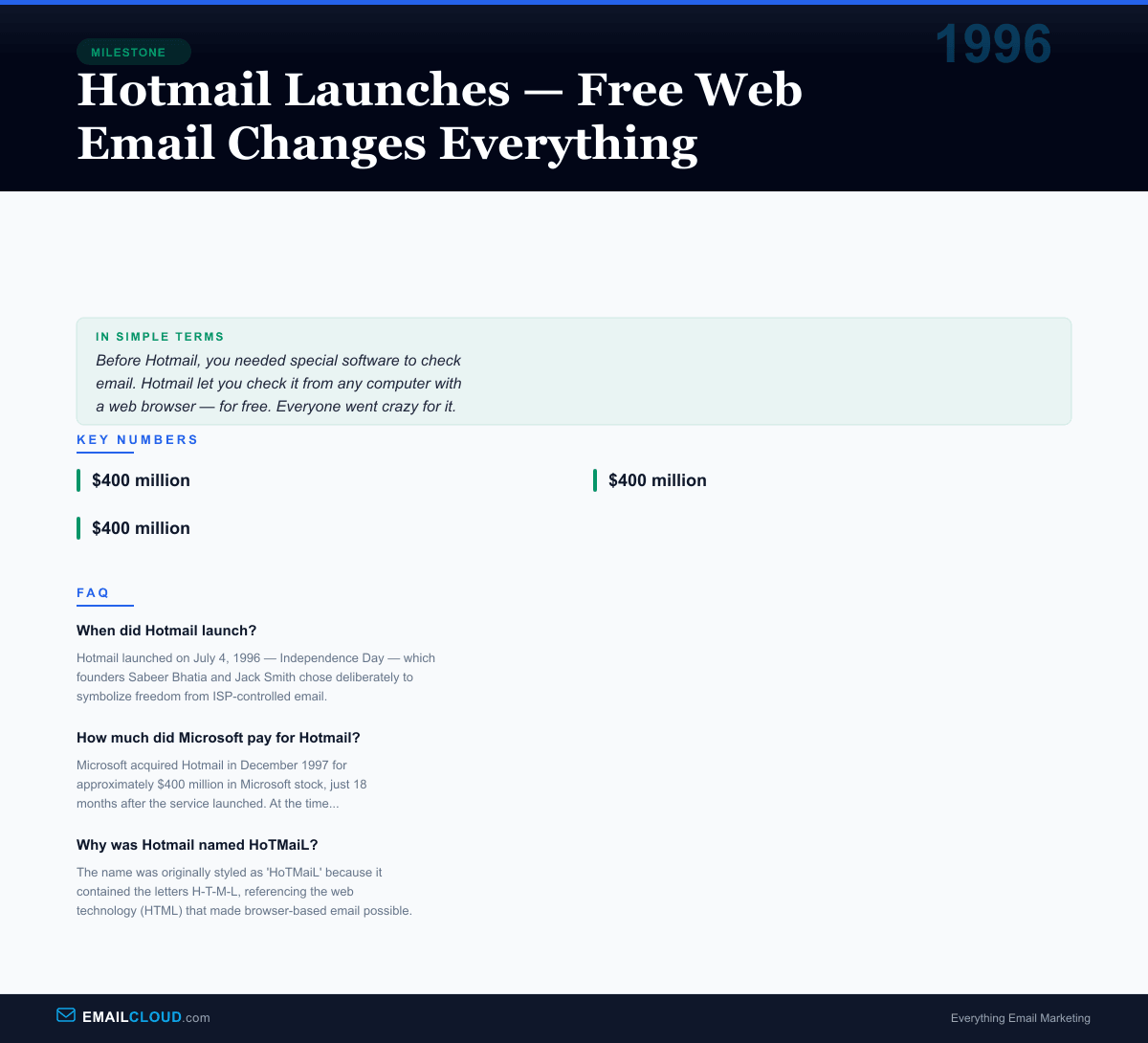
When did Hotmail launch?
Hotmail launched on July 4, 1996 — Independence Day — which founders Sabeer Bhatia and Jack Smith chose deliberately to symbolize freedom from ISP-controlled email.
How much did Microsoft pay for Hotmail?
Microsoft acquired Hotmail in December 1997 for approximately $400 million in Microsoft stock, just 18 months after the service launched. At the time of acquisition, Hotmail had roughly 8.5 million registered users.
Why was Hotmail named HoTMaiL?
The name was originally styled as 'HoTMaiL' because it contained the letters H-T-M-L, referencing the web technology (HTML) that made browser-based email possible.