2004: Gmail Launches on April Fools' Day with 1GB Storage
On the morning of April 1, 2004, Google sent out a press release announcing a new free email service called Gmail. It would offer 1 gigabyte of free storage — at a time when Hotmail gave users 2 megabytes and Yahoo offered 4. That’s not a typo: Google was offering 500 times more storage than the market leader. The tech world read the announcement, looked at the date, and collectively concluded that Google was pulling an elaborate April Fools’ joke. It wasn’t.
The Secret Project
Gmail had been in development inside Google since 2001, led by engineer Paul Buchheit. Internally, the project was codenamed “Caribou” and was initially built as an internal email tool for Google employees. Buchheit, who had previously worked on Google Groups, built the first version of Gmail in a single day by repurposing existing Google Groups code.
The project’s mandate from co-founder Larry Page was ambitious: build an email service that Google employees would actually prefer over Microsoft Outlook. Page believed that search — Google’s core competency — could transform email. Instead of organizing messages into folders, what if you could just search for what you needed?
This was a radical idea in 2004. Every existing email service was built around folders and manual organization. Gmail said: stop organizing, start searching. Keep everything. Find it when you need it.
The 1GB Bombshell
The storage offer was the headline grabber, but it was more than a marketing stunt. Google engineers had done the math and realized that the cost of storage was dropping so fast that offering 1GB per user was economically viable. They were right — storage costs continued plummeting, and Gmail’s free storage has grown to 15GB (shared across Google services) without Google breaking a sweat.
But on April 1, 2004, offering 1GB felt genuinely impossible. Hotmail’s 2MB limit meant users constantly had to delete old messages. Yahoo’s 4MB was barely better. The idea that a company would give away 250 to 500 times more storage than its competitors — for free — seemed absurd.
Tech journalists genuinely debated whether the announcement was real. Slashdot’s comment section was full of skepticism. It took Google’s official confirmation and the first wave of invite-only beta users to convince the world that Gmail was real.
The Invite Economy
Gmail launched as an invite-only service, and this turned out to be a stroke of marketing genius — whether intentional or not. Each early user received a small number of invites to share with friends. This created artificial scarcity that made Gmail accounts feel exclusive and desirable.
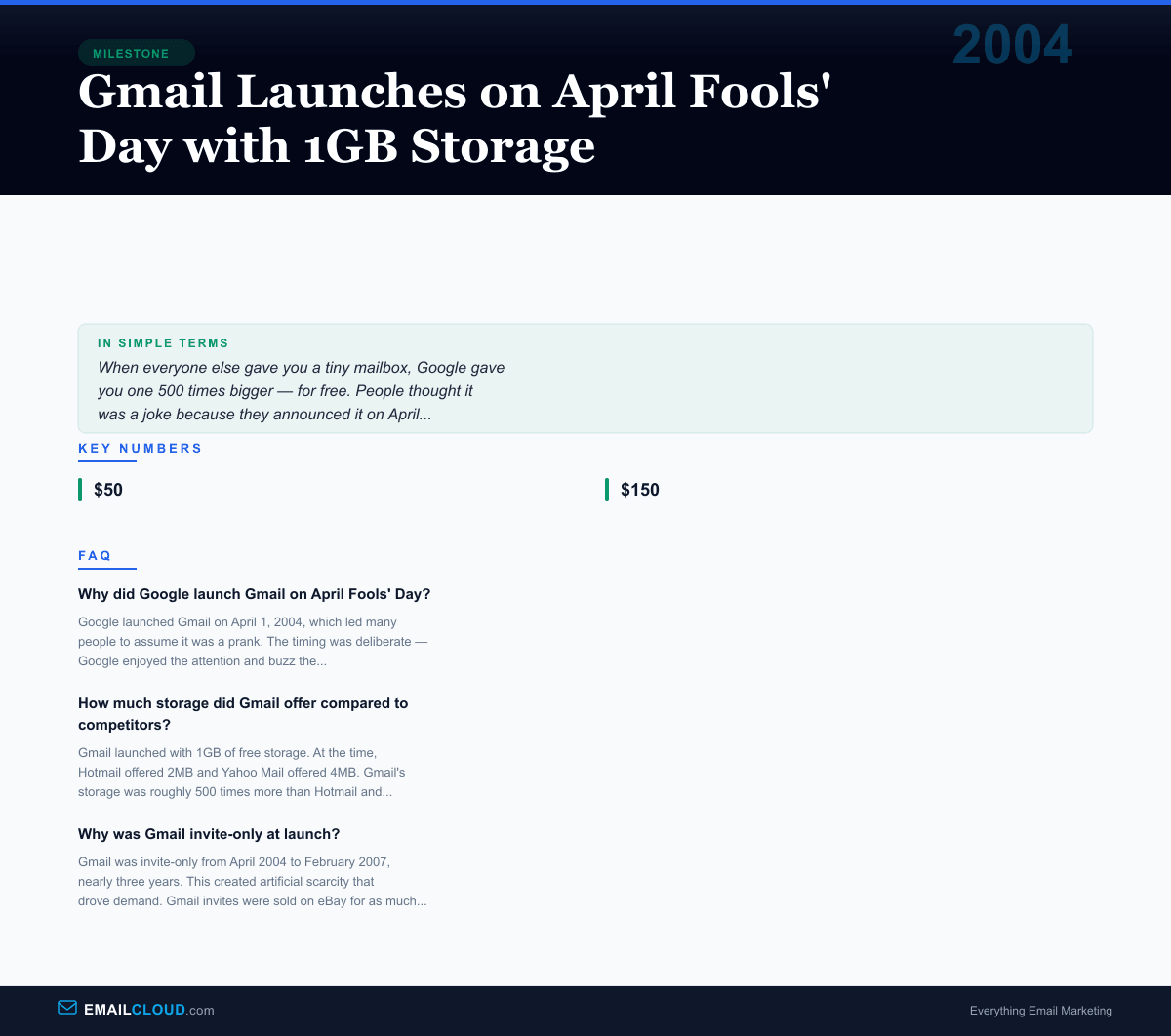
Gmail invites became a commodity. They were traded on eBay, with some selling for $50 to $150 at the height of the frenzy. Websites dedicated to swapping Gmail invites popped up overnight. Having a Gmail address in 2004-2005 was a genuine status symbol in tech circles — it signaled that you were connected enough to get an invite.
The invite-only period lasted nearly three years, from April 2004 until February 2007, when Google finally opened registration to the public. By then, Gmail had built an enormous waitlist and a reputation as the most desirable email service in the world.
Threaded Conversations and Labels
Beyond storage, Gmail introduced two features that redefined how people think about email. Threaded conversations grouped all replies to a message into a single, expandable chain. Instead of seeing ten separate messages in your inbox, you saw one conversation thread. This seems obvious now, but in 2004 it was revolutionary.
Labels replaced folders. Instead of moving a message into a single folder, you could apply multiple labels to it. An email could be both “Work” and “Project X” and “Urgent” simultaneously. Combined with Google’s search capability, labels made email organization far more flexible than the rigid folder hierarchies of Outlook and Yahoo.
The Privacy Controversy
Gmail wasn’t without controversy. The service scanned email content to display targeted advertisements alongside messages — a practice that alarmed privacy advocates. The idea that Google’s systems were “reading” your email (even if it was automated and no humans were involved) generated significant pushback.
Thirty-one privacy organizations signed a letter asking Google to suspend the service until privacy concerns were addressed. California State Senator Liz Figueroa introduced legislation to ban Gmail-style email scanning. Google weathered the storm, and users ultimately voted with their feet — Gmail’s convenience and features outweighed privacy concerns for most people. Google eventually stopped scanning email content for ad targeting in 2017.
Why It Matters
Gmail didn’t just win the webmail wars — it reset the entire industry’s expectations. Within months of Gmail’s launch, Yahoo increased its free storage to 1GB, then to unlimited. Hotmail scrambled to match. The era of storage scarcity in email was over.
More importantly, Gmail proved that email could be reinvented. The threaded conversation model, the search-first approach, and the clean interface influenced every email client and service that followed. Gmail currently has over 1.8 billion active users, making it the most popular email service in the world.
For email marketers, Gmail’s dominance means that Gmail’s spam filters, promotions tab, and rendering engine are the most important gatekeepers to reaching an audience. Understanding Gmail’s filtering is essential for deliverability — start by running your campaigns through our Spam Word Checker to see how your content might be classified.
Infographic
Share this visual summary. Right-click to save.
Related Events
Frequently Asked Questions
Why did Google launch Gmail on April Fools' Day?
Google launched Gmail on April 1, 2004, which led many people to assume it was a prank. The timing was deliberate — Google enjoyed the attention and buzz the confusion generated, and the seemingly too-good-to-be-true 1GB storage offer added to the skepticism.
How much storage did Gmail offer compared to competitors?
Gmail launched with 1GB of free storage. At the time, Hotmail offered 2MB and Yahoo Mail offered 4MB. Gmail's storage was roughly 500 times more than Hotmail and 250 times more than Yahoo — a genuinely shocking difference.
Why was Gmail invite-only at launch?
Gmail was invite-only from April 2004 to February 2007, nearly three years. This created artificial scarcity that drove demand. Gmail invites were sold on eBay for as much as $150, and the exclusivity made having a Gmail account a status symbol in tech circles.