2009: Google Wave: The 'Future of Email' That Lasted One Year
On May 28, 2009, at the Google I/O developer conference in San Francisco, brothers Lars and Jens Rasmussen took the stage to demonstrate what Google was calling the future of communication. The product was Google Wave, and the demo was genuinely jaw-dropping. Messages appeared character by character in real time. Multiple people could edit the same conversation simultaneously. You could drag photos, videos, and maps directly into a message thread. Conversations could be replayed from the beginning like a recording. You could embed interactive applications — polls, games, translation tools — directly inside a message.
The audience gave it a standing ovation. The tech press called it revolutionary. Google opened a waitlist, and within 24 hours, over 100,000 people had requested invites. The hype was staggering. This was going to replace email.
It didn’t.
What Google Wave Actually Was
The Rasmussen brothers — who had previously created Google Maps, so their credibility was impeccable — conceived Wave as a reimagination of email from first principles. Their starting question was: if email were invented today, with modern technology, what would it look like?
The answer they came up with was a “wave” — a shared space that combined the functions of email, instant messaging, document collaboration, and social networking. A wave was simultaneously a message thread, a collaborative document, and a real-time chat. Participants could reply to specific parts of a message, edit their own or others’ contributions, and add “gadgets” (embedded applications) that all participants could interact with.
The technology was genuinely impressive. The operational transformation algorithm that powered real-time simultaneous editing was a significant engineering achievement. The protocol was designed to be open and federated, meaning anyone could run their own Wave server, just as anyone can run their own email server.
The Invitation Problem
Google launched Wave as an invite-only preview in September 2009, initially limiting access to about 100,000 users. This created an immediate problem: Wave was a communication tool, but most of the people you wanted to communicate with didn’t have access. A messaging platform with no one to message is an empty room.
The invite-only strategy had worked brilliantly for Gmail in 2004, but Gmail was a replacement for something people already did (email) with people already doing it (other email users). Wave was trying to create an entirely new communication paradigm, and you can’t demonstrate the value of a new paradigm to someone when they’re the only person in the room.
When Google gradually expanded access, opening it to the public in May 2010, the initial excitement had already cooled. Early adopters who had eagerly requested invites months earlier had largely stopped using the product.
The Complexity Trap
Google Wave’s fatal flaw was that nobody could explain what it was for. It was email, but not email. It was chat, but persistent. It was a document, but conversational. It was all of these things simultaneously, which meant it was none of them well enough to justify switching from the tools people already used.
The user interface compounded the problem. Wave presented a three-panel layout — contact list, inbox, and wave view — that was dense with information and interactions. Basic tasks like replying to a message required understanding concepts like “blips” (individual message segments within a wave) and “wavelets” (sub-conversations within a wave). The real-time typing feature, where other participants could see every character you typed as you typed it, was technically impressive but socially uncomfortable. People were accustomed to composing their thoughts privately before hitting send.
Enterprise users, who might have benefited most from the collaboration features, were put off by the lack of administrative controls, security certifications, and integration with existing business tools. Individual users, meanwhile, couldn’t figure out why they should use Wave instead of just sending an email.
The End
On August 4, 2010 — barely a year after the triumphant I/O demo — Google Vice President of Engineering Urs Holzle posted a blog entry announcing that Wave would be discontinued. “Wave has not seen the user adoption we would have liked,” he wrote, in what may be the most understated post-mortem in tech history.
The announcement came just three months after Wave had been opened to the general public. Google kept the service running until April 2012 before shutting it down entirely. The underlying technology was donated to the Apache Software Foundation as Apache Wave, where it continues to exist as an open-source project with minimal activity.
What Wave Got Right (Too Early)
The irony of Google Wave is that many of its core ideas have since become mainstream — just not as a single product. Real-time collaborative editing became the defining feature of Google Docs. Threaded, semi-persistent messaging showed up in Slack and Microsoft Teams. Embedded interactive elements became commonplace in modern messaging apps. The concept of a shared space where communication and collaboration happen simultaneously is essentially what Notion, Coda, and other modern workspace tools offer.
Wave’s mistake wasn’t vision — it was packaging. The product tried to replace too many things at once without being clearly superior at any one of them. Email, for all its age and limitations, had the advantage of being simple and universal. You write a message, you send it, the recipient reads it. Wave required you to learn an entirely new mental model of communication, and the payoff wasn’t clear enough to justify the effort.
Google Wave remains the most prominent example of a fundamental truth about email: it’s extraordinarily difficult to replace because its simplicity is its strength. The protocol that Ray Tomlinson cobbled together in 1971 has outlasted every attempt to “reinvent” it — not because email is perfect, but because it’s good enough, universally understood, and owned by no one.
If the future of communication still runs through the inbox, make sure your emails are built to perform. Our Subject Line Grader helps you craft openings that work within email’s simple, proven framework.
Infographic
Share this visual summary. Right-click to save.
Related Events
Frequently Asked Questions
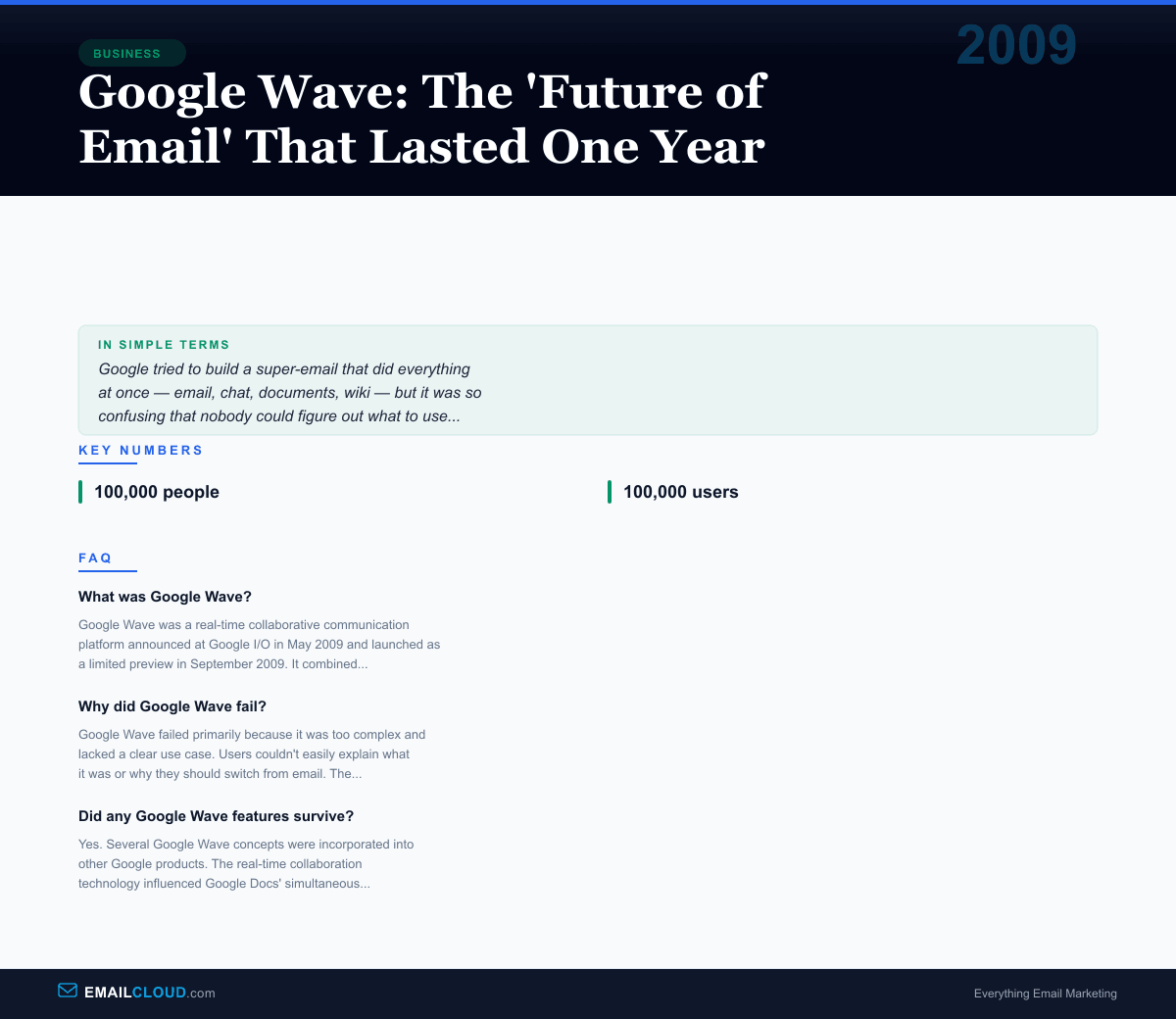
What was Google Wave?
Google Wave was a real-time collaborative communication platform announced at Google I/O in May 2009 and launched as a limited preview in September 2009. It combined email, instant messaging, wiki-style editing, and social networking into a single interface where multiple users could edit messages simultaneously. Google discontinued it in August 2010 due to low adoption.
Why did Google Wave fail?
Google Wave failed primarily because it was too complex and lacked a clear use case. Users couldn't easily explain what it was or why they should switch from email. The invite-only rollout meant most people's contacts weren't on the platform, creating a chicken-and-egg problem. The real-time character-by-character typing was also unsettling to many users who were accustomed to composing messages privately before sending.
Did any Google Wave features survive?
Yes. Several Google Wave concepts were incorporated into other Google products. The real-time collaboration technology influenced Google Docs' simultaneous editing features. The threaded conversation model appeared in Google+ and later Google Chat. The Wave protocol was open-sourced as Apache Wave, though it never gained significant traction.