2011: Amazon SES: When Cloud Giant Pricing Hit the Email Market
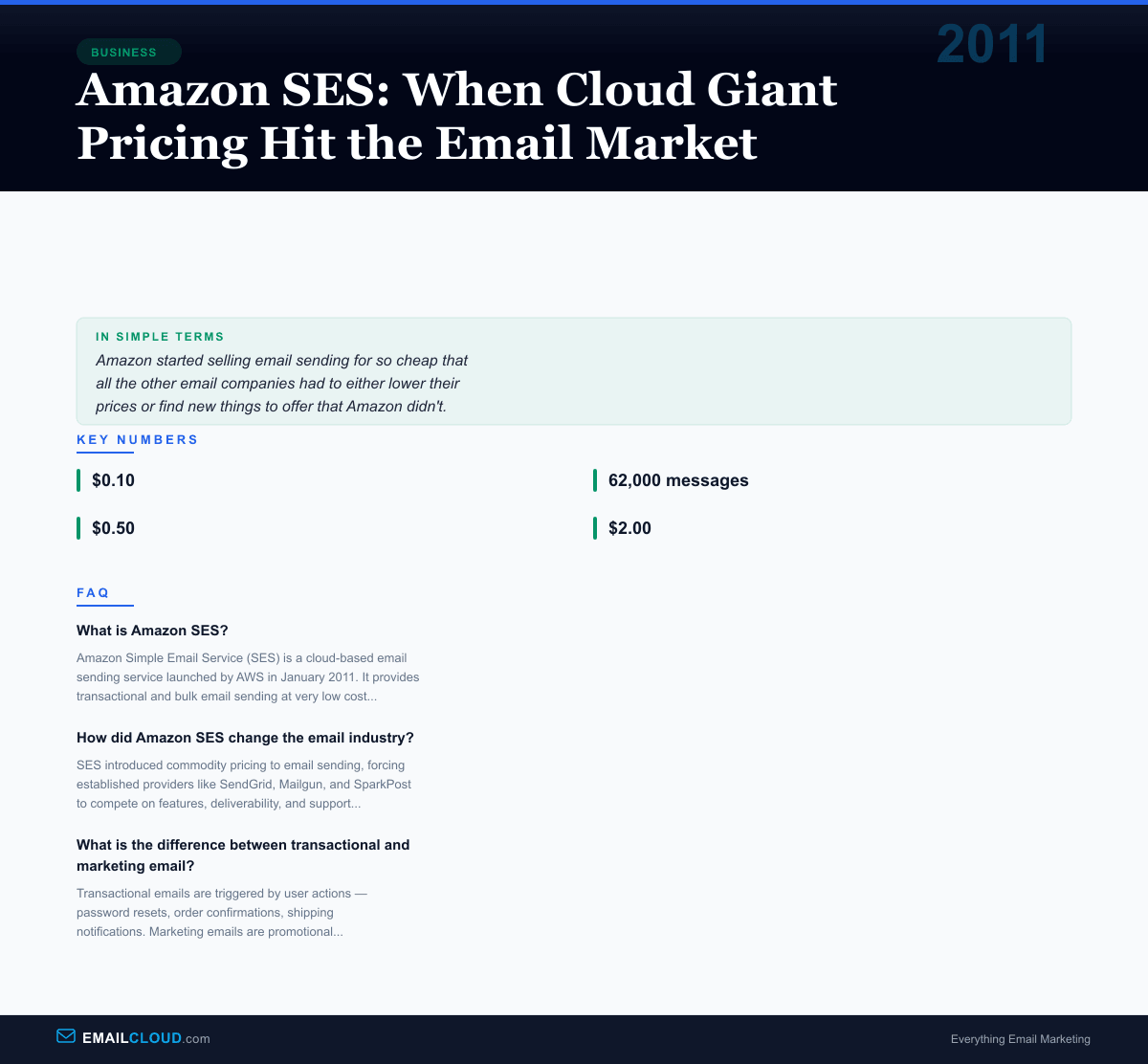
In January 2011, Amazon Web Services quietly announced a new service with the typically understated AWS naming convention: Amazon Simple Email Service, or SES. The pricing was simple too: $0.10 per thousand emails. For emails sent from EC2 instances (Amazon’s cloud computing platform), the first 62,000 messages per month were free.
In the email infrastructure world, this was the equivalent of a bomb going off in the middle of a dinner party.
The Market Before SES
Before Amazon entered the picture, sending transactional email at scale was neither simple nor cheap. Transactional emails — the password resets, order confirmations, shipping notifications, and account alerts that every web application needs to send — required either running your own mail servers (expensive, complex, and fraught with deliverability challenges) or paying a dedicated email service provider.
The major players in 2010 included SendGrid (founded 2009), Postmark (founded 2009), and the still-emerging Mailgun (founded 2010), along with established enterprise players like MessageSystems (later SparkPost) and Port25. These companies charged varying rates, but typical pricing for mid-volume senders ranged from $0.50 to $2.00 per thousand messages, depending on volume, features, and support levels.
These were reasonable prices for the value provided. Running reliable email infrastructure is genuinely difficult. Maintaining sender reputation, managing IP warming, handling bounces and complaints, navigating blocklists, and ensuring consistent deliverability requires significant expertise and operational overhead. The email service providers weren’t overcharging — they were selling a complex service.
Then Amazon walked in and offered the same basic capability for a fraction of the cost.
The AWS Playbook
Amazon’s approach to SES followed the same pattern AWS had used to disrupt storage (S3), computing (EC2), and databases (RDS): offer a no-frills version of an established service at a price point that existing providers couldn’t match, leverage massive scale and shared infrastructure to make the low pricing sustainable, and let the market sort itself out.
SES was deliberately stripped down. It didn’t offer the deliverability consulting that SendGrid provided. It didn’t include the detailed analytics that Postmark built. It didn’t have the user-friendly dashboard that Mailchimp offered. It was a pipe: put email in one end, it comes out the other. Configuration was through APIs and the AWS console, which was (and remains) intimidating to non-technical users.
But for developers building on AWS — and by 2011, that was a rapidly growing population — SES had an irresistible advantage beyond price: integration. If your application already ran on EC2, your database was on RDS, and your files were on S3, adding SES for email was trivially simple. It was another AWS service, managed through the same console, billed through the same account, accessible through the same APIs.
The Industry Response
The established email service providers had three options: panic, differentiate, or both.
Most chose both, though they publicly chose to project calm.
SendGrid leaned into its developer-friendly reputation, robust analytics, and deliverability expertise. The company positioned itself as the premium choice — yes, you could send email more cheaply through SES, but SendGrid offered better deliverability, better support, and better tooling. The strategy worked well enough that SendGrid went public in 2017 and was acquired by Twilio for $2 billion in 2018.
Mailgun (acquired by Rackspace in 2012, later spun out) competed aggressively on developer experience, offering a cleaner API and better documentation than SES. Mailgun carved out a strong niche among developers who wanted SES-like simplicity with better ergonomics.
Postmark took the boldest stance, focusing exclusively on transactional email (refusing to send marketing email entirely) and positioning deliverability and speed as its primary differentiators. Postmark published real-time delivery statistics to demonstrate its advantage over SES, particularly for time-sensitive messages like password resets.
SparkPost (formerly MessageSystems) positioned itself as the enterprise-grade alternative, offering the scale of SES with the deliverability intelligence that large senders required.
The Deliverability Question
The early criticism of SES centered on deliverability — the percentage of emails that actually reach the inbox rather than being filtered as spam. Critics argued that SES’s low pricing attracted spammers and low-quality senders, which could poison the shared IP pools and drag down deliverability for all SES users.
There was some truth to this in the early days. SES’s initial reputation management was less sophisticated than established providers, and shared sending infrastructure meant that one bad actor could affect others. Over time, Amazon addressed this with stricter sending policies, dedicated IP options, and improved reputation monitoring. By the mid-2010s, SES deliverability was competitive with dedicated providers for senders who followed best practices.
The Pricing Cascade
SES’s most lasting impact was on pricing across the entire industry. While established providers maintained premium pricing for premium features, the baseline cost of email sending dropped significantly in the years following SES’s launch. The “commodity email” category — basic sending without bells and whistles — converged toward SES-level pricing across the industry.
This benefited every company that needed to send email. Startups, in particular, were the biggest winners. Before SES, a startup might spend $200-$500 per month on email infrastructure while still in pre-revenue. After SES, the same startup could send tens of thousands of transactional emails for effectively zero incremental cost. This removed email sending from the list of significant startup expenses, which in turn encouraged more application-to-user communication via email.
Where SES Stands Today
Amazon SES has become one of the largest email sending platforms in the world by volume. Amazon doesn’t publish specific numbers, but industry estimates suggest SES handles billions of messages daily. The service has expanded from its bare-bones origins to include features like dedicated IPs, email receiving (not just sending), event publishing, and integration with other AWS services.
The pricing model has barely changed. As of 2025, SES charges $0.10 per thousand emails. For emails sent from EC2, the first 62,000 per month are still free. In an era of inflation and rising SaaS prices, SES’s price stability is remarkable — and continues to exert gravitational pull on the rest of the market.
Amazon did to email sending what it did to cloud computing, book retail, and grocery delivery: it offered a good-enough product at a price that forced everyone else to either compete on value or accept commoditization. For email infrastructure, the result has been better products, lower prices, and more choices — the textbook outcome of disruptive competition.
Infographic
Share this visual summary. Right-click to save.
Related Events
Frequently Asked Questions
What is Amazon SES?
Amazon Simple Email Service (SES) is a cloud-based email sending service launched by AWS in January 2011. It provides transactional and bulk email sending at very low cost — originally $0.10 per thousand messages, with even lower rates for emails sent from EC2 instances.
How did Amazon SES change the email industry?
SES introduced commodity pricing to email sending, forcing established providers like SendGrid, Mailgun, and SparkPost to compete on features, deliverability, and support rather than just price. It also made email infrastructure accessible to startups and small developers.
What is the difference between transactional and marketing email?
Transactional emails are triggered by user actions — password resets, order confirmations, shipping notifications. Marketing emails are promotional messages sent to subscriber lists. Different infrastructure and compliance rules apply to each type.