2015: Slack Claims to 'Kill Email' — Email Thrives Anyway
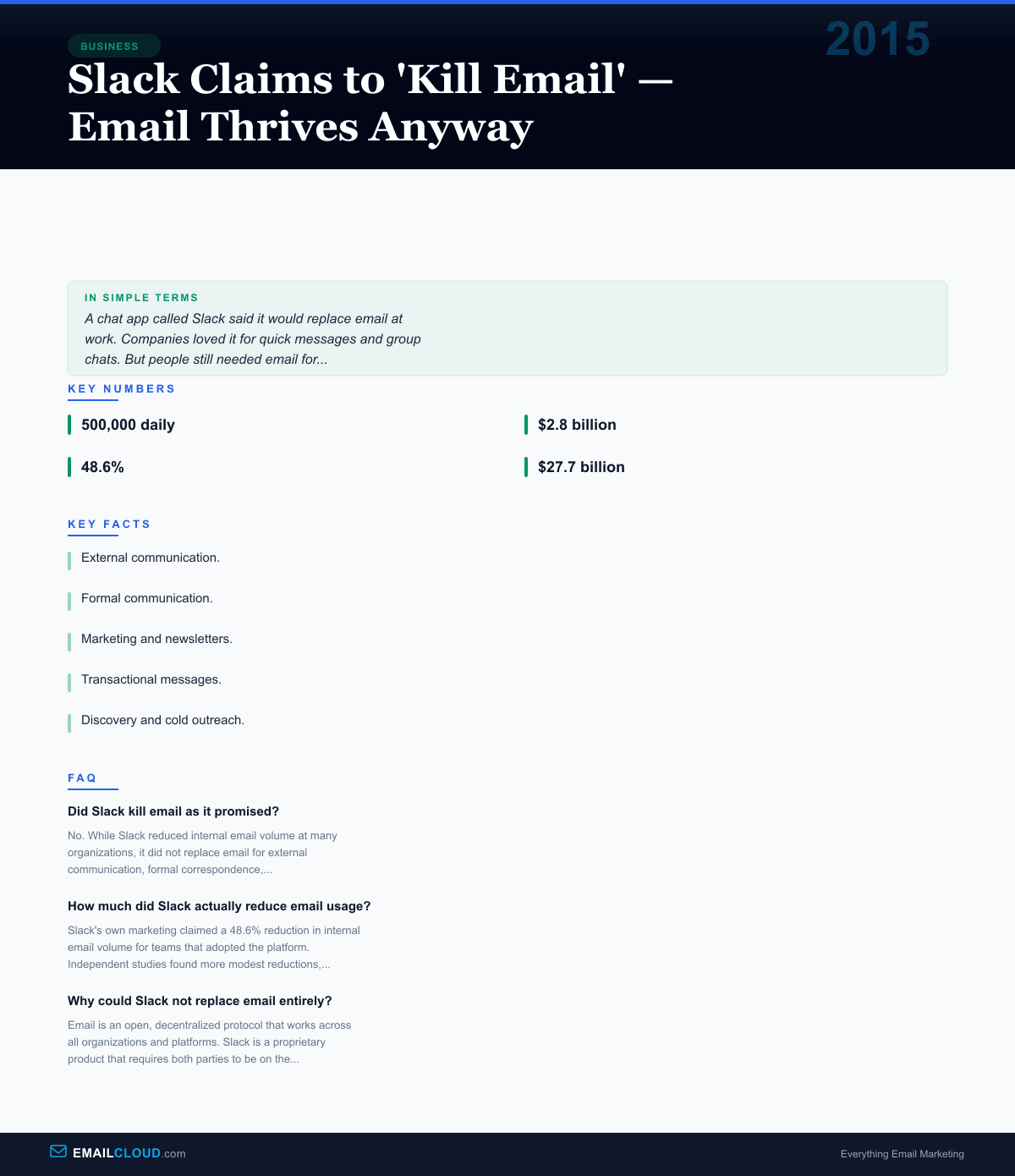
In 2015, Slack was the hottest company in enterprise technology. The team messaging platform, which had launched publicly in February 2014, was growing at a pace that defied precedent. By February 2015, Slack reported 500,000 daily active users. By the end of the year, that number had passed 2 million. The company’s valuation soared to $2.8 billion in April 2015 — less than two years after launch.
And Slack had a narrative that the tech press loved: it was going to kill email.
“We’re trying to do something that is really quite audacious and f***ing hard,” Slack CEO Stewart Butterfield told interviewers in 2015. The company’s own marketing claimed that teams using Slack saw a 48.6% reduction in internal email. Headlines proclaimed the death of email in workplace after workplace. Slack’s tagline — “Be less busy” — implied that email was the source of workplace inefficiency, and Slack was the cure.
A decade later, email has more users than ever. Slack was acquired by Salesforce for $27.7 billion in 2021. And the relationship between the two turned out to be nothing like anyone predicted.
The Real Problem Slack Solved
To understand why Slack did not kill email, you first need to understand what Slack actually did well. And it did several things brilliantly.
Slack solved the problem of scattered internal communication. Before Slack, teams communicated through a patchwork of email threads, instant messages, text messages, shared documents, and in-person conversations. Information lived in dozens of places. Context was constantly lost. New team members had no way to catch up on decisions made before they joined.
Slack organized communication into channels — persistent, searchable, topic-based conversations that anyone on the team could access. Instead of an email thread that only included the original recipients, a Slack channel included everyone who might need the information, both now and in the future. The threaded, real-time format was genuinely better than email for quick questions, status updates, and informal team coordination.
Slack also nailed integrations. By connecting to project management tools, code repositories, customer support systems, and dozens of other platforms, Slack became a central hub where work happened rather than just where messages were exchanged.
Where the “Kill Email” Narrative Fell Apart
The 48.6% reduction in internal email that Slack touted was real for many teams. When you give people a better tool for quick internal communication, they use it. Fewer “quick question” emails, fewer “FYI” forwards, fewer reply-all threads about lunch orders. That part of the promise was delivered.
But internal email was only a fraction of how people used email, and Slack’s narrative conveniently ignored everything else.
External communication. Slack workspaces are closed systems. You cannot Slack a client, a vendor, a partner, or a prospect unless they are invited to your workspace. For the vast majority of cross-organization communication, email remained the only universal option. No company was going to ask every client and partner to join their Slack.
Formal communication. Contracts, legal notices, HR communications, official announcements — these require the permanence, formality, and documentation that email provides. A Slack message can be edited or deleted after the fact. An email, once sent and received, becomes a record that both parties possess.
Marketing and newsletters. Slack had no mechanism for brands to communicate with their audiences. Email marketing, newsletters, product announcements, and promotional campaigns continued to live exclusively in email. The entire marketing email ecosystem — which generates billions of dollars in revenue annually — was completely outside Slack’s scope.
Transactional messages. Order confirmations, shipping notifications, password resets, account alerts, receipts, invoices — the infrastructure of online commerce runs on email. None of this was going to move to Slack.
Discovery and cold outreach. You can email anyone whose email address you know. You cannot Slack someone who is not in your workspace. For sales, networking, job applications, and any form of cold outreach, email remained the only option.
The Irony of Slack’s Email Dependency
Perhaps the most telling indicator that Slack was not going to kill email was how heavily Slack itself depended on email to function.
Slack sent notification emails for missed messages. Slack sent weekly digest emails summarizing channel activity. Slack sent onboarding emails to new users. Slack sent account verification emails, password reset emails, billing emails, and product update emails. If you used Slack but did not check it for a few hours, your inbox filled with emails from Slack telling you what you missed.
The platform that was supposed to replace email became one of the most prolific senders of email in the enterprise software category. The irony was not lost on email marketers, though it was rarely acknowledged in the press coverage celebrating email’s imminent demise.
The Notification Fatigue Problem
By 2017 and 2018, a counter-narrative began to emerge. Workers who had adopted Slack enthusiastically were beginning to feel a familiar sensation: overwhelm. The constant stream of messages, the red notification badges, the expectation of immediate response, the anxiety of missing something important in a busy channel — it sounded a lot like the email problems Slack was supposed to solve.
Cal Newport’s concept of “communication overhead” applied equally to Slack and email. The problem was never the medium; it was the volume and the expectations around responsiveness. Replacing email chains with Slack threads did not reduce the total amount of communication — in many cases, it increased it, because the lower friction of Slack messaging made it easier to send messages that would not have warranted an email.
Studies began to show that workers in Slack-heavy organizations often felt more interrupted, not less. The always-on, real-time nature of Slack created pressure to respond immediately, whereas email’s asynchronous nature allowed for batching and prioritization. Some organizations that had enthusiastically adopted Slack began instituting “Slack-free hours” or “focus time” — the same kinds of boundaries they had tried to set around email.
What Actually Happened
The reality that emerged by 2020 was that Slack (and its competitors, particularly Microsoft Teams) had carved out a valuable niche: real-time internal team communication. They were excellent at replacing the subset of email that consisted of quick internal messages, status updates, and casual team coordination.
But they added to total communication volume rather than replacing it. Workers now managed both an email inbox and multiple Slack or Teams channels. The dream of a single, unified communication tool remained just that — a dream.
Email, meanwhile, continued its steady growth. Global email users passed 4 billion in 2020 and exceeded 4.5 billion by 2025. Email volume grew every year. Email marketing ROI remained the highest of any digital channel. The protocol that Slack was supposed to kill was growing faster than Slack itself.
The Lesson for Email Marketers
The Slack-vs-email saga reinforced a principle that email marketers already knew: email is infrastructure, not an application. Applications can be disrupted by better applications. Infrastructure persists because the cost of switching is prohibitive and the network effects are unbreakable.
Slack was a better application for real-time team chat. It was not a replacement for the infrastructure that connects 4.5 billion people across every organization, platform, and use case on the planet. The two were never really competing, despite the marketing narratives.
For email marketers, the takeaway is reassuring. Your email list is not at risk from the latest messaging platform. It is an asset built on the most resilient communication protocol in the history of the internet. The question is not whether email will survive — it always does — but whether you are using it well.
Make every email count. Check your campaigns with our Subject Line Grader and verify your copy with our Spam Word Checker.
Infographic
Share this visual summary. Right-click to save.
Related Events
Frequently Asked Questions
Did Slack kill email as it promised?
No. While Slack reduced internal email volume at many organizations, it did not replace email for external communication, formal correspondence, marketing, transactional messages, or cross-organization collaboration. Email users grew from approximately 2.6 billion in 2015 to over 4.5 billion by 2025. Slack itself relied heavily on email for notifications, onboarding, and account management.
How much did Slack actually reduce email usage?
Slack's own marketing claimed a 48.6% reduction in internal email volume for teams that adopted the platform. Independent studies found more modest reductions, typically 20-30% for internal messages. However, total email volume continued to grow globally because Slack did not address external email, marketing email, transactional email, or email between organizations.
Why could Slack not replace email entirely?
Email is an open, decentralized protocol that works across all organizations and platforms. Slack is a proprietary product that requires both parties to be on the same workspace. Email handles formal communication, legal documentation, marketing, account verification, receipts, and cross-company correspondence — none of which Slack was designed for. The two tools served complementary, not competing, purposes.