2000: How A/B Testing Transformed Email Marketing
In the world of email marketing, opinions are cheap. Everyone has a theory about what subject line works best, what time to send, whether to use one call-to-action or three. Marketing meetings are filled with confident assertions: “Our audience prefers short subject lines.” “Tuesday mornings are the best send time.” “Red buttons convert better than blue.”
A/B testing replaced opinions with evidence. By splitting an audience and sending different versions of the same email, marketers could measure what actually worked rather than guessing. The practice, borrowed from decades of direct mail testing, transformed email marketing from a creative guessing game into a data-driven discipline — and the results often overturned the most confidently held assumptions.
Roots in Direct Mail
A/B testing didn’t originate with email. Direct mail marketers had been split-testing since at least the 1960s. The practice was straightforward: print two versions of a mail piece (different headlines, different offers, different layouts), send each version to a random sample of the mailing list, and measure which version produced more responses.
Legendary direct mail copywriter John Caples documented the power of testing in his 1932 book “Tested Advertising Methods,” establishing principles that email marketers would later apply: test one variable at a time, use large enough samples for statistical significance, and let the data override your intuition.
When email marketing emerged in the mid-1990s, the opportunity for testing was obvious — and far more practical than direct mail testing. Physical split tests required printing different versions, managing separate mailing streams, and waiting weeks for results. Email split tests could be configured in minutes, sent instantly, and produced results within hours.
The Email Testing Revolution
By the late 1990s and early 2000s, email marketers were conducting split tests, but the process was largely manual. A marketer would create two versions of an email, manually divide the subscriber list, send each version to its segment, and compare the results in a spreadsheet.
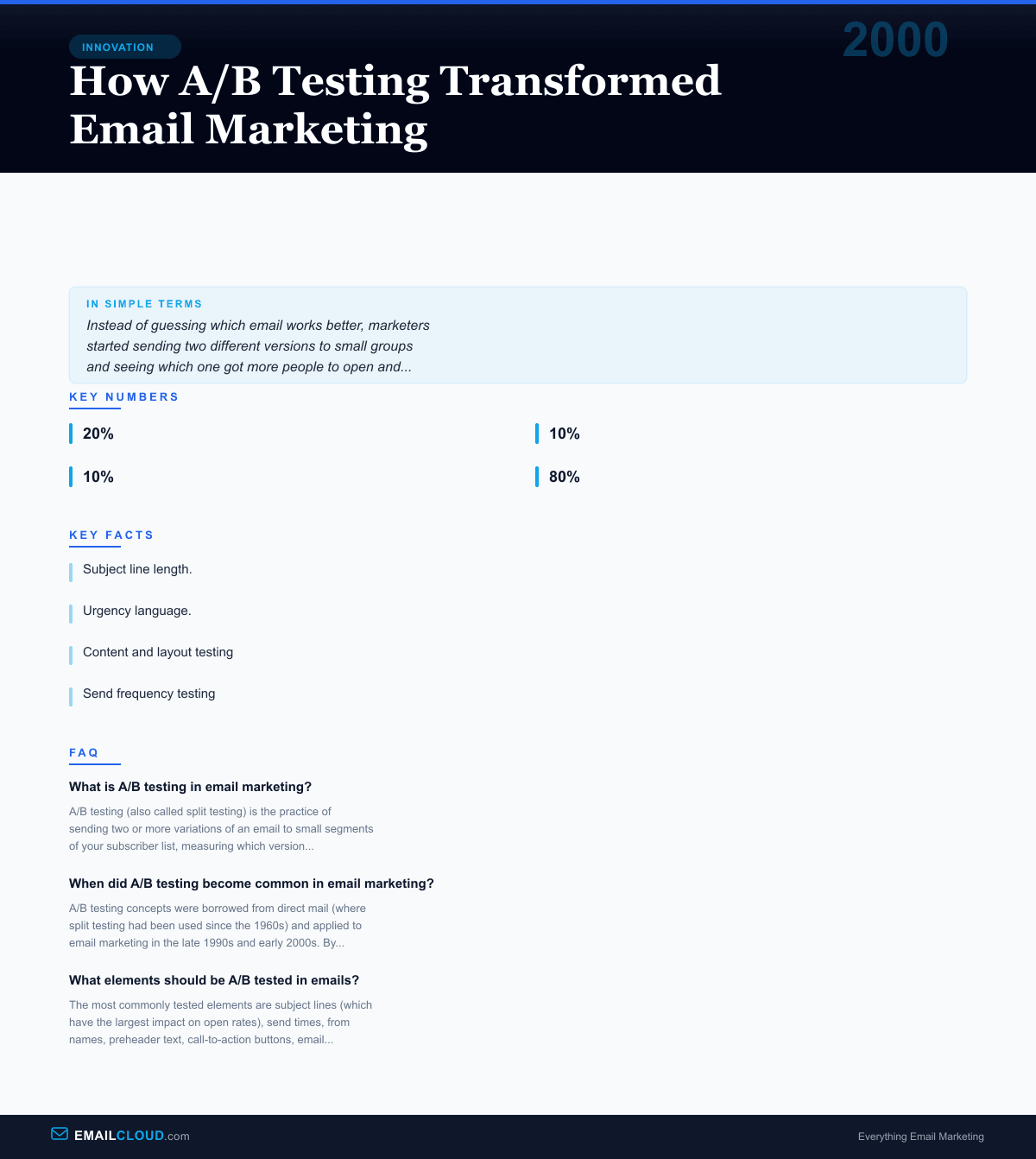
The breakthrough came when email marketing platforms built A/B testing into their software. Instead of manual list splitting, a marketer could create two subject line variations, specify the test sample size (say, 20% of the list), define the winning metric (open rate, click rate), and set a waiting period. The platform handled the rest: it sent Version A to 10% of the list and Version B to another 10%, measured results over the specified period, and automatically sent the winning version to the remaining 80%.
Mailchimp, Constant Contact, Campaign Monitor, and most other major platforms added A/B testing features by the mid-2000s. The feature went from nice-to-have to table stakes — a platform without A/B testing was considered incomplete.
What Testing Revealed
The beauty of A/B testing is that it regularly produces counterintuitive results. Some of email marketing’s most established “best practices” have been overturned by testing.
Subject line length. Conventional wisdom said shorter is better. Testing has shown that the optimal length varies dramatically by audience and context. Some segments respond better to detailed, descriptive subject lines (50-70 characters). Others prefer terse, curiosity-driven ones (20-30 characters). There is no universal best length — only the best length for your audience, discoverable through testing.
Send time. “Tuesday at 10 AM” has been cited as the optimal send time for years. Testing has revealed that optimal send times vary by industry, audience, and even individual subscriber behavior. What works for a B2B SaaS company (weekday mornings) may fail for a consumer retailer (evenings and weekends).
From name. Testing whether to send from a company name (“Acme Co”) or a person’s name (“Sarah from Acme”) consistently produces strong results — but the direction of the result varies by brand, industry, and audience relationship. There’s no universal answer.
Urgency language. Subject lines with urgency (“Last chance,” “Ending tonight”) sometimes outperform neutral alternatives by 30%+ and sometimes underperform them. The difference depends on how frequently urgency is used (overuse causes fatigue), the credibility of the urgency (is it actually ending?), and the audience’s tolerance for pressure tactics.
The Methodology
Effective email A/B testing requires more discipline than most marketers initially apply. Common pitfalls include testing multiple variables simultaneously (making it impossible to isolate which change caused the result), using sample sizes too small for statistical significance, and declaring winners too quickly before enough data has accumulated.
The standard methodology that emerged through the 2000s follows a simple framework. First, form a hypothesis: “A question-format subject line will generate a higher open rate than a statement format.” Second, create two versions that differ only in the tested element. Third, split a random, representative sample of the list. Fourth, define the winning metric and the minimum sample size needed for significance. Fifth, run the test for a sufficient duration. Sixth, analyze the results with appropriate statistical rigor.
Platforms like Mailchimp eventually added statistical significance indicators, telling marketers when a result was likely meaningful versus a random fluctuation. This was a crucial addition — many “winning” A/B tests that were declared based on small differences with small samples were actually just noise.
Beyond Subject Lines
While subject line testing dominated the early A/B testing landscape (because subject lines are easy to change and open rates are easy to measure), sophisticated marketers began testing every element of their emails.
Content and layout testing compared different email designs, different amounts of content, different image-to-text ratios, and different content ordering. Some audiences responded to long-form editorial content; others preferred brief, visual emails with minimal text.
CTA testing explored button color, button text, button placement, and the number of calls to action per email. The results were often surprising — “Shop Now” didn’t always outperform “See What’s New,” and adding a second CTA sometimes reduced overall click rates rather than increasing them.
Send frequency testing examined how often to email subscribers. More frequent sending increased total clicks but sometimes increased unsubscribe rates. The optimal frequency was always a balance between reach and fatigue, discoverable only through testing.
The Cultural Shift
A/B testing did more than improve individual campaigns. It changed the culture of email marketing teams. Decisions that were previously made by the highest-paid person in the room (the HiPPO — Highest Paid Person’s Opinion) were increasingly made by data.
“What does the test show?” became the answer to every creative debate. Should the email be funny or serious? Test it. Should the hero image show the product or a person using the product? Test it. Should the discount be 15% off or free shipping? Test it.
This data-driven culture, fostered by the ease and speed of email A/B testing, would later influence testing practices across all digital marketing channels — landing pages, ads, app interfaces, and product features. Email, with its rapid feedback loops and clean measurement, was the testing ground where data-driven marketing learned to walk.
Infographic
Share this visual summary. Right-click to save.
Related Events
Frequently Asked Questions
What is A/B testing in email marketing?
A/B testing (also called split testing) is the practice of sending two or more variations of an email to small segments of your subscriber list, measuring which version performs better on a specific metric (open rate, click rate, conversions), and then sending the winning version to the remainder of the list.
When did A/B testing become common in email marketing?
A/B testing concepts were borrowed from direct mail (where split testing had been used since the 1960s) and applied to email marketing in the late 1990s and early 2000s. By the mid-2000s, most major email marketing platforms offered built-in A/B testing features.
What elements should be A/B tested in emails?
The most commonly tested elements are subject lines (which have the largest impact on open rates), send times, from names, preheader text, call-to-action buttons, email layout, and content length. Best practice is to test one element at a time to isolate its effect.