1999: The Permission Marketing Revolution and Double Opt-In
In 1999, Seth Godin published a book called “Permission Marketing: Turning Strangers into Friends and Friends into Customers.” The core argument was deceptively simple: marketing works better when people ask for it. Instead of interrupting strangers with unwanted messages (what Godin called “interruption marketing”), businesses should seek permission first, then deliver anticipated, personal, and relevant communication to people who actually want it.
The book was a sensation in marketing circles. And while Godin’s ideas applied to marketing broadly, they found their most natural and powerful expression in email — where the concept of double opt-in turned permission from philosophy into practice.
The Permission Concept
Godin didn’t invent the idea that people respond better to messages they’ve requested than to messages that are forced upon them. Direct mail marketers had long known that response rates from house lists (people who’d previously bought from you) dramatically outperformed rented lists (people who hadn’t). But Godin crystallized the principle and gave it a name that stuck.
Permission marketing, as Godin defined it, had three characteristics. It was anticipated — the recipient expected the message and looked forward to it. It was personal — the message was relevant to the individual. And it was relevant — the content mattered to the recipient based on their interests and behavior.
This was the opposite of how most marketing worked in 1999. Television ads interrupted programs you were watching. Telemarketing calls interrupted your dinner. Spam email interrupted your inbox. Banner ads interrupted your browsing. The default model was interruption: grab attention by force and hope something sticks.
Godin argued that this model was not just ineffective but fundamentally broken. As consumers gained more control over their attention (TiVo, caller ID, spam filters, ad blockers), interruption marketing would become increasingly worthless. The alternative — earning attention through permission — was not just more ethical but more profitable.
Enter Double Opt-In
The practical implementation of permission marketing in email required a mechanism that demonstrated genuine consent. Single opt-in — simply entering an email address into a web form — was better than nothing, but it was vulnerable to several problems.
Fake signups: anyone could enter anyone else’s email address, signing up strangers without their knowledge. Typos: misspelled email addresses could result in messages being sent to the wrong person. Spam traps: addresses that end up on lists through scraping or purchasing can include spam trap addresses maintained by ISPs and anti-spam organizations. Bot submissions: automated scripts could submit thousands of fake email addresses.
Double opt-in solved all of these problems with one additional step: after entering their email address, the subscriber receives a confirmation email containing a unique verification link. Only after clicking that link is the subscription activated.
This simple mechanism provided powerful benefits. It verified that the email address was valid and accessible. It confirmed that the person who owned the address actually wanted to subscribe. It created a documented record of consent. And it filtered out bots, typos, and malicious signups.
The Tradeoff
Double opt-in wasn’t universally adopted, and the reason was straightforward: it reduced list growth. Studies consistently showed that 10-30% of people who entered their email address in a single opt-in form never completed the confirmation step in a double opt-in process. They entered their address, the confirmation email arrived, and they simply didn’t click the link — distracted, lost interest, or missed the email entirely.
For marketers focused on list size, this was a painful tradeoff. Every subscriber lost to the confirmation step was a potential customer who would never receive a marketing message. The counterargument — that subscribers who couldn’t be bothered to click a confirmation link were unlikely to engage with marketing emails anyway — was valid but didn’t ease the sting of watching signup numbers drop.
This tension between list size and list quality became one of email marketing’s most enduring debates. Large lists with questionable consent produced higher total reach but lower engagement rates, worse deliverability, and higher complaint rates. Smaller lists built through double opt-in produced lower total reach but higher engagement, better deliverability, and stronger sender reputation.
The Quality Argument Wins
Over time, the evidence accumulated in favor of double opt-in. Studies showed that double opt-in lists consistently outperformed single opt-in lists on virtually every metric that mattered.
Open rates were higher because every subscriber on a double opt-in list had demonstrated active interest. Click rates were higher for the same reason. Complaint rates (marking emails as spam) were lower because subscribers had explicitly chosen to receive messages. Bounce rates were lower because every address had been verified. And deliverability — the percentage of emails that reach the inbox rather than the spam folder — was better because ISPs used engagement metrics and complaint rates to determine inbox placement.
The deliverability advantage was particularly compelling. Email service providers began recommending (and in some cases requiring) double opt-in for their customers, recognizing that senders with verified lists produced fewer complaints and better engagement, which benefited the shared sending infrastructure that all customers relied on.
The German Standard
Germany became the de facto standard-bearer for double opt-in, not through legislation but through court decisions. German courts established that demonstrating consent for commercial email required more than a database record showing that an email address was entered into a form. The sender needed to prove that the address owner actually consented — and double opt-in, with its confirmation click creating a documented consent event, was the cleanest way to do that.
This judicial standard effectively made double opt-in a practical requirement for email marketing in Germany, even though no law explicitly mandated it. The German approach influenced practice across the European Union, where GDPR’s requirement for “demonstrable consent” made double opt-in the safest compliance strategy.
The Legacy of Permission
Godin’s permission marketing concept, implemented through double opt-in and reinforced by two decades of performance data, fundamentally reshaped email marketing from an interruption channel to a consent-based one.
The shift wasn’t complete — plenty of marketers still build lists through aggressive tactics, purchased data, and questionable consent. But the industry’s center of gravity moved decisively toward permission. The best email marketers in the world build their programs on the foundation Godin described in 1999: anticipated, personal, relevant communication to people who asked for it.
Double opt-in was the mechanism that made that foundation verifiable. Not just “we think they consented” but “they clicked the link, here’s the timestamp.” In an era of increasing privacy regulation and decreasing tolerance for unsolicited contact, that verification isn’t just good practice — it’s the bedrock on which sustainable email marketing is built.
Infographic
Share this visual summary. Right-click to save.
Related Events
Frequently Asked Questions
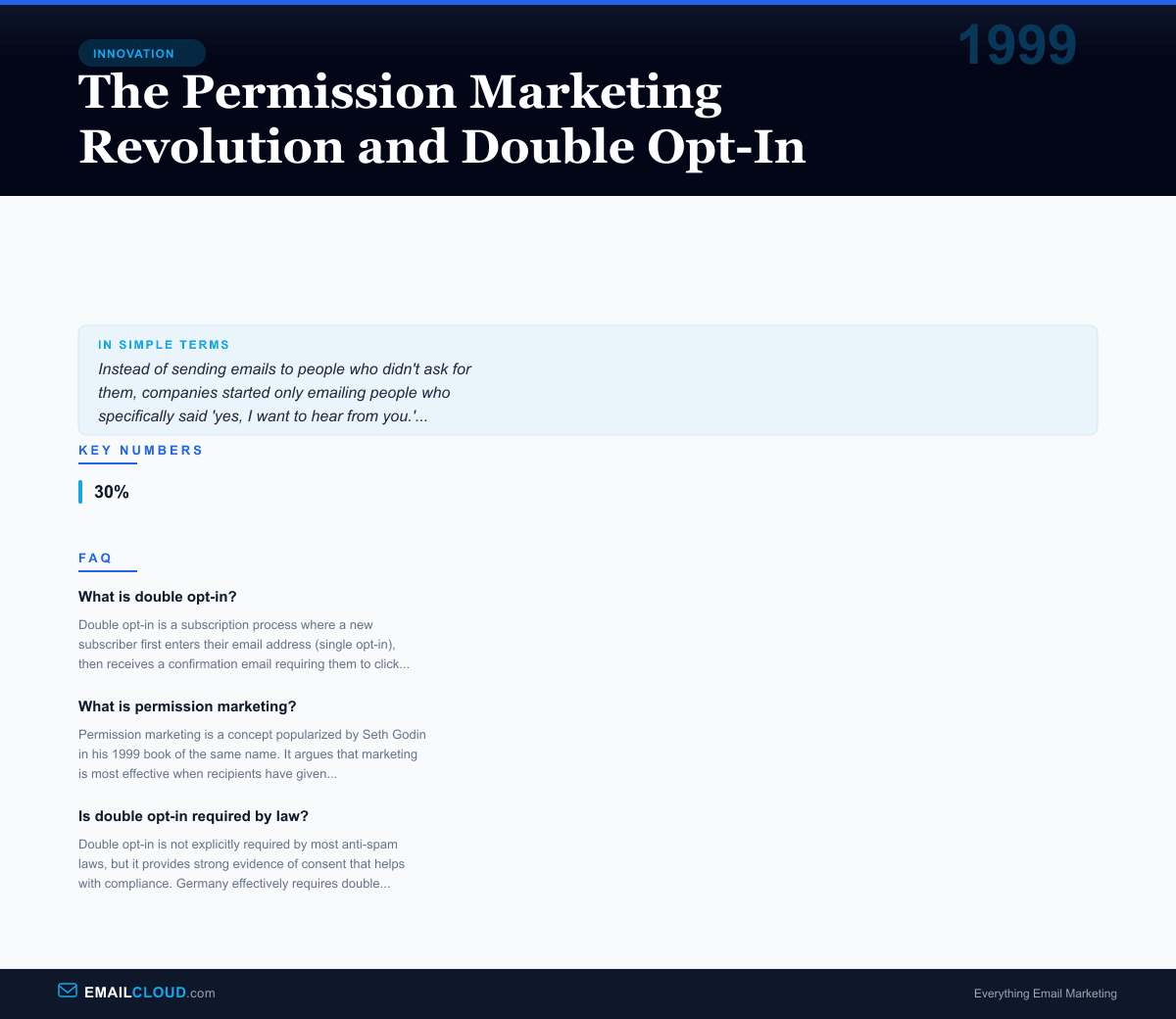
What is double opt-in?
Double opt-in is a subscription process where a new subscriber first enters their email address (single opt-in), then receives a confirmation email requiring them to click a link to verify their address and confirm their subscription. Only after clicking the confirmation link are they added to the mailing list.
What is permission marketing?
Permission marketing is a concept popularized by Seth Godin in his 1999 book of the same name. It argues that marketing is most effective when recipients have given explicit permission to receive it, creating an anticipated, personal, and relevant communication that the audience actually wants.
Is double opt-in required by law?
Double opt-in is not explicitly required by most anti-spam laws, but it provides strong evidence of consent that helps with compliance. Germany effectively requires double opt-in through court precedent. GDPR requires demonstrable consent, which double opt-in cleanly provides. Most email marketing experts recommend it as a best practice regardless of legal requirements.