1993: How Spam Got Its Name: From Monty Python to Your Inbox
In 1970, the British comedy troupe Monty Python aired a sketch that had absolutely nothing to do with computers, networking, or electronic mail. It had everything to do with canned meat. And yet, more than two decades later, that three-minute sketch would lend its central word to one of the most universally understood terms in technology.
The Sketch That Started It All
The Monty Python “SPAM” sketch, first broadcast on December 15, 1970, on BBC’s Monty Python’s Flying Circus (Season 2, Episode 12), is set in a greasy cafe. A couple walks in and asks what’s on the menu. The waitress — played by Terry Jones in drag — begins reading off options: “Egg and bacon. Egg, sausage, and bacon. Egg and SPAM. Egg, bacon, and SPAM. Egg, bacon, sausage, and SPAM…” Every single item contains SPAM. The wife (Graham Chapman) protests that she doesn’t want SPAM, but she’s drowned out by a table of Vikings who begin singing “SPAM, SPAM, SPAM, SPAM” with increasing enthusiasm, making all conversation impossible.
The joke is simple: SPAM is inescapable, overwhelming, and nobody asked for it. Sound familiar?
From MUDs to Usenet: The Word Catches On
The journey from comedy sketch to tech vocabulary began in the early internet communities of the 1980s. On MUDs (Multi-User Dungeons) — the text-based multiplayer games that were among the first online social spaces — users would sometimes flood chat with repeated junk text to annoy others. The practice reminded people of the Monty Python Vikings drowning out conversation with the word SPAM, and the comparison stuck.
By the late 1980s, “spamming” was common slang on MUDs and Usenet newsgroups for any act of flooding a channel with unwanted, repeated content. Joel Furr, a Usenet regular, is often credited with helping popularize the term in the early 1990s, though like many internet neologisms, its adoption was organic and hard to pin on a single person.
1993-1994: Junk Email Gets Its Name
The word jumped from describing chat flooding to describing unsolicited bulk email around 1993-1994, as the internet began its commercial expansion. Richard Depew accidentally posted 200 duplicate messages to a Usenet newsgroup in March 1993 due to a software bug — an event that many cite as a pivotal moment in cementing “spam” as the go-to term for unwanted bulk messages.
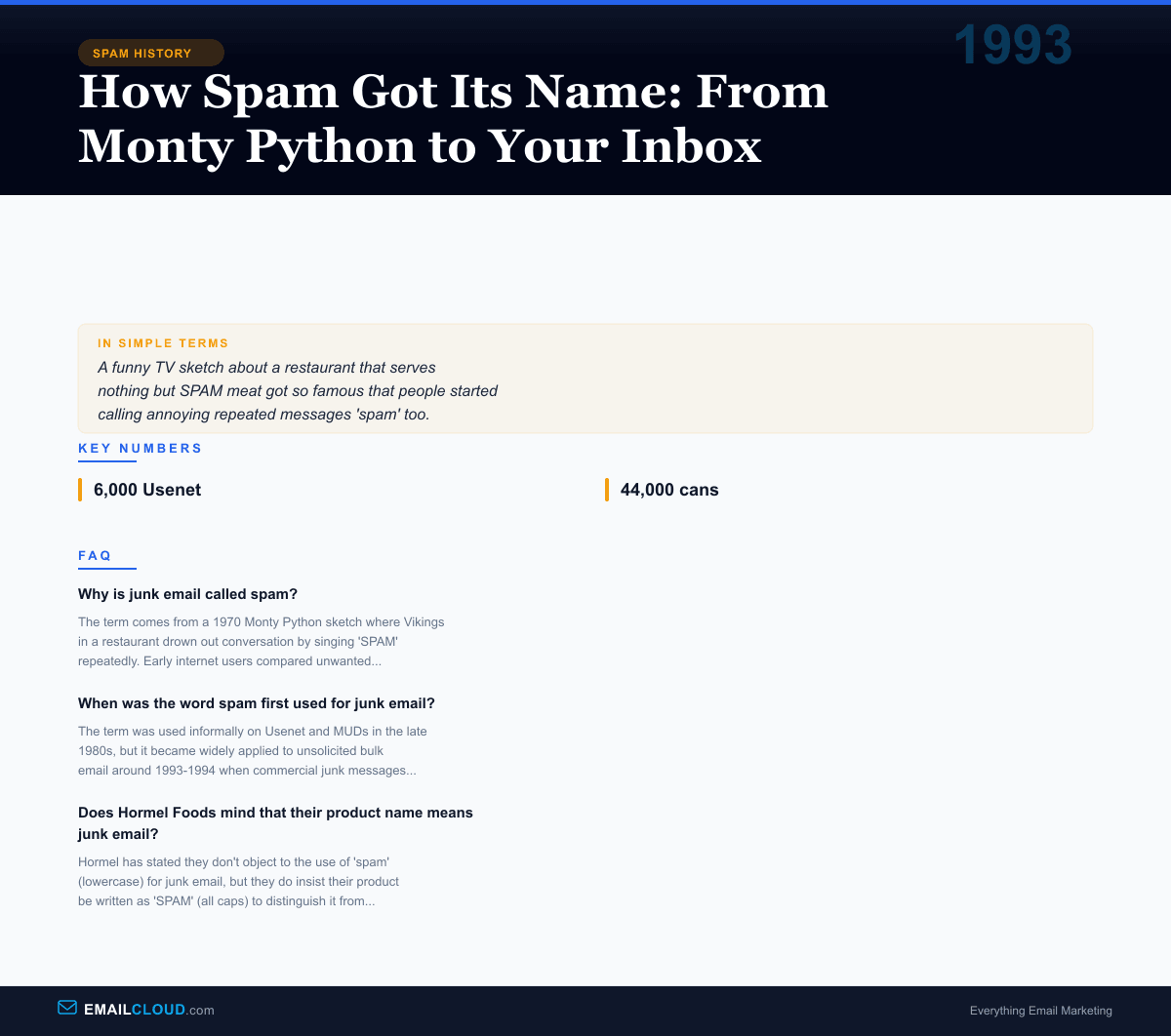
Then came the event that truly married “spam” to email forever. On April 12, 1994, immigration lawyers Laurence Canter and Martha Siegel posted an advertisement for their green card lottery services to over 6,000 Usenet newsgroups simultaneously. The internet community was furious. The backlash was immediate and intense — and everyone called the offending messages “spam.”
Canter and Siegel, showing a remarkable lack of shame, went on to write a book called How to Make a Fortune on the Information Superhighway, essentially a guide to doing exactly what everyone hated them for. The book sold modestly. Their reputation did not recover.
Why That Word and Not Another?
What makes the Monty Python connection so perfect is that it captures something deeper than just “unwanted message.” The sketch works because SPAM doesn’t just appear — it dominates. It crowds out everything else. It fills every available space until nothing remains but SPAM. That’s precisely what junk email does. It doesn’t politely knock on your inbox door; it kicks the door down and moves in the furniture.
Other terms were proposed over the years — “unsolicited commercial email” (UCE), “unsolicited bulk email” (UBE), “junk mail” — but none had the visceral, instantly understood punch of “spam.” The word carries built-in contempt, a whiff of cheap processed meat and shouting Vikings. It’s impossible to say “spam” in a positive context, which is exactly the point.
Hormel’s Surprisingly Good Humor
Hormel Foods Corporation, maker of the SPAM luncheon meat that inspired the sketch that inspired the term, has handled the situation with unusual grace for a trademark holder. The company’s official position, stated as early as the late 1990s, is that they don’t object to the use of “spam” (lowercase) for junk email, but they ask that their product be referred to as “SPAM” (uppercase) to avoid confusion.
In reality, the whole saga probably helped SPAM sales more than it hurt them. The brand has leaned into its Monty Python connection with the SPAM Museum in Austin, Minnesota (admission: free), and has generally treated the situation as free publicity. As of 2025, Hormel sells over 44,000 cans of SPAM every hour worldwide.
The Word Today
“Spam” is now so deeply embedded in global vocabulary that it transcends email entirely. People talk about “spam calls,” “spam texts,” and “spam comments” on social media. The word has been adopted into virtually every language with an internet-connected population. In 2003, Merriam-Webster officially added the lowercase “spam” to the dictionary, defining it as “unsolicited usually commercial messages sent to a large number of recipients or posted in a large number of places.”
Not bad for a word that started its life describing a canned pork product that British Vikings couldn’t stop singing about.
The irony, of course, is that today we fight spam with the very tools that early internet pioneers could only dream of. Our Spam Word Checker can analyze your email content for hundreds of trigger words that might land your legitimate messages in junk folders — a problem that exists entirely because those early internet pranksters and marketers made the word “spam” necessary in the first place.
Infographic
Share this visual summary. Right-click to save.
Related Events
Frequently Asked Questions
Why is junk email called spam?
The term comes from a 1970 Monty Python sketch where Vikings in a restaurant drown out conversation by singing 'SPAM' repeatedly. Early internet users compared unwanted bulk messages to that overwhelming repetition.
When was the word spam first used for junk email?
The term was used informally on Usenet and MUDs in the late 1980s, but it became widely applied to unsolicited bulk email around 1993-1994 when commercial junk messages began flooding the internet.
Does Hormel Foods mind that their product name means junk email?
Hormel has stated they don't object to the use of 'spam' (lowercase) for junk email, but they do insist their product be written as 'SPAM' (all caps) to distinguish it from the unwanted message variety.