1998: You've Got Mail: The Movie That Made Email Romantic
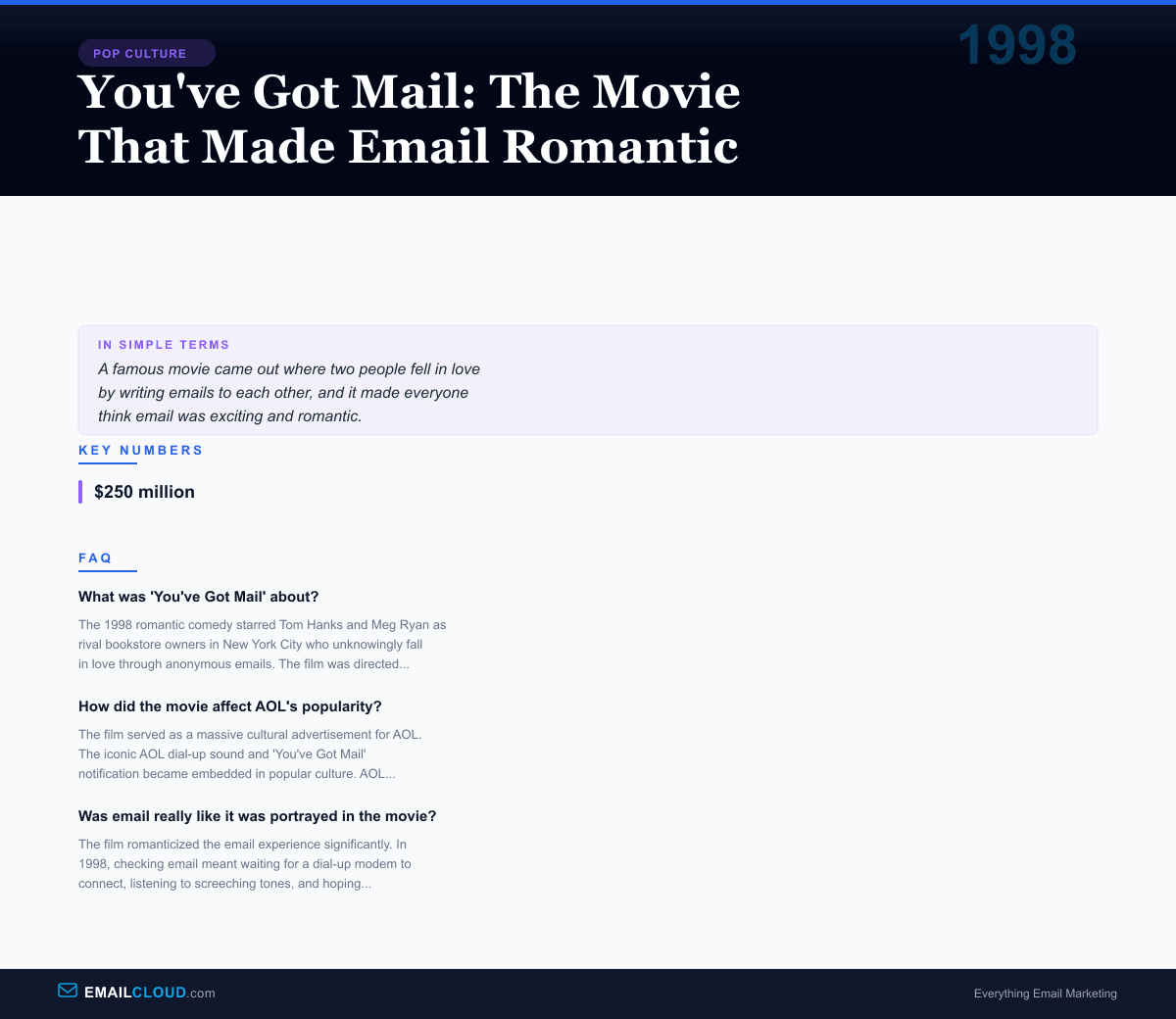
On December 18, 1998, Warner Bros. released a romantic comedy that would permanently link email to love, excitement, and the thrill of a new message notification. “You’ve Got Mail” starred Tom Hanks and Meg Ryan as two New Yorkers who despised each other in person but were falling in love through anonymous email exchanges. The film grossed $250 million worldwide, and in the process, made email — a communication tool most people were still figuring out — feel impossibly romantic.
The Plot That Sold Email to America
The premise was elegant. Kathleen Kelly (Meg Ryan) owned a small, charming children’s bookstore on the Upper West Side. Joe Fox (Tom Hanks) was the heir to a Barnes & Noble-style mega-chain opening a superstore around the corner that would put her out of business. In real life, they were enemies. Online, they were anonymous pen pals falling in love in an AOL chatroom turned private email exchange.
Director Nora Ephron — who had already proven she understood romantic communication with “Sleepless in Seattle” — understood something fundamental about email in 1998: it was intimate in a way that phone calls and face-to-face conversations were not. Email gave people time to craft their thoughts, to be wittier and more vulnerable than they might be in person. The film captured that perfectly.
The email exchanges in the film were lyrical and contemplative. Characters described their mornings, their neighborhoods, their small observations about life. Nobody was forwarding chain letters or dealing with spam. It was email as people wished it could be — pure, thoughtful, personal correspondence.
AOL’s Starring Role
The film was essentially a 119-minute advertisement for America Online, and AOL leaned into it hard. The company was a promotional partner for the film, and the iconic AOL elements were front and center: the dial-up connection sequence, the mailbox icon, and most importantly, the cheerful male voice announcing “You’ve got mail!” every time a new message arrived.
That sound bite — three words spoken by voice actor Elwood Edwards, who had originally recorded it for AOL in 1989 — became one of the most recognizable audio cues of the late 1990s. The film amplified its cultural reach enormously. For millions of Americans who were just getting their first email addresses, the AOL notification sound became synonymous with the excitement of digital communication.
AOL was at its peak during this period. The company had roughly 12 million subscribers in 1998 and would grow to over 25 million by 2002. The film both reflected and reinforced AOL’s dominance as the gateway through which most Americans experienced the internet and email.
The Reality Behind the Romance
The film’s depiction of email was, of course, deeply romanticized. In reality, checking email in 1998 meant sitting down at a desktop computer, launching AOL’s client software, waiting for the dial-up modem to screech and handshake its way to a connection, and hoping nobody in the household picked up the phone — because dial-up internet and telephone service shared the same line.
Messages were plain text. There was no rich formatting, no embedded images, no GIFs. The AOL interface was clunky by modern standards. And the internet connection was slow enough that downloading a single large attachment could take several minutes.
But the film captured something real about the email experience of that era: the genuine excitement of receiving a personal message. In 1998, email still felt novel. Most people’s inboxes contained a manageable number of messages, and most of those messages were from actual human beings who had something to say. The dopamine hit of hearing “You’ve got mail” was real because it usually meant someone was thinking about you.
A Modern “Shop Around the Corner”
Ephron was transparent about the film’s lineage. “You’ve Got Mail” was a deliberate update of the 1940 film “The Shop Around the Corner,” directed by Ernst Lubitsch, in which Jimmy Stewart and Margaret Sullavan played feuding coworkers who were secretly romantic pen pals. Ephron simply swapped physical letters for email, and a Budapest gift shop for a Manhattan bookstore.
The update worked because email in 1998 occupied the same emotional space that letter-writing had in 1940: it was personal, slightly formal, and allowed for a carefully composed version of oneself. The anonymous aspect — neither character knew the other’s real identity — added romantic tension that the medium enabled perfectly.
Cultural Impact
“You’ve Got Mail” cemented email’s place in popular culture at a critical moment. The internet was transitioning from a niche technology used by academics and early adopters to a mainstream tool used by ordinary people. The film normalized email as something fun, personal, and emotionally meaningful — not just a business tool or a novelty.
The movie also established several lasting cultural touchstones. The phrase “you’ve got mail” entered the common lexicon as shorthand for receiving any exciting digital message. The idea of online relationships — meeting and connecting with someone through text before meeting in person — was presented as charming rather than suspicious, laying groundwork for the acceptance of online dating that would follow in the 2000s.
The Irony of It All
There is a bittersweet irony to “You’ve Got Mail” in hindsight. The film romanticized AOL email at the exact moment email was about to become overwhelming. Within a few years, spam would flood inboxes, marketing messages would crowd out personal correspondence, and the thrill of “you’ve got mail” would be replaced by the dread of an inbox with 847 unread messages.
The charming, intimate, carefully-composed email exchanges depicted in the film bear almost no resemblance to how most people experience email today. But for a brief window in the late 1990s, email really did feel the way Nora Ephron portrayed it — personal, exciting, and full of possibility. The film captured that moment perfectly, even if the moment was already passing.
Infographic
Share this visual summary. Right-click to save.
Related Events
Frequently Asked Questions
What was 'You've Got Mail' about?
The 1998 romantic comedy starred Tom Hanks and Meg Ryan as rival bookstore owners in New York City who unknowingly fall in love through anonymous emails. The film was directed by Nora Ephron and was a modern retelling of the 1940 film 'The Shop Around the Corner.'
How did the movie affect AOL's popularity?
The film served as a massive cultural advertisement for AOL. The iconic AOL dial-up sound and 'You've Got Mail' notification became embedded in popular culture. AOL saw increased sign-ups during the film's theatrical run, though the company was already growing rapidly during this period.
Was email really like it was portrayed in the movie?
The film romanticized the email experience significantly. In 1998, checking email meant waiting for a dial-up modem to connect, listening to screeching tones, and hoping nobody picked up the phone line. Messages were plain text with no formatting. But the excitement of receiving a new message was real — email felt personal and intimate in ways it rarely does today.