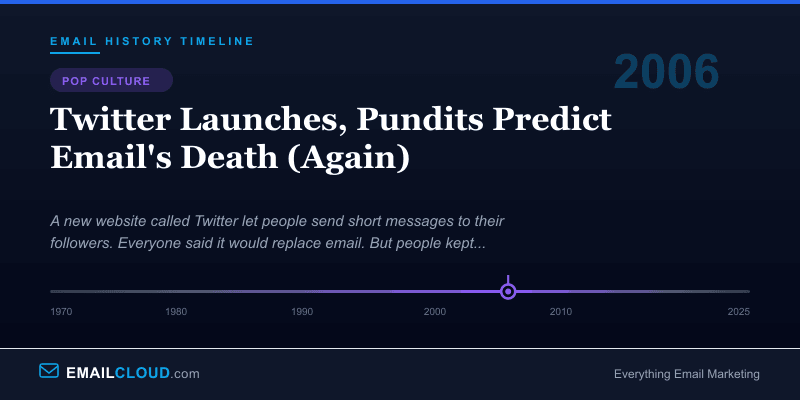
2006: Twitter Launches, Pundits Predict Email's Death (Again)
On July 15, 2006, Jack Dorsey sent the first public tweet: “just setting up my twttr.” The microblogging platform — originally called “twttr,” borrowing the vowel-dropping convention from Flickr — had been in internal development at Odeo, a struggling podcasting startup, since March. By mid-2006, it was open to the public. And almost immediately, a familiar narrative emerged in the tech press: this was the thing that would finally kill email.
It would not be the first time someone predicted email’s death. It would not be the last. And it would not be correct.
The Prediction
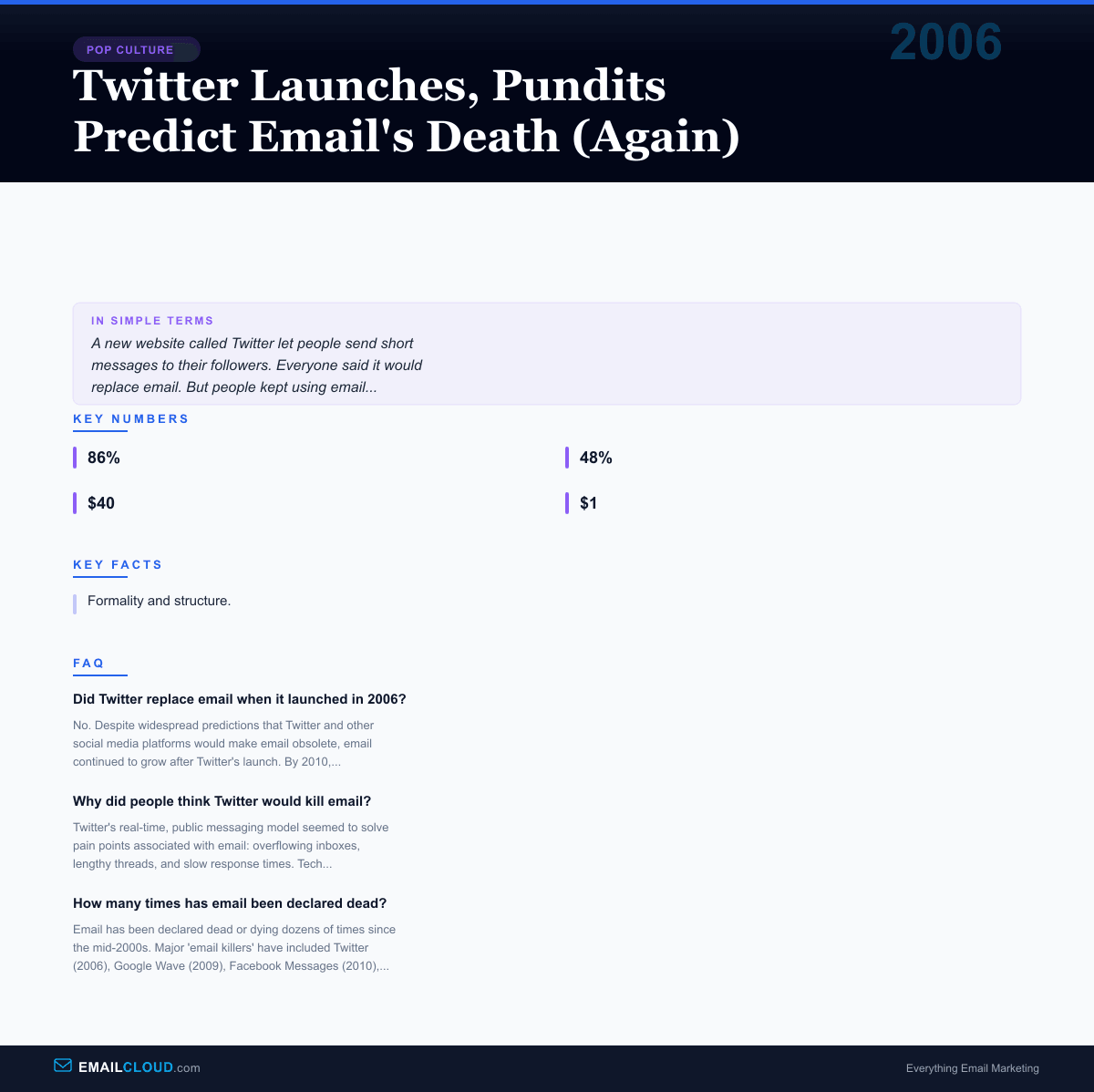
The logic seemed reasonable on the surface. Email inboxes were drowning. By 2006, spam accounted for an estimated 86% of all email traffic worldwide. The average office worker received over 100 emails per day. Email threads spiraled into incomprehensible chains of replies and forwards. CC culture created information overload. People hated their inboxes.
Twitter offered a seductive alternative. Messages were limited to 140 characters — a constraint inherited from SMS character limits, since early Twitter was designed to work via text message. There were no attachments, no lengthy threads, no CC lists. Communication was immediate and public by default. Following someone was a one-click action, not a negotiation over contact information. The simplicity was genuinely refreshing.
Tech bloggers and early adopters were smitten. Robert Scoble, then one of the most influential tech bloggers in the world, declared that Twitter was making email irrelevant for a growing portion of his communication. Michael Arrington at TechCrunch called Twitter the most important company in Silicon Valley. The narrative that social messaging would render email obsolete gained momentum throughout 2007 and 2008 as Twitter’s user base grew from thousands to millions.
What Actually Happened
Email kept growing. Twitter kept growing. They were not competing for the same use cases.
By 2008, Twitter had roughly 6 million users. Email had approximately 1.3 billion users. By 2010, Twitter had grown to 54 million active users — impressive growth by any measure. Email had grown to 2.9 billion accounts. The gap was not closing.
The reason was structural. Twitter and email served fundamentally different functions, and the things that made Twitter appealing were precisely the things that made it unsuitable as an email replacement.
Privacy. Email is private by default. Your messages go to specific recipients. Twitter is public by default. Your tweets go to everyone. For business communication, sensitive information, financial transactions, account management, and personal correspondence, privacy is not optional — it is the entire point.
Reliability. Email delivery is guaranteed (assuming no technical failures). When you send an email, it arrives in the recipient’s inbox. Twitter’s timeline was algorithmic from early on, and tweets could easily be missed in a fast-moving feed. You cannot build business processes on a communication channel where messages might not be seen.
Universality. Email is an open protocol. Anyone with an email address can communicate with anyone else who has an email address, regardless of what email provider either party uses. Twitter was a single platform owned by a single company. If you were not on Twitter, you could not participate. Email required no single platform’s permission to function.
Formality and structure. Email supports long-form communication, attachments, formatting, threading, and archiving. Twitter’s 140-character limit was charming for casual updates but useless for sending a contract, a project brief, a quarterly report, or a customer support response.
The Real Relationship
What emerged was not replacement but complementarity. Twitter became a discovery and conversation layer — a place to share ideas, follow news, and engage in public discourse. Email remained the action layer — a place to conduct business, manage accounts, and communicate privately.
In fact, Twitter actively relied on email to function. New follower notifications? Email. Direct message alerts? Email. Account verification? Email. Password resets? Email. The platform that was supposed to replace email could not operate without it.
This pattern would repeat with every subsequent “email killer.” Facebook launched Facebook Messages in 2010 with explicit ambitions to replace email for younger users. Google launched Wave in 2009 as a revolutionary replacement for email and real-time communication. Slack launched in 2013 claiming to reduce email by 48%. In every case, the new platform found its niche, and email continued to grow.
The Marketing Angle
For email marketers, the Twitter era created an interesting dynamic. Social media generated enormous excitement and marketing budgets flowed toward Twitter, Facebook, and other platforms. But when marketers measured actual return on investment, email consistently outperformed social media by wide margins.
By the late 2000s, the Direct Marketing Association reported that email marketing generated approximately $40 in revenue for every $1 spent — a figure that social media could not touch. The reason was straightforward: email delivered messages directly to individuals who had opted in to receive them. Social media delivered messages to algorithms that decided whether individuals would see them.
Smart marketers learned to use both channels symbiotically. Social media was excellent for brand awareness, audience discovery, and community building. Email was excellent for conversion, retention, and revenue. Using social media to grow an email list, then using email to drive revenue, became a standard marketing playbook that remains effective to this day.
The Lesson That Keeps Repeating
Twitter’s launch in 2006 was the most prominent early example of what has become a recurring pattern in technology coverage: a new communication platform launches, pundits declare email dead, and email continues to grow. The predictions underestimate email for the same reasons every time.
Email is not a product. It is a protocol — an open, decentralized, universally adopted standard that belongs to no one and works for everyone. Products can be disrupted by better products. Protocols are nearly impossible to displace once they reach critical mass. Email reached critical mass in the 1990s and has been gaining users ever since.
Twitter’s contribution to email’s story is not as a competitor but as a case study. It proved that even the most viral, most culturally significant new communication platform could not replace email. Not because Twitter was flawed — it was, in its early years, a genuinely brilliant product — but because email occupied a category that no social platform could fully address.
Twenty years after Twitter’s launch, email has over 4.5 billion users. Twitter (now X) has struggled to maintain 500 million. Email’s obituary has been written many times. The funeral has never taken place.
Make the most of the channel that keeps outlasting every challenger. Start with our Subject Line Grader and ROI Calculator to measure the real impact of your email program.
Infographic
Share this visual summary. Right-click to save.
Related Events
Frequently Asked Questions
Did Twitter replace email when it launched in 2006?
No. Despite widespread predictions that Twitter and other social media platforms would make email obsolete, email continued to grow after Twitter's launch. By 2010, there were over 2.9 billion email accounts worldwide compared to Twitter's 54 million active users. Email and Twitter served fundamentally different communication purposes and coexisted rather than competed.
Why did people think Twitter would kill email?
Twitter's real-time, public messaging model seemed to solve pain points associated with email: overflowing inboxes, lengthy threads, and slow response times. Tech commentators argued that public-by-default, short-form communication would replace private, long-form email for most use cases. They underestimated how much of email's value came from privacy, direct delivery, and universal interoperability.
How many times has email been declared dead?
Email has been declared dead or dying dozens of times since the mid-2000s. Major 'email killers' have included Twitter (2006), Google Wave (2009), Facebook Messages (2010), Slack (2015), and various other messaging and social platforms. As of 2026, email has over 4.5 billion users worldwide and generates the highest ROI of any digital marketing channel.