2006: Inbox Zero: Merlin Mann's Productivity Philosophy
In July 2006, a productivity blogger named Merlin Mann published a series of posts on his website 43 Folders that would spark one of the most enduring — and most debated — movements in personal email management. The concept was called Inbox Zero, and its premise was both radical and obvious: your email inbox should be empty.
Not empty because you’ve ignored everything. Empty because you’ve processed everything — decided what to do with each message as it arrives, acted on it or scheduled it, and moved it out of the inbox. The inbox is not a storage system, Mann argued. It’s a processing queue. And a queue should be cleared regularly.
The idea went viral. Mann’s 2007 Google Tech Talk on Inbox Zero became one of the most-watched productivity presentations on the internet. “Inbox Zero” entered the mainstream vocabulary. And millions of people who had been drowning in thousands of unread emails suddenly had a framework — and a name — for getting their inbox under control.
The Problem Inbox Zero Addressed
By 2006, email overload was a genuine productivity crisis. The average office worker received 50-100 emails per day. Many received far more. Inboxes had swelled into unmanageable repositories containing thousands of messages — a mix of urgent requests, irrelevant newsletters, FYI forwards, spam that escaped the filter, and messages that had been “meaning to get to” for weeks.
The default behavior for most people was to read email as it arrived, respond to the urgent stuff, and leave everything else in the inbox. Over time, the inbox became a chaotic mixture of read and unread, urgent and trivial, actionable and archived. Finding a specific email required scrolling through hundreds of messages. Important tasks fell through the cracks because the emails containing them were buried under newer arrivals.
The psychological toll was significant. Studies from the era found that email overload correlated with increased stress, reduced job satisfaction, and a persistent feeling of being behind. The inbox had become a source of anxiety — a visible, ever-growing reminder of things left undone.
Mann’s Framework
Inbox Zero, as Mann articulated it, was built on a few key principles drawn from David Allen’s Getting Things Done (GTD) methodology, adapted specifically for email.
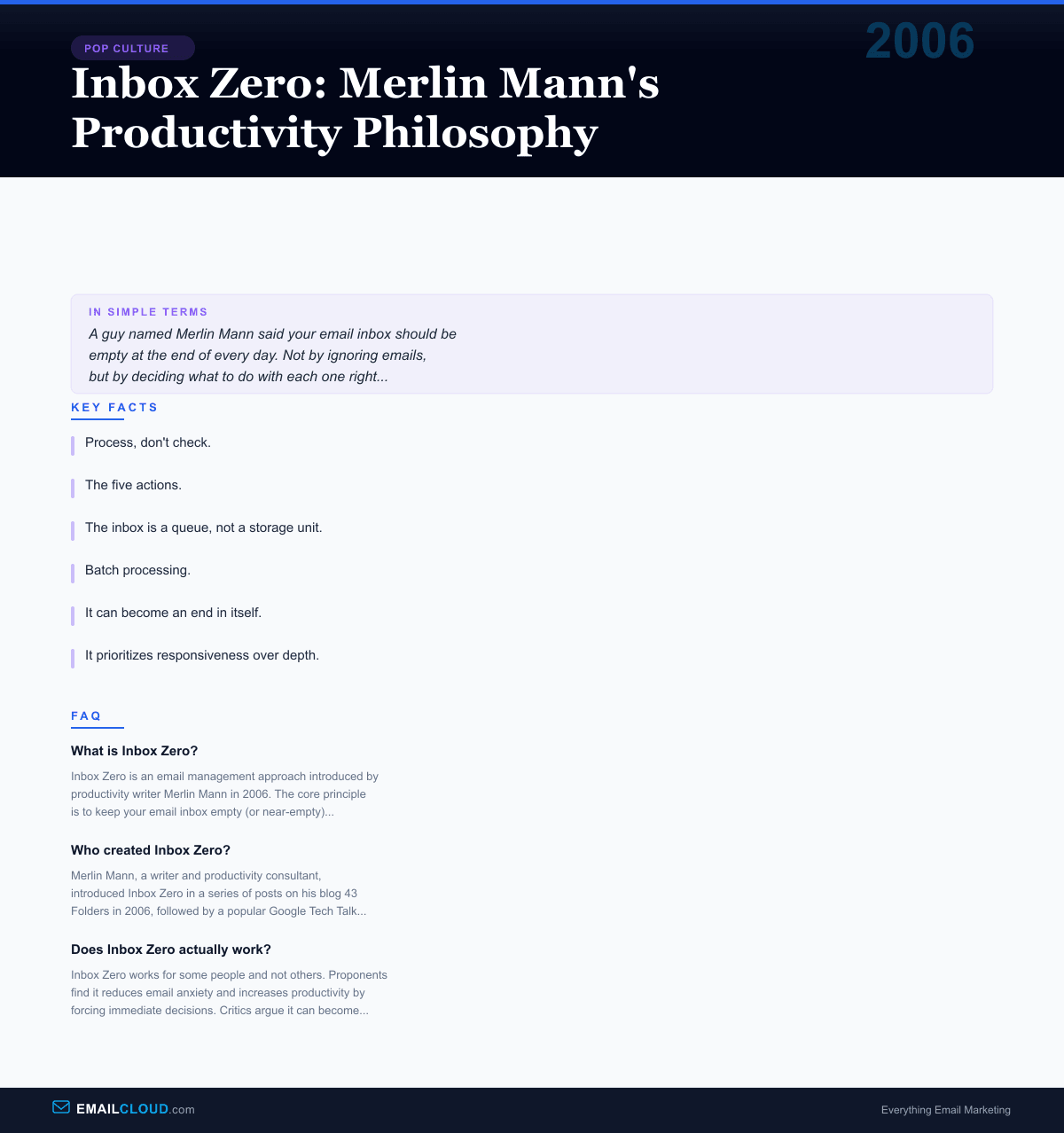
Process, don’t check. Most people “check” email — they read messages, get anxious about them, and leave them in the inbox to deal with later. Mann advocated “processing” email — looking at each message and making an immediate decision about what to do with it.
The five actions. For every email, there are only five possible actions: delete it (irrelevant or spam), delegate it (forward to the right person), respond to it (if it takes less than two minutes), defer it (move it to a task list or calendar for later action), or do it (if it’s quick and you’re the right person).
The inbox is a queue, not a storage unit. Once processed, emails should be archived, filed, or deleted — removed from the inbox. The inbox’s job is to hold new, unprocessed messages. Keeping processed messages in the inbox creates visual noise and false urgency.
Batch processing. Rather than monitoring email continuously (which fragments attention), Mann recommended processing email in batches at defined times — perhaps three times per day — and ignoring it between processing sessions.
The Cultural Impact
Inbox Zero resonated far beyond the productivity niche. The concept was covered by major media outlets, discussed in corporate training sessions, and referenced in workplace culture broadly. “Are you Inbox Zero?” became a personality identifier — a marker of organizational discipline (or obsessive tendencies, depending on who was asking).
The movement spawned an entire ecosystem of email management tools and features. Gmail introduced the “Archive” button (distinct from delete), making it easy to remove processed emails from the inbox without losing them. Multiple inbox views, labels, and filters were promoted as Inbox Zero enablers. Third-party apps like Mailbox (acquired by Dropbox), SaneBox, and Spark built their entire value propositions around helping users achieve and maintain Inbox Zero.
Apple, Google, and Microsoft all incorporated Inbox Zero principles into their email client designs. Swipe gestures for quick archiving, snooze features for deferred emails, and smart categorization (Gmail’s tabs, for instance) all reflected the idea that email should be processed efficiently rather than accumulated indefinitely.
The Backlash
Inevitably, Inbox Zero faced criticism. Detractors raised several arguments.
It can become an end in itself. Some people became so focused on maintaining an empty inbox that they spent more time managing email than doing actual work. The tool designed to reduce email anxiety became a source of its own anxiety — the need to process every message immediately, the guilt of seeing even one unread email, the compulsive checking to ensure the inbox stayed at zero.
It prioritizes responsiveness over depth. By encouraging immediate processing of every incoming email, Inbox Zero implicitly prioritized responding to other people’s agendas over focused work on your own priorities. Deep work — sustained, concentrated effort on complex tasks — requires ignoring email for extended periods, which feels like an Inbox Zero violation.
Not all email needs processing. Many emails are informational — they don’t require action, they don’t require a response, they just need to be seen (or not). Processing every FYI email with the full decision framework feels like over-engineering a simple problem.
Mann himself later expressed ambivalence about how his concept had been interpreted. In interviews, he noted that Inbox Zero was supposed to be about reducing the mental weight of email (“zero” referred to the amount of time and attention your inbox should occupy in your brain), not about literally having zero messages at all times. The nuance was lost as the concept went mainstream.
The Legacy
Nearly two decades after Mann introduced the concept, Inbox Zero remains a reference point in any conversation about email productivity. People either practice it, reject it, or practice a modified version that takes the useful principles (process rather than accumulate, archive rather than hoard) without the rigidity (it’s fine to have a few emails in your inbox).
The broader impact was cultural. Inbox Zero gave people vocabulary and framework for thinking about email management as a skill rather than a burden. Before Mann, email overwhelm was just something that happened to you. After Mann, it was something you could address with a system.
For email marketers, Inbox Zero presented a challenge: how do you earn a place in the inbox of someone who ruthlessly processes every message? The answer is the same as it’s always been — be relevant, be valuable, and be worth the subscriber’s attention. In an Inbox Zero world, every email that isn’t worth reading gets archived or deleted within seconds. The emails that survive are the ones that earn their keep.
Infographic
Share this visual summary. Right-click to save.
Related Events
Frequently Asked Questions
What is Inbox Zero?
Inbox Zero is an email management approach introduced by productivity writer Merlin Mann in 2006. The core principle is to keep your email inbox empty (or near-empty) by processing each message when you read it — responding, delegating, archiving, or deleting — rather than letting messages accumulate.
Who created Inbox Zero?
Merlin Mann, a writer and productivity consultant, introduced Inbox Zero in a series of posts on his blog 43 Folders in 2006, followed by a popular Google Tech Talk in 2007. Mann was influenced by David Allen's Getting Things Done (GTD) methodology.
Does Inbox Zero actually work?
Inbox Zero works for some people and not others. Proponents find it reduces email anxiety and increases productivity by forcing immediate decisions. Critics argue it can become an obsessive habit that prioritizes inbox maintenance over actual work. Most productivity experts now recommend finding a personal email management system rather than strictly adhering to any single approach.