2004: Bill Gates Predicts Spam Will Be Solved in Two Years
On January 24, 2004, Bill Gates stepped onto the stage at the World Economic Forum in Davos, Switzerland, and made a prediction that would age spectacularly badly.
“Two years from now, spam will be solved,” Gates declared to an audience of world leaders, executives, and policymakers.
He was not hedging. He was not speculating. He was the founder of Microsoft, one of the most influential technologists in history, and he was stating it as a near-certainty. Microsoft, he explained, was developing technical solutions that would make mass spam uneconomical. The spam problem would be a distant memory by 2006.
It is now 2026. We still get spam.
The Context
Gates’s prediction wasn’t made in a vacuum. In 2004, spam was at crisis levels and getting worse. Industry estimates suggested that spam accounted for 60-70% of all email traffic, up from roughly 40% just two years earlier. Inboxes were drowning in offers for discount pharmaceuticals, Nigerian prince schemes, mortgage refinancing pitches, and anatomy-enhancing products. For many users, email was becoming unusable.
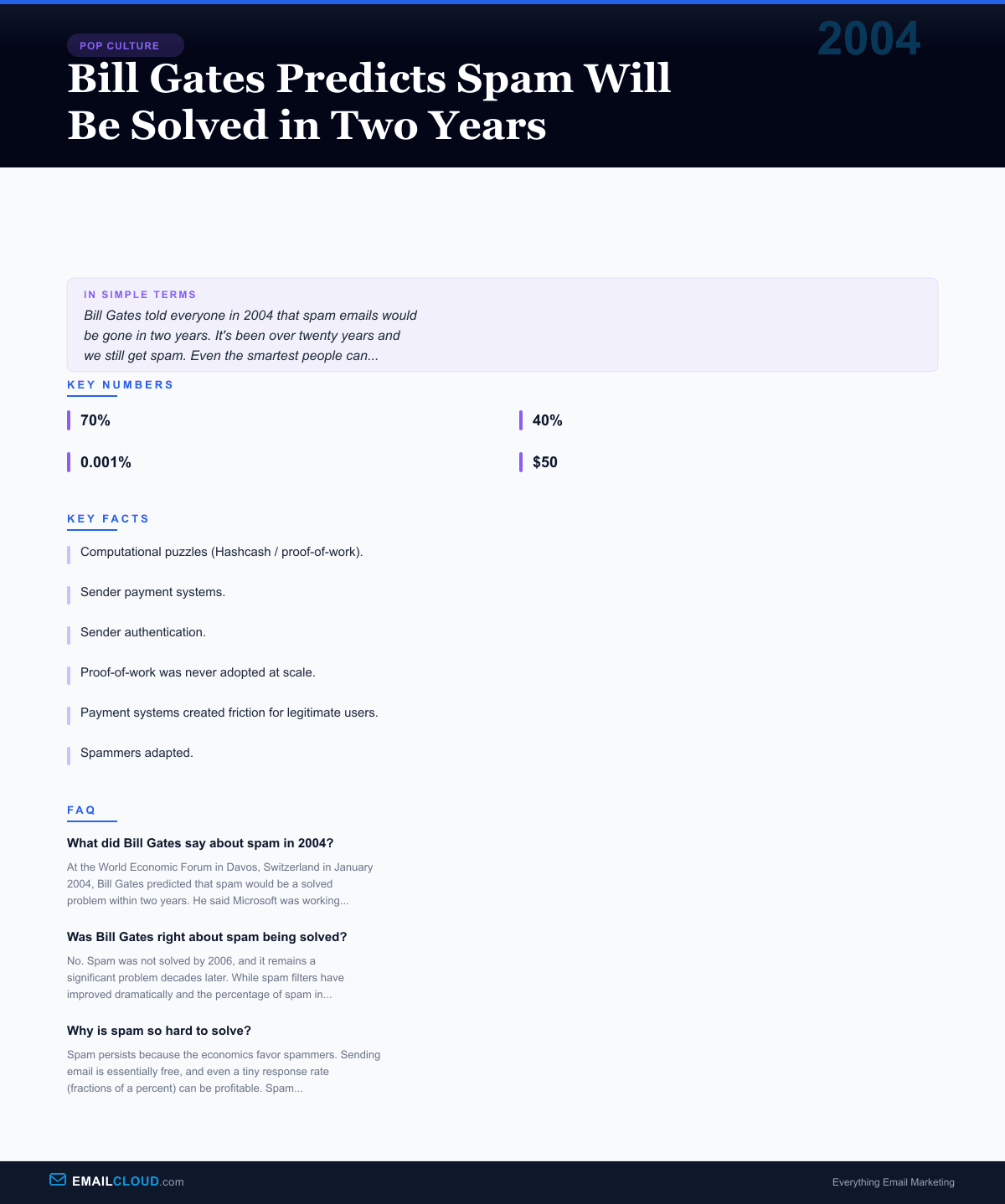
The economic incentive for spammers was straightforward and maddening. Sending a million emails cost almost nothing — perhaps a few dollars using compromised computers or cheap hosting. If even 0.001% of recipients responded (that’s 10 people out of a million), and each response generated $50 in revenue, the spammer made $500 on a $5 investment. The economics were so favorable that spam volume grew exponentially.
Microsoft, IBM, Yahoo, and other major tech companies were throwing significant resources at the problem. Spam filters were improving. Legal frameworks like the CAN-SPAM Act (signed into law just weeks before Gates’s speech) were being established. There was genuine momentum, and Gates’s optimism, while aggressive, reflected the industry’s belief that smart people with sufficient resources could engineer a solution.
The Proposed Solutions
Gates outlined several approaches Microsoft was pursuing, all centered on raising the cost of sending email to make mass spam uneconomical.
Computational puzzles (Hashcash / proof-of-work). The idea was that sending an email would require the sender’s computer to solve a small computational puzzle — trivial for a single message, but cripplingly expensive when multiplied by millions. A legitimate sender emailing a few hundred contacts would barely notice the processing cost. A spammer sending ten million messages would need enormous computing power.
Sender payment systems. Similar in concept to computational puzzles, these proposed that senders attach a small monetary payment (fractions of a cent) to each email. Recipients could automatically waive the payment for known contacts. Unknown senders would pay the toll, making mass spam expensive.
Sender authentication. Microsoft pushed Sender ID (and later DKIM/DMARC), protocols that verified the identity of email senders to prevent spoofing. If every email could be traced to its true sender, spammers would lose their anonymity.
Each solution had theoretical merit. None would prove sufficient in practice.
Why Gates Was Wrong
The fundamental problem with Gates’s prediction was that it treated spam as a technical challenge that could be solved with the right engineering. In reality, spam was — and is — an economic and behavioral problem that adapts faster than technical countermeasures can contain it.
Proof-of-work was never adopted at scale. The idea of computational puzzles required universal adoption to work. If even a fraction of email servers didn’t implement the system, spammers would simply route through those servers. Getting the entire email ecosystem — billions of servers and clients operated by millions of organizations — to adopt any single standard proved impossible.
Payment systems created friction for legitimate users. Attaching monetary cost to email would have penalized newsletters, transactional messages, and legitimate marketing alongside spam. The cure was arguably worse than the disease for many legitimate use cases.
Spammers adapted. When spam filters improved, spammers evolved. Image-based spam (text embedded in images to evade text analysis). Snowshoe spam (distributing volume across thousands of IPs to avoid blacklists). Compromised accounts (sending spam from legitimate email addresses). Every technical countermeasure triggered a counter-countermeasure.
Botnets changed the economics. By the mid-2000s, spammers weren’t paying for their own computing resources. They were using botnets — networks of thousands or millions of compromised personal computers — to send spam. The cost of computational puzzles was borne by unsuspecting PC owners, not the spammers. The economic calculus that proof-of-work was supposed to break didn’t apply when you were using other people’s computers.
What Actually Happened
Spam wasn’t solved by 2006. It got worse. Global spam volume peaked around 2008-2010, when spam accounted for an estimated 89-92% of all email traffic. Billions of spam messages were sent daily, overwhelming infrastructure and annoying users worldwide.
What eventually brought spam under control — not eliminated, but controlled — wasn’t any single brilliant solution. It was a combination of incremental improvements deployed over many years.
Machine learning spam filters, particularly Google’s implementation in Gmail, became remarkably effective at identifying and quarantining spam. By the mid-2010s, Gmail’s spam filter caught more than 99.9% of spam before it reached the inbox.
Sender authentication protocols (SPF, DKIM, DMARC) matured and achieved widespread adoption, making it harder to forge sender identities. Major ISPs began requiring authentication, which pushed legitimate senders to comply and made unauthenticated email suspicious by default.
Law enforcement actions, particularly internationally coordinated takedowns of major botnets, disrupted the infrastructure spammers relied on. The 2008 takedown of McColo, a hosting provider responsible for an estimated 75% of global spam, caused worldwide spam volumes to drop by 50-70% overnight.
The Legacy of a Bad Prediction
Gates’s prediction has become a standard cautionary tale about technological overconfidence. It’s cited in articles about failed predictions alongside the Segway being predicted to be bigger than the internet and flying cars being expected by the year 2000.
But there’s a more nuanced lesson embedded in the failure. Gates was right that smart technical solutions could dramatically reduce the impact of spam. He was wrong about the timeline, the completeness of the solution, and the adaptability of the adversary. Spam wasn’t solved — it was managed. The inbox you use today is heavily filtered, authenticated, and protected by layers of technology that didn’t exist in 2004. Spam still accounts for roughly 45-50% of all email sent, but the vast majority of it never reaches your eyes.
That’s not the crisp, complete victory Gates predicted. But for most email users, the practical problem — “my inbox is unusable because of spam” — has been solved. Just not in two years, and not through any single breakthrough. Through twenty years of slow, unglamorous, incremental improvement. Which, come to think of it, is how most problems actually get solved.
Infographic
Share this visual summary. Right-click to save.
Related Events
Frequently Asked Questions
What did Bill Gates say about spam in 2004?
At the World Economic Forum in Davos, Switzerland in January 2004, Bill Gates predicted that spam would be a solved problem within two years. He said Microsoft was working on technical solutions including computational puzzles (proof-of-work) and payment-based systems that would make mass spam uneconomical.
Was Bill Gates right about spam being solved?
No. Spam was not solved by 2006, and it remains a significant problem decades later. While spam filters have improved dramatically and the percentage of spam in total email has declined from its 2008 peak of 92%, spam still accounts for approximately 45-50% of all email sent worldwide.
Why is spam so hard to solve?
Spam persists because the economics favor spammers. Sending email is essentially free, and even a tiny response rate (fractions of a percent) can be profitable. Spam filters catch the vast majority of spam, but spammers constantly evolve techniques to evade detection. The open nature of the email protocol, which is also its greatest strength, makes it impossible to prevent unwanted messages entirely.