2023: Meta Launches Threads — The Latest 'Email Killer' That Isn't
On July 5, 2023, Meta launched Threads, a text-based social media platform designed to compete with the increasingly chaotic Twitter/X. Within its first five days, Threads had attracted 100 million sign-ups — the fastest any app had reached that milestone in history, shattering ChatGPT’s previous record of two months.
The tech press, as it does approximately once every 18 months, dutifully produced articles asking whether this new platform might finally be the thing that makes email obsolete. “Could Threads Replace Your Email Newsletter?” one outlet pondered. Others speculated about whether Threads’ integration with Instagram would finally consolidate communication in ways that would squeeze email out.
If you have been following the history of email, you already know how this story ends.
The Graveyard of Email Killers
Threads joined a distinguished roster of technologies that were supposed to end email’s reign. The list reads like a tech industry memorial wall.
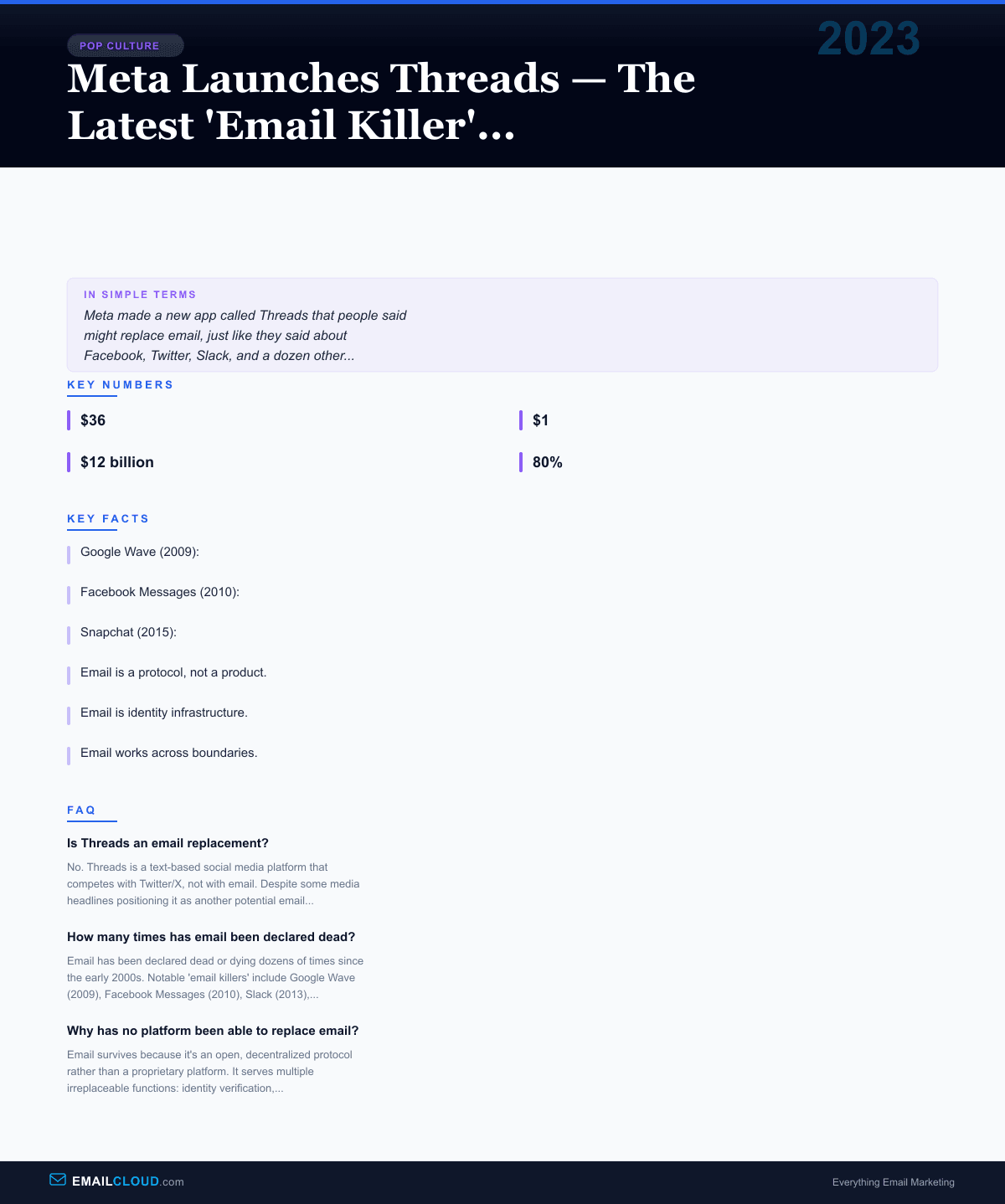
Google Wave (2009): Announced to a standing ovation at Google I/O, discontinued within a year. The “future of communication” couldn’t explain itself to ordinary users.
Facebook Messages (2010): Mark Zuckerberg declared that email was too slow for young people. Facebook @facebook.com email addresses were quietly killed by 2014.
Google+ (2011): Google’s social network was supposed to unify communication. It lasted eight years, never achieved meaningful adoption outside Google employees, and was shut down in 2019.
Slack (2013): The workplace messaging app was explicitly pitched as an email killer. “We’re replacing email,” co-founder Stewart Butterfield told press. A decade later, Slack users average 200+ messages per day — and still use email for everything external.
Snapchat (2015): Predicted to replace email for younger demographics. It carved out a niche in ephemeral visual messaging but never touched email’s core functions.
Each of these products was genuinely innovative. Several were commercially successful. None of them made even a dent in email’s user base, which has grown every single year since tracking began.
Why Threads Was Never a Threat
Threads’ positioning as a Twitter/X competitor made the “email killer” framing particularly absurd. Threads is a public social media platform for broadcasting short-form thoughts to followers. Email is a private, direct communication channel for one-to-one and one-to-many messaging. They solve completely different problems.
But the broader pattern is worth examining, because it reveals why email is structurally unkillable.
Email is a protocol, not a product. Threads is owned by Meta. If Meta decides to shut it down (as it has with numerous products before), Threads disappears. Email is defined by open standards — SMTP, IMAP, POP3 — that are implemented by thousands of independent providers. You can’t shut down email any more than you can shut down the English language.
Email is identity infrastructure. Your email address is the closest thing the internet has to a universal ID. It’s how you verify accounts, reset passwords, receive purchase confirmations, file taxes, communicate with doctors, and sign legal documents. Threads does none of these things. No social media platform does.
Email works across boundaries. A Gmail user can email an Outlook user can email a ProtonMail user can email a custom-domain user. Threads users can only communicate with other Threads users. (Meta’s eventual adoption of the ActivityPub protocol for federation partially addresses this, but the fundamental limitation remains.)
Email is a marketing channel. Businesses send over 300 billion emails per day. Email marketing generates $36-42 for every $1 spent. The entire email marketing industry exceeds $12 billion annually. Threads offers no comparable direct marketing capability and has shown no interest in developing one.
The “Email Is Dead” Industrial Complex
At this point, declaring email dead has become its own cottage industry. Tech writers know that “X will kill email” generates clicks. Startup founders know that “we’re replacing email” generates venture capital. Conference speakers know that “the future beyond email” fills conference rooms.
The reality, stubbornly and boringly, is that email is not dying. It is growing. The Radicati Group projects that email users will surpass 4.7 billion by 2026. Daily email volume continues to increase year over year. Email marketing ROI remains the highest of any digital channel.
What the “email is dead” predictions consistently miss is that email doesn’t need to be exciting to be indispensable. Nobody loves email. Nobody wakes up thrilled to check their inbox. But everybody uses it, because the alternative — managing dozens of separate communication channels for different purposes — is worse.
Threads’ Actual Trajectory
For its part, Threads followed a predictable pattern after its explosive launch. The initial 100 million sign-ups were largely driven by Instagram integration — existing Instagram users could create a Threads account with a single tap. But usage dropped sharply after the novelty wore off. Meta reported that daily active users declined by roughly 80% within the first month.
The platform stabilized and has since grown through steady feature development and its positioning as a “nicer” alternative to X. But nobody — not even Meta — seriously talks about Threads as an email replacement anymore. It found its niche as a social media platform, which is exactly what it was designed to be.
The Enduring Truth
The Threads episode was just the latest data point in email’s most remarkable quality: its persistence. Email was old when the World Wide Web was born. It was ancient when social media arrived. It’s practically prehistoric by tech industry standards. And it keeps growing.
The reason is simple: email solves a fundamental human need — asynchronous, private, cross-platform written communication — better than anything else ever created. Every “email killer” either fails to replicate email’s full functionality or succeeds only by becoming, essentially, email with a different name.
The protocol that has now survived every challenger for more than 50 years isn’t going anywhere. If you’re building a communication strategy, building it on email is still the safest bet in technology.
Stop worrying about whether email is dying and start making your emails better. Test your subject lines with our Subject Line Grader and run your content through the Spam Word Checker to ensure maximum deliverability.
Infographic
Share this visual summary. Right-click to save.
Related Events
Frequently Asked Questions
Is Threads an email replacement?
No. Threads is a text-based social media platform that competes with Twitter/X, not with email. Despite some media headlines positioning it as another potential email killer, Threads serves a fundamentally different purpose — public social conversation rather than private, direct communication. Email's role as identity infrastructure, authentication layer, and marketing channel is completely outside Threads' scope.
How many times has email been declared dead?
Email has been declared dead or dying dozens of times since the early 2000s. Notable 'email killers' include Google Wave (2009), Facebook Messages (2010), Slack (2013), Snapchat (2015), and countless others. As of 2025, email has over 4.5 billion users and continues to grow year over year, making it the most resilient communication technology in internet history.
Why has no platform been able to replace email?
Email survives because it's an open, decentralized protocol rather than a proprietary platform. It serves multiple irreplaceable functions: identity verification, account authentication, formal communication, legal documentation, marketing channel, and transactional notifications. No single platform can replace all of these functions, and email's universality means it reaches everyone regardless of which other platforms they use.