2003: History of Anti-Spam Legislation Around the World
The year 2003 was the tipping point. Spam had grown from an annoyance to a crisis — accounting for over half of all email traffic worldwide — and governments on every continent finally decided to do something about it. What followed was a patchwork of national laws, each taking a slightly different approach to the same problem. Some were strict. Some were permissive. Some were well-enforced. Some were purely symbolic. Together, they represent the global community’s collective, messy, and ongoing attempt to keep email usable.
The Two Philosophies
Before diving into specific laws, it’s important to understand the fundamental philosophical divide that separates anti-spam legislation worldwide.
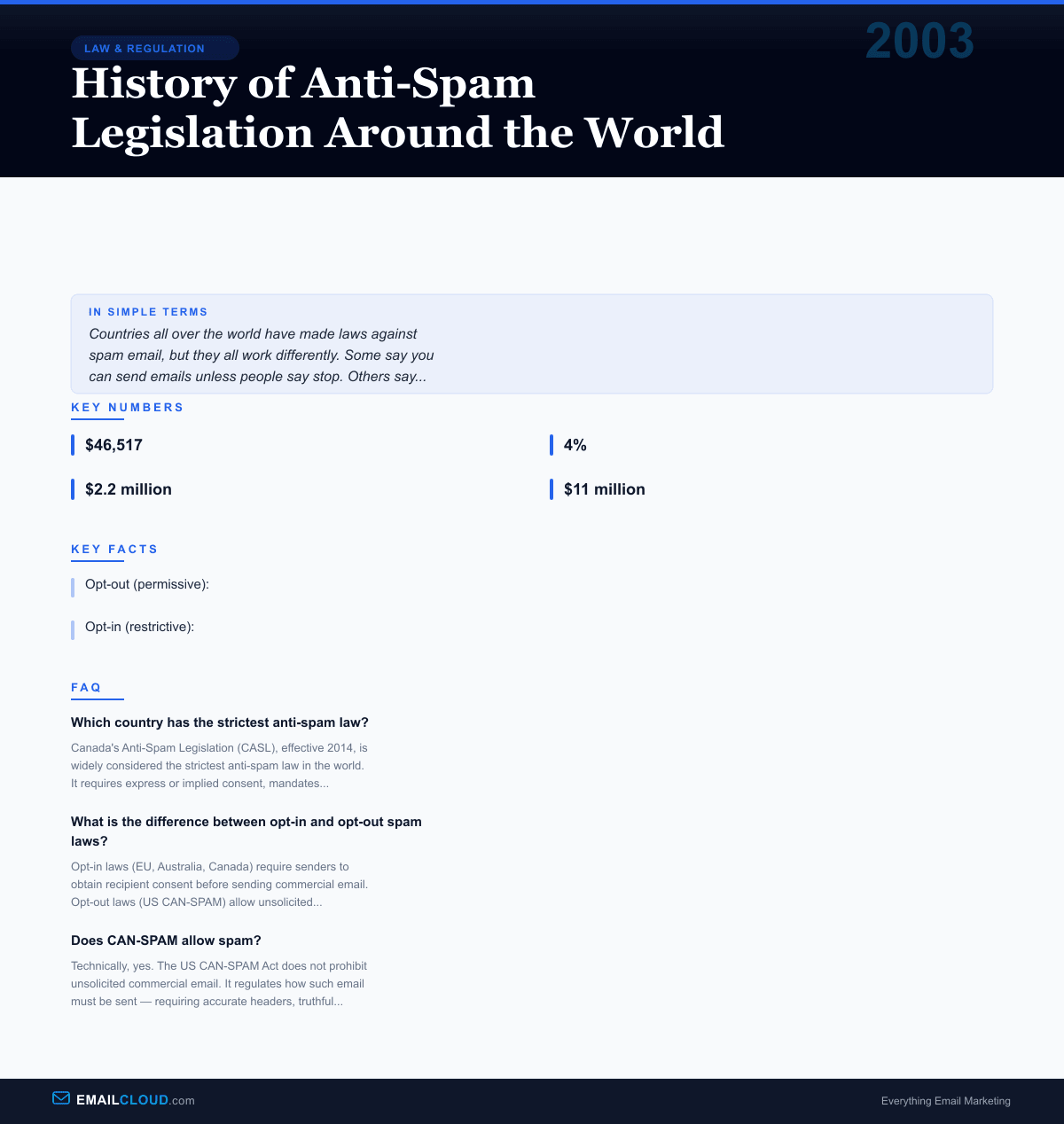
Opt-out (permissive): You can send commercial email to anyone, but you must stop if they ask. The sender has the default right to email; the recipient has the right to refuse. The United States is the most prominent opt-out jurisdiction.
Opt-in (restrictive): You cannot send commercial email without the recipient’s prior consent. The recipient has the default right to not be emailed; the sender must earn permission. The European Union, Australia, and Canada are the most prominent opt-in jurisdictions.
This divide shapes everything about how email marketing operates in each jurisdiction — from list building to campaign strategy to compliance infrastructure.
United States: CAN-SPAM Act (2003)
The Controlling the Assault of Non-Solicited Pornography and Marketing Act (CAN-SPAM) was signed into law by President George W. Bush in December 2003. Despite its aggressive name, CAN-SPAM is one of the more permissive anti-spam laws in the world.
CAN-SPAM does not require prior consent to send commercial email. Instead, it establishes rules for how commercial email must be sent: accurate header information, non-deceptive subject lines, identification as an advertisement, a valid physical postal address, and a working unsubscribe mechanism that must be honored within 10 business days.
Penalties can reach $46,517 per email in violation, though enforcement has been selective. The FTC has pursued major cases but lacks the resources to police the vast majority of CAN-SPAM violations.
Critics have called CAN-SPAM the “You Can Spam Act” because it effectively legalizes unsolicited commercial email as long as senders follow the formatting rules. The law preempts stricter state laws, meaning states cannot impose opt-in requirements that exceed CAN-SPAM’s opt-out framework.
European Union: ePrivacy Directive (2002) + GDPR (2018)
The EU took the opposite approach. The ePrivacy Directive of 2002 required opt-in consent for commercial electronic messages, establishing the principle that recipients must actively agree to receive marketing before the first message is sent.
GDPR, effective May 2018, added a broader layer of data protection that applies to the collection and processing of email addresses themselves. Under GDPR, storing an email address is processing personal data, requiring a lawful basis (typically consent or legitimate interest) and compliance with data minimization, purpose limitation, and data subject rights.
The combination of ePrivacy and GDPR creates the strictest email marketing framework among major economies. Penalties under GDPR can reach 4% of global annual turnover or 20 million euros, whichever is higher.
Australia: Spam Act (2003)
Australia’s Spam Act requires express or inferred consent before sending commercial electronic messages. Penalties can reach AUD $2.2 million per day for individuals and AUD $11 million per day for corporations. The Australian Communications and Media Authority (ACMA) has pursued aggressive enforcement, making Australia one of the most inhospitable jurisdictions for spammers.
Canada: CASL (2014)
Canada’s Anti-Spam Legislation is widely considered the strictest anti-spam law in the developed world. CASL requires express or implied consent, mandates detailed sender identification, and carries penalties up to $1 million CAD per violation for individuals and $10 million CAD per violation for organizations.
CASL’s consent requirements are particularly demanding. Express consent must be actively given (no pre-checked boxes). Implied consent has strict time limits — it expires after two years from a business transaction or six months from an inquiry. The burden of proving consent falls on the sender.
The law also includes a private right of action, allowing individuals to sue senders for statutory damages — though this provision was suspended before it took effect and has remained in limbo.
Japan: Act on Regulation of Transmission of Specified Electronic Mail (2002, amended 2008)
Japan initially adopted an opt-out approach in 2002, similar to CAN-SPAM. In 2008, the law was amended to require opt-in consent, aligning Japan more closely with the European and Australian models. The law applies to emails sent from or to Japan and requires senders to retain records of consent.
South Korea: Act on Promotion of Information and Communications Network Utilization (2001)
South Korea implemented opt-in requirements early, prohibiting commercial email without prior consent. The law requires clear identification of commercial messages and includes provisions for automated spam filtering. South Korea has also been aggressive in pursuing cross-border spam enforcement.
Brazil: Marco Civil da Internet (2014) + LGPD (2020)
Brazil’s internet regulations evolved in two phases. The Marco Civil da Internet established baseline internet rights, while the LGPD (Lei Geral de Protecao de Dados) — modeled heavily on GDPR — added comprehensive data protection including consent requirements for commercial email.
China: Regulations on Internet Email Services (2006)
China’s approach to email regulation is shaped by its broader internet control framework. The regulations prohibit sending commercial email without consent and require senders to use accurate identification. Enforcement operates through China’s internet regulatory apparatus, which has broad authority over electronic communications.
The Compliance Challenge
For email marketers operating globally, the patchwork of national laws creates a complex compliance landscape. A company sending email from the United States to recipients in Europe, Australia, and Canada must simultaneously comply with CAN-SPAM, GDPR, the ePrivacy Directive, Australia’s Spam Act, and CASL — each with different consent requirements, different penalty structures, and different enforcement mechanisms.
The practical solution adopted by most sophisticated global marketers is to default to the strictest applicable standard. If you build your email program to comply with CASL and GDPR — the two strictest major frameworks — you will be compliant virtually everywhere. This means genuine opt-in consent, clear sender identification, easy unsubscription, and robust record-keeping.
This convergence toward the strictest standard has had a positive effect on global email marketing practices. Companies that invested in permission-based marketing to comply with European or Canadian law found that their email performance improved worldwide — opt-in subscribers engage more, convert better, and generate higher lifetime value than unsolicited recipients.
The anti-spam legislative landscape continues to evolve. New laws, amendments, and enforcement actions add complexity every year. But the global trend is clear: the world is moving toward opt-in, and the email marketers who build their programs on genuine consent are positioned to thrive regardless of which jurisdiction’s rules apply.
Infographic
Share this visual summary. Right-click to save.
Related Events
Frequently Asked Questions
Which country has the strictest anti-spam law?
Canada's Anti-Spam Legislation (CASL), effective 2014, is widely considered the strictest anti-spam law in the world. It requires express or implied consent, mandates sender identification, and carries penalties up to $10 million CAD per violation for businesses. Australia's Spam Act 2003 is similarly strict.
What is the difference between opt-in and opt-out spam laws?
Opt-in laws (EU, Australia, Canada) require senders to obtain recipient consent before sending commercial email. Opt-out laws (US CAN-SPAM) allow unsolicited commercial email as long as an unsubscribe mechanism is provided. Most of the world has moved toward opt-in requirements.
Does CAN-SPAM allow spam?
Technically, yes. The US CAN-SPAM Act does not prohibit unsolicited commercial email. It regulates how such email must be sent — requiring accurate headers, truthful subject lines, identification as an advertisement, a physical address, and a working unsubscribe mechanism. Critics have called it the 'You Can Spam Act.'