2003: Australia's Spam Act 2003: $2.2 Million Per Day Penalty
In December 2003, the Australian Parliament passed the Spam Act 2003, creating one of the most aggressive anti-spam legal frameworks in the world. Where the American CAN-SPAM Act (passed the same year) took a relatively permissive approach — allowing unsolicited commercial email as long as it included an unsubscribe option — Australia went the opposite direction. Under the Spam Act, sending commercial email without prior consent was flatly illegal, with penalties that could reach $2.2 million AUD per day for individuals and $11 million AUD for corporations.
The law took effect on April 10, 2004, and immediately established Australia as one of the most inhospitable jurisdictions for email spammers on earth.
The Australian Context
Australia’s tough stance on spam was driven by the same problem plaguing every other connected country: inboxes drowning in unsolicited commercial messages. By 2003, estimates suggested that over 50% of email traffic in Australia was spam. Australian consumers and businesses were complaining loudly, and the government’s response was characteristically direct.
The Australian Communications and Media Authority (ACMA), the body tasked with enforcing the new law, had a reputation for aggressive regulation. Unlike some regulatory agencies that relied primarily on warnings and voluntary compliance, ACMA was prepared to pursue enforcement actions, levy fines, and make examples of violators.
The political will behind the Spam Act was bipartisan. Both major parties agreed that spam was an economic drain and a consumer nuisance that required strong legislative action. The debate wasn’t about whether to regulate spam, but about how strictly to regulate it.
The Consent Requirement
The Spam Act’s most significant provision — and the one that distinguished it from the American approach — was the consent requirement. Under the Act, sending a commercial electronic message requires either express consent (the recipient explicitly agreed to receive messages) or inferred consent (an existing business relationship that makes the message expected and reasonable).
Express consent means the recipient took a clear, affirmative action to agree to receive commercial messages. Checking a box on a website, signing up for a newsletter, or providing an email address specifically for marketing purposes all qualify. Pre-checked boxes, buried terms of service, or purchased email lists do not.
Inferred consent is more nuanced. If a customer purchases a product from a business, the business can reasonably infer consent to send related commercial messages — but only for a reasonable period and only for messages related to the existing relationship. A hardware store that sold you a drill can email you about drill accessories. It cannot sell your address to a mortgage broker.
This opt-in framework was fundamentally different from the American CAN-SPAM model, which effectively created an opt-out system. Under CAN-SPAM, a business could email anyone as long as it provided an unsubscribe link. Under Australia’s Spam Act, a business needed permission before sending the first message.
The Penalties
The Spam Act’s penalty structure was designed to deter through severity. Maximum civil penalties of $2.2 million AUD per day for individuals and $11 million AUD per day for bodies corporate were dramatic numbers — far exceeding the typical penalties in other jurisdictions.
The per-day structure was particularly significant. Unlike one-time fines that a large company might absorb as a cost of doing business, per-day penalties created escalating exposure for ongoing violations. A company that continued sending spam after being notified faced theoretically unlimited financial liability.
ACMA also had the power to issue infringement notices (essentially tickets for spam), accept enforceable undertakings (formal agreements from violators to change their behavior), and seek injunctions in federal court. This range of enforcement tools allowed ACMA to calibrate its response from gentle warning to nuclear option.
Enforcement in Action
ACMA didn’t just pass the law and walk away. The authority pursued enforcement actions against both Australian and international spammers, establishing that the Act had real consequences.
In 2007, ACMA obtained a $5.5 million AUD penalty against Clarity1, a company that had sent over 200 million spam messages advertising mobile phone content. The case was one of the largest spam penalties in the world at the time and sent a clear signal to the market.
The authority also pursued international cooperation, working with regulatory agencies in the United States, United Kingdom, and other countries to address cross-border spam. The international dimension was critical because spam, by nature, ignores national boundaries — a spammer in one country can target recipients in another with ease.
ACMA maintained a public register of enforceable undertakings, naming companies that had violated the Act and documenting the corrective actions they agreed to take. This public accountability added reputational consequences to the financial penalties.
The Global Influence
Australia’s opt-in approach to spam regulation influenced subsequent legislation in other jurisdictions. The European Union’s ePrivacy Directive (which also required prior consent for commercial email) and the later GDPR both aligned more closely with Australia’s opt-in model than with the American opt-out approach.
Canada’s Anti-Spam Legislation (CASL), passed in 2010 and effective in 2014, borrowed heavily from both Australian and European models, implementing strict consent requirements with substantial penalties.
The philosophical divide between the Australian/European opt-in model and the American opt-out model remains one of the most significant differences in global email regulation. Marketers operating internationally must navigate both frameworks, typically defaulting to the stricter standard to ensure compliance across all jurisdictions.
Impact on Email Marketing
For legitimate email marketers, Australia’s Spam Act initially created compliance headaches but ultimately improved industry practices. The consent requirement forced marketers to build subscriber lists based on genuine opt-in rather than purchased data or scraped addresses. The result was smaller but higher-quality lists with better engagement rates.
Marketers who complied with the Australian standard typically found their email performance improved. Opt-in subscribers open more emails, click more links, and convert at higher rates than unsolicited recipients. The law, in effect, forced marketers to adopt best practices that they should have been following anyway.
The Spam Act also established a clear legal framework that reduced ambiguity. Marketers who maintained proper consent records and included required identification and unsubscribe mechanisms could operate with confidence. The rules were strict but clear, which is often preferable to vague guidelines that leave compliance uncertain.
Twenty years after its passage, the Spam Act 2003 remains one of the toughest and most effective anti-spam laws in the world. Australia’s spam volumes have declined significantly (though not eliminated), and the law has served as a model for countries seeking to protect their citizens from unwanted commercial email. Not bad for a country that decided the best way to fight spam was to make it terrifyingly expensive.
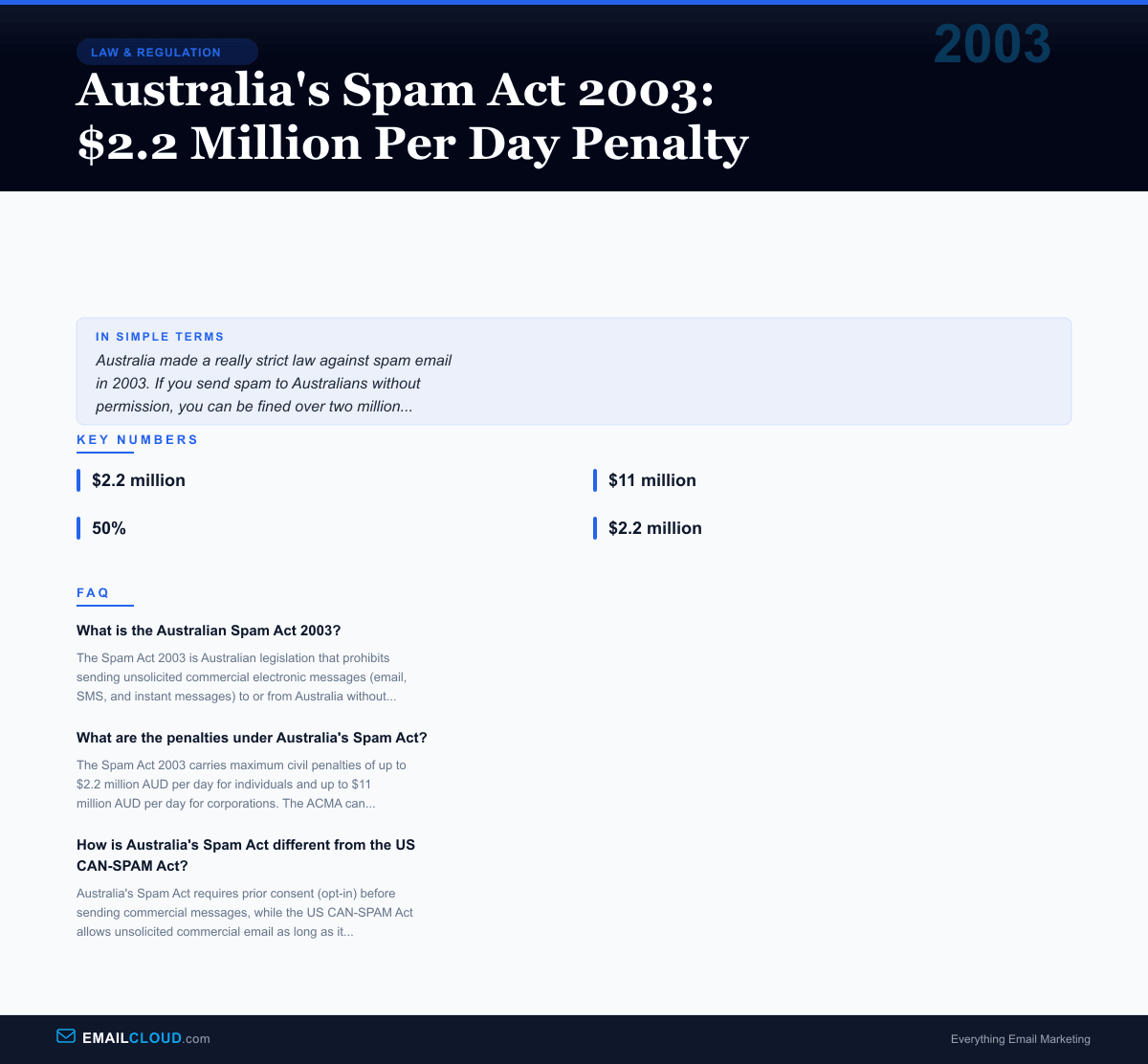
Infographic
Share this visual summary. Right-click to save.
Related Events
Frequently Asked Questions
What is the Australian Spam Act 2003?
The Spam Act 2003 is Australian legislation that prohibits sending unsolicited commercial electronic messages (email, SMS, and instant messages) to or from Australia without the recipient's consent. It took effect on April 10, 2004, and is enforced by the Australian Communications and Media Authority (ACMA).
What are the penalties under Australia's Spam Act?
The Spam Act 2003 carries maximum civil penalties of up to $2.2 million AUD per day for individuals and up to $11 million AUD per day for corporations. The ACMA can also issue formal warnings, enforceable undertakings, and injunctions.
How is Australia's Spam Act different from the US CAN-SPAM Act?
Australia's Spam Act requires prior consent (opt-in) before sending commercial messages, while the US CAN-SPAM Act allows unsolicited commercial email as long as it includes an opt-out mechanism. Australia's approach is considered stricter and more consumer-protective.