2002: The Invention of Drip Campaigns: Automated Email Sequences
Somewhere around 2002, a marketer had an insight that seems painfully obvious in retrospect: relationships don’t happen in a single email. A stranger doesn’t become a customer because of one message, any more than a first date leads directly to a wedding proposal. There are stages. There’s a progression. And if email marketing was going to work like relationship building, it needed to work in sequences, not isolated blasts.
The drip campaign was born — and it would become the single most effective tactic in the email marketer’s arsenal.
The Name
The term “drip campaign” comes from drip irrigation — the agricultural technique of slowly delivering small amounts of water to plants over time, rather than flooding the field all at once. The metaphor is apt. Instead of drenching a prospect with everything you want to tell them in one massive email, you drip-feed information gradually, each message building on the last, each one nudging the recipient a little closer to action.
The concept existed in direct mail long before email. Insurance companies, car dealerships, and real estate agents had used sequential mailings for decades — send a postcard, follow up with a letter, follow up with another letter. But physical mail was slow and expensive. Each piece required printing, postage, and handling. Running a 10-step direct mail sequence to 5,000 prospects cost thousands of dollars and took months.
Email made drip sequences fast and virtually free. Once the sequence was written and the automation set up, it ran itself indefinitely. The marginal cost of adding the 5,001st prospect to a drip sequence was effectively zero.
The First Implementations
The earliest automated email sequences were crude by modern standards. Early marketing automation platforms like Eloqua (founded 1999) and tools like InfusionSoft (later Keap, founded 2001) offered basic time-based automation: send Email 1 immediately, send Email 2 three days later, send Email 3 seven days after that.
These early drips were linear — every recipient followed the same path at the same pace, regardless of their behavior. If you opened every email and clicked every link, you got the same drip as someone who never opened any of them. The sequence was time-based, not behavior-based.
This was still a massive improvement over manual campaigns. A marketer could set up a 10-email welcome sequence, configure the timing, and walk away. Every new subscriber would automatically receive the entire sequence over the following weeks. No manual sending, no remembering who got what, no risk of forgetting to send the third email in the series.
The Behavioral Revolution
The next evolution — and the one that made drip campaigns truly powerful — was behavior-based branching. Instead of every recipient following the same path, the sequence could adapt based on what the recipient did.
If a subscriber opened Email 3 and clicked the link to your pricing page, they might be fast-tracked to a sales-oriented sequence. If they didn’t open Email 3, they might receive a re-engagement email instead. If they made a purchase at any point, they’d exit the prospect drip and enter a customer onboarding drip.
This branching logic turned drip campaigns from simple sequences into complex workflows — decision trees that responded to individual behavior in real time. The terminology shifted too: what started as “drip campaigns” became “workflows,” “automations,” or “journeys,” reflecting their increased sophistication.
Platforms like HubSpot, ActiveCampaign, and Marketo built visual workflow builders that let marketers design branching automations by dragging and connecting boxes on a canvas — if/then logic made visual and accessible.
The Classic Drip Sequences
Over two decades of practice, several drip campaign archetypes have proven their value across virtually every industry:
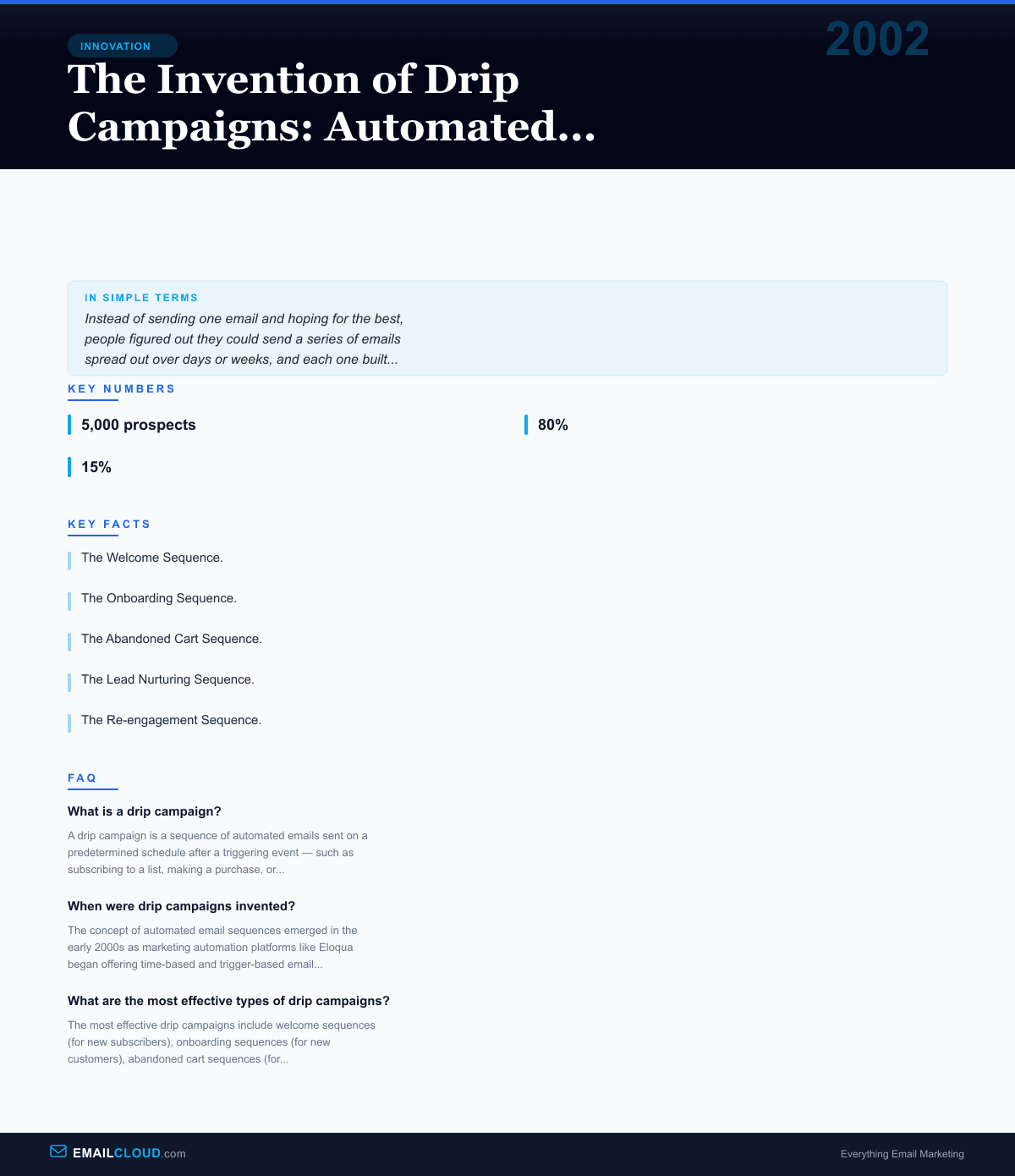
The Welcome Sequence. Triggered when someone subscribes to a list. Typically 3-7 emails over 1-3 weeks. Introduces the brand, sets expectations, delivers a promised lead magnet, and establishes the relationship. Welcome emails have the highest open rates of any email type — often 50-80% — because the subscriber just opted in and is at peak interest.
The Onboarding Sequence. Triggered when someone creates an account or makes a first purchase. Guides the new user through setup, key features, and early wins. SaaS companies live and die by their onboarding sequences — a well-designed drip can dramatically reduce churn by ensuring new users reach their “aha moment” quickly.
The Abandoned Cart Sequence. Triggered when an e-commerce shopper adds items to their cart but doesn’t complete the purchase. Typically 3 emails: a reminder (1 hour), a persuasion email (24 hours), and a final-chance offer (48-72 hours). Abandoned cart emails recover an estimated 5-15% of otherwise lost revenue — making them one of the highest-ROI automations in all of marketing.
The Lead Nurturing Sequence. Triggered when a prospect downloads content, attends a webinar, or takes another top-of-funnel action. Delivers progressively more specific information over days or weeks, moving the prospect from awareness to consideration to purchase intent.
The Re-engagement Sequence. Triggered when a subscriber becomes inactive — typically defined as not opening or clicking for 30-90 days. Attempts to reignite interest with a compelling offer, a content roundup, or a direct “do you still want to hear from us?” message. Subscribers who don’t re-engage are cleaned from the list.
The Impact
The impact of drip campaigns on email marketing economics is difficult to overstate. Before automation, every email required a marketer’s active involvement — writing, scheduling, sending, analyzing. The marketer’s time was the bottleneck, which meant that the volume and sophistication of email communication was limited by headcount.
After automation, the marketer’s job shifted from executing campaigns to designing systems. A well-constructed set of drip sequences could handle welcome emails, onboarding, lead nurturing, cross-selling, win-back, and re-engagement — all running simultaneously, 24 hours a day, with no manual intervention.
This shift created a compounding effect. Each automated sequence a company built continued generating value indefinitely. A welcome sequence written in January was still nurturing subscribers in December. An abandoned cart sequence configured once recovered revenue from every cart abandonment, forever. The marketer’s effort was invested once; the returns accumulated continuously.
The drip campaign is, in the end, email marketing’s answer to the question every business faces: how do you build relationships at scale? Not with a single brilliant message, but with a patient, consistent, well-timed sequence of relevant messages. Not with a flood, but with a drip.
Infographic
Share this visual summary. Right-click to save.
Related Events
Frequently Asked Questions
What is a drip campaign?
A drip campaign is a sequence of automated emails sent on a predetermined schedule after a triggering event — such as subscribing to a list, making a purchase, or downloading content. Each email 'drips' additional information to move the recipient toward a goal.
When were drip campaigns invented?
The concept of automated email sequences emerged in the early 2000s as marketing automation platforms like Eloqua began offering time-based and trigger-based email workflows. The term 'drip campaign' became widely used by the mid-2000s.
What are the most effective types of drip campaigns?
The most effective drip campaigns include welcome sequences (for new subscribers), onboarding sequences (for new customers), abandoned cart sequences (for e-commerce), re-engagement sequences (for inactive subscribers), and educational sequences (for lead nurturing).