2019: Email Reaches 4 Billion Users — More Than Any Social Platform
In 2019, a milestone passed that most of the tech world barely noticed. The Radicati Group, a technology market research firm that has tracked email statistics since the 1990s, reported that the number of worldwide email users had reached approximately 3.9 billion and was on pace to cross 4 billion by early 2020. To put that number in context: Facebook, the largest social media platform on Earth, had about 2.4 billion monthly active users. Instagram had around 1 billion. Twitter had roughly 330 million.
Email — a protocol designed in the 1970s, running on technology standards finalized in the 1980s, perpetually declared dead by tech pundits — had more users than any social media platform. It wasn’t even close.
The Numbers Nobody Talks About
The tech media loves social media growth stories. Facebook’s rise from a dorm room to 2 billion users generated thousands of breathless articles. Instagram hitting a billion was front-page news. TikTok’s explosive growth from 2018 onward became the story of a generation.
But email’s quiet growth to 4 billion users received almost no attention. There were no IPO celebrations, no founder profiles, no congressional hearings. Email just kept growing, year after year, roughly tracking global internet adoption because email was — and remains — the internet’s default identity layer.
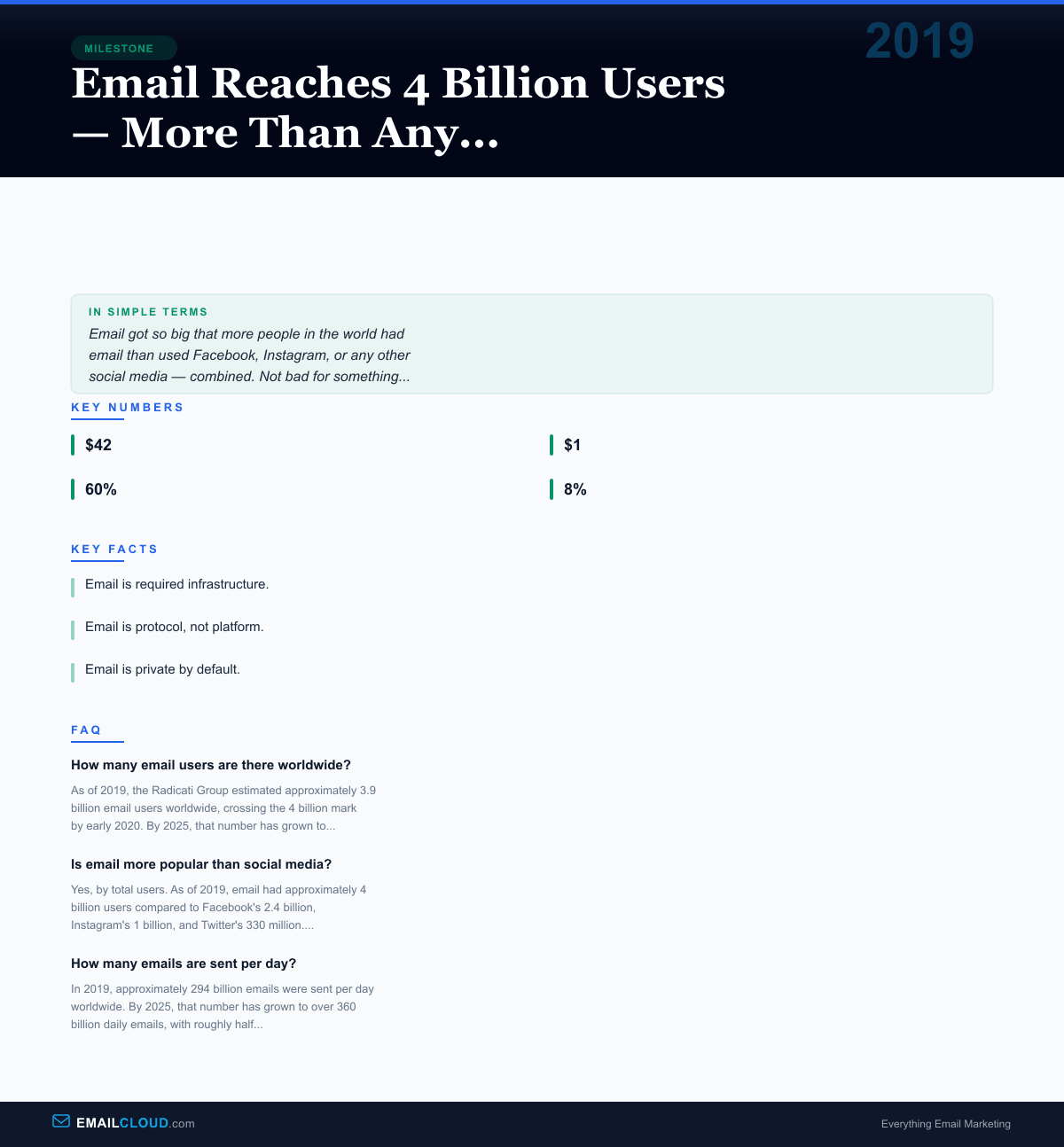
The numbers tell a story of remarkable resilience. In 2019, approximately 294 billion emails were sent per day. The average office worker received 121 emails daily. Email marketing generated an estimated $42 in return for every $1 spent, maintaining its position as the highest-ROI marketing channel for the seventh consecutive year according to the Data & Marketing Association.
Why Email Keeps Growing
Email’s growth to 4 billion users wasn’t driven by any single innovation or company. It was driven by three structural forces that no competing platform can replicate.
Email is required infrastructure. You need an email address to create an account on Facebook, Instagram, Twitter, TikTok, Amazon, Netflix, your bank, your government’s tax portal, your children’s school system, and virtually every other online service. Email isn’t just a communication tool — it’s the digital equivalent of a street address. As internet adoption expands in Africa, South Asia, and Southeast Asia, email adoption follows automatically because you can’t be on the internet without it.
Email is protocol, not platform. Nobody owns email. Gmail, Outlook, Yahoo Mail, and thousands of smaller providers all interoperate using the same open standards (SMTP, IMAP, POP3). This means email doesn’t suffer from the network effects that trap users on closed platforms. You can switch from Gmail to ProtonMail without losing the ability to communicate with anyone. This openness means email can never be disrupted by a single company’s decisions the way social media audiences can vanish when an algorithm changes.
Email is private by default. An email sits in your inbox until you choose to read it. It doesn’t compete with an algorithmic feed. The sender doesn’t know if you read it, when you read it, or how long you spent reading it (absent tracking pixels, which can be blocked). In an era of increasing privacy consciousness, email’s basic architecture is more appealing than ever.
The Social Media Comparison
The 4-billion-user milestone was particularly striking when compared to the trajectory of social media platforms that had been repeatedly predicted to “replace” email.
Facebook, founded in 2004, reached 2.4 billion monthly active users in 2019 — impressive by any standard, but still just 60% of email’s reach. And Facebook’s numbers included significant bot activity and duplicate accounts that inflated the true user count.
Twitter, launched in 2006, peaked at about 330 million monthly active users — roughly 8% of email’s user base. Despite its outsized cultural influence, Twitter never came close to email’s scale.
Even messaging apps — WhatsApp (1.5 billion users in 2019), Facebook Messenger (1.3 billion), and WeChat (1.1 billion) — were each far smaller than email. And unlike email, each operated within a walled garden where users could only communicate with others on the same platform.
What 4 Billion Users Means for Marketers
The scale of email’s user base is the fundamental reason that email marketing continues to dominate digital marketing ROI. Consider the math: if your target audience is “people with internet access,” email reaches essentially all of them. No social media ad campaign can make that claim.
The 4-billion-user milestone also underscored a demographic reality that social media platforms struggle with. Email usage spans every age group roughly evenly. According to Statista, email penetration in 2019 exceeded 90% for adults aged 25-64 in developed markets. Social media usage, by contrast, skews younger, with significant drop-offs among users over 55.
For businesses, this means email is the one channel that reliably reaches customers regardless of age, geography, or platform preference. A 65-year-old grandmother and a 22-year-old college student may use completely different social media platforms — or none at all — but both almost certainly have email.
The Quiet Giant
Email’s 4-billion-user milestone was a reminder that the most important technologies aren’t always the most exciting ones. Email doesn’t trend on social media. It doesn’t generate viral moments. It doesn’t make founders into celebrities. But it connects more people than any communication technology in human history, and it does so using open, decentralized protocols that no single company controls.
The protocol that Ray Tomlinson invented in 1971 with a test message between two adjacent computers now serves half the world’s population. That’s not just survival — that’s dominance.
Reaching even a fraction of those 4 billion users starts with emails that actually get opened. Build stronger subject lines with our free Subject Line Grader and calculate what your email audience is worth with our ROI Calculator.
Infographic
Share this visual summary. Right-click to save.
Related Events
Frequently Asked Questions
How many email users are there worldwide?
As of 2019, the Radicati Group estimated approximately 3.9 billion email users worldwide, crossing the 4 billion mark by early 2020. By 2025, that number has grown to an estimated 4.6 billion. Email remains the most widely used digital communication tool in the world.
Is email more popular than social media?
Yes, by total users. As of 2019, email had approximately 4 billion users compared to Facebook's 2.4 billion, Instagram's 1 billion, and Twitter's 330 million. Even today, email has more active users than any single social media platform, partly because an email address is required to create accounts on virtually every social network.
How many emails are sent per day?
In 2019, approximately 294 billion emails were sent per day worldwide. By 2025, that number has grown to over 360 billion daily emails, with roughly half being business-related and the other half split between marketing, transactional, and personal messages.