2021: Apple Mail Privacy Protection Breaks Open Rate Tracking
On September 20, 2021, Apple released iOS 15, and email marketing would never be the same. Buried in the update alongside FaceTime improvements and a redesigned notification system was a feature called Mail Privacy Protection (MPP). When users enabled it — and Apple made sure most users would — it fundamentally broke the metric that email marketers had relied on for over two decades: the open rate.
How Open Rate Tracking Worked
Since the late 1990s, email marketers had tracked open rates using a deceptively simple technique: the tracking pixel. An invisible 1x1 pixel image was embedded in the HTML of every marketing email. When a recipient opened the email, their email client loaded the image from the sender’s server. That image request told the sender: this person opened this email, from this IP address, at this time, on this device.
Open rates weren’t perfect — they didn’t work for plain text emails, and image-blocking in some clients suppressed them — but they were the universally accepted standard for measuring email engagement. Open rates determined send time optimization, list segmentation, subject line testing, deliverability monitoring, and campaign reporting. Entire email marketing strategies were built on the foundation of “who opened what.”
What Apple Did
Apple’s Mail Privacy Protection was elegant in its simplicity. When enabled, Apple’s Mail app pre-fetched all email content — including tracking pixels — through Apple’s own proxy servers, regardless of whether the user actually opened the email. This had three immediate effects.
First, every email sent to an Apple Mail user with MPP enabled appeared to be “opened,” whether the person read it or not. Second, the IP address recorded by the tracking pixel was Apple’s proxy, not the user’s real IP, eliminating location tracking. Third, the timing was Apple’s fetch time, not when the user actually read the message, eliminating behavioral timing data.
Apple made it easy to enable MPP. During the iOS 15 setup process, users were prompted to “Protect Mail activity” with a clear, privacy-friendly description. Research from various email platforms suggested that 95-97% of iOS 15 users opted in. Given Apple’s market share in email clients — Apple Mail was the most-used email client worldwide, handling roughly 50% of all email opens across iPhone, iPad, and Mac — the impact was massive.
The Immediate Fallout
Email marketing teams worldwide watched their open rate data become meaningless almost overnight. Brands that had been tracking 20-25% open rates suddenly saw rates jump to 40-60% as Apple Mail users registered as “opened” regardless of actual behavior.
The problem wasn’t just inflated numbers — it was that the numbers were now unreliable. You couldn’t tell the difference between an Apple Mail user who read your email carefully and one who deleted it without looking. Segmentation strategies that relied on “opened in the last 30 days” became worthless for half the subscriber base. Sunset policies that removed “inactive” subscribers based on open activity suddenly couldn’t identify inactive Apple Mail users.
A/B testing of subject lines — a cornerstone practice — was compromised because Apple Mail opens didn’t reflect genuine human choice. If half your test audience was on Apple Mail, your open rate data was polluted with phantom opens.
The Industry Adapts
The email marketing industry’s response to MPP was remarkably fast. Within months, the conversation shifted from “open rates are king” to “open rates are dead.” While that was an oversimplification — open rates still worked for Gmail, Yahoo, and Outlook users — the industry collectively began de-emphasizing open rates and pivoting to more reliable metrics.
Click-through rates became the new primary engagement metric for many teams. Unlike open tracking, click tracking relies on URL redirects that MPP doesn’t interfere with. When a subscriber clicks a link in your email, that click is genuine and trackable.
Conversion tracking grew in importance. Instead of asking “did they open it?” marketers began asking “did they buy something?” Revenue per email, conversion rate, and downstream attribution became the metrics that mattered.
Reply rates emerged as a deliverability signal, particularly for B2B senders. A subscriber who replies to your email is definitively engaged — no tracking pixel required.
Some platforms introduced “engaged open rate” metrics that attempted to filter out Apple Mail phantom opens using heuristics. These were imperfect but better than raw open rates.
The Broader Privacy Movement
Apple’s MPP wasn’t an isolated action. It was part of a broader industry trend toward user privacy that included Safari’s Intelligent Tracking Prevention, Firefox’s Enhanced Tracking Protection, Google’s (delayed, complicated) deprecation of third-party cookies, and an overall shift in consumer expectations around data privacy.
For email marketers, MPP was a wake-up call. The tracking techniques that the industry had relied on for twenty years were built on a foundation of user surveillance that was increasingly unacceptable to platforms, regulators, and users themselves.
Why It Matters
Apple Mail Privacy Protection forced the email marketing industry to mature. Open rates had always been a vanity metric — they told you who opened your email, but not who actually read it, engaged with it, or took action because of it. MPP pushed marketers toward metrics that actually correlate with business outcomes.
The companies that adapted fastest — shifting to click-based segmentation, revenue attribution, and engagement scoring — found that their marketing actually improved. They were optimizing for actions, not eyeballs.
If you’re still building your email strategy around open rates, it’s time to evolve. Focus on crafting compelling content that drives clicks and conversions. Our ROI Calculator can help you model the real business impact of your email campaigns beyond open rates.
Infographic
Share this visual summary. Right-click to save.
Related Events
Frequently Asked Questions
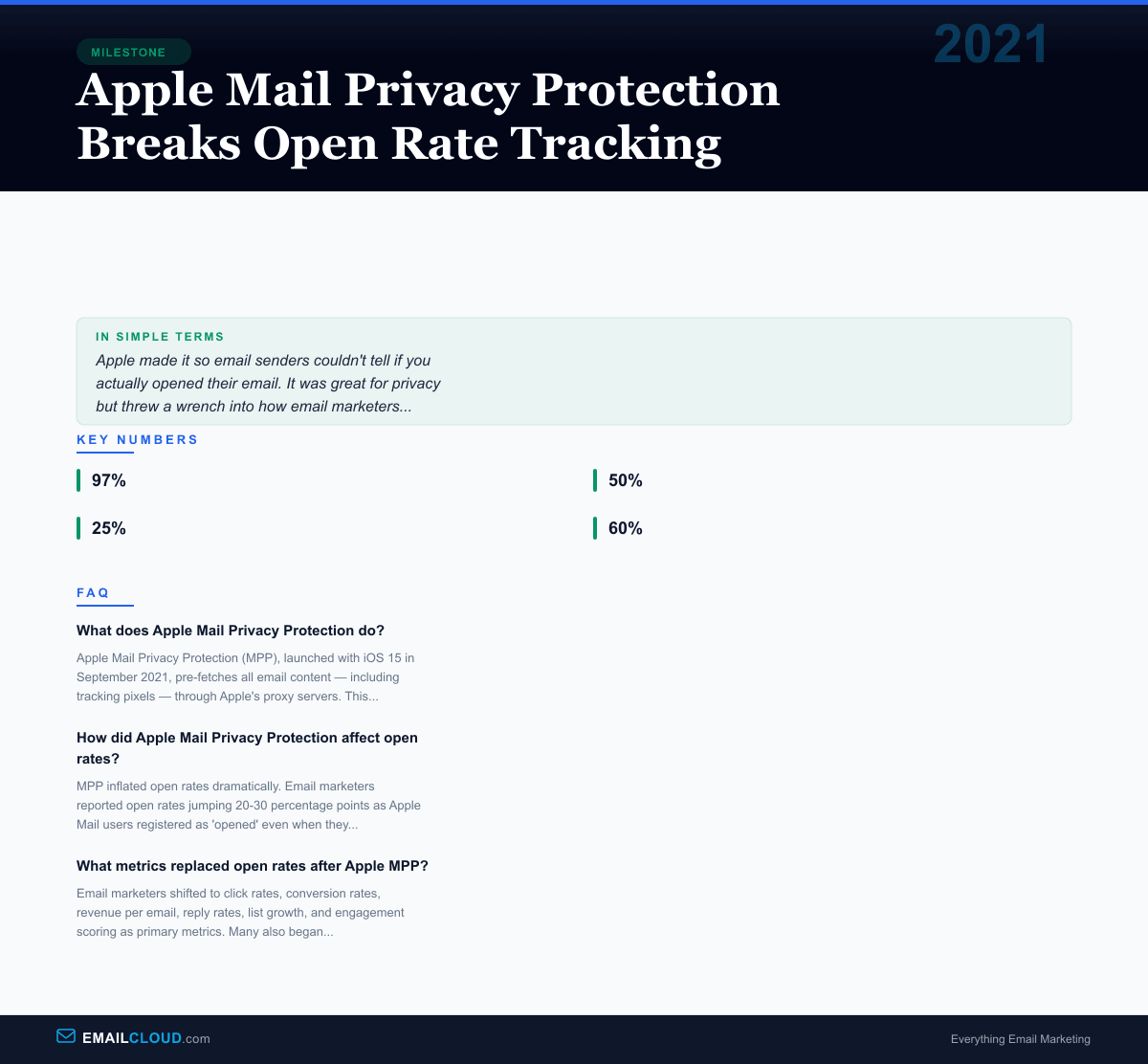
What does Apple Mail Privacy Protection do?
Apple Mail Privacy Protection (MPP), launched with iOS 15 in September 2021, pre-fetches all email content — including tracking pixels — through Apple's proxy servers. This makes every email appear 'opened' regardless of whether the recipient actually read it, and hides the recipient's IP address and location.
How did Apple Mail Privacy Protection affect open rates?
MPP inflated open rates dramatically. Email marketers reported open rates jumping 20-30 percentage points as Apple Mail users registered as 'opened' even when they never looked at the email. Open rates became an unreliable metric for roughly half of all email recipients.
What metrics replaced open rates after Apple MPP?
Email marketers shifted to click rates, conversion rates, revenue per email, reply rates, list growth, and engagement scoring as primary metrics. Many also began using survey-based feedback and downstream conversion tracking to measure campaign effectiveness.